
Properties of metals and non-metals
Answer in short
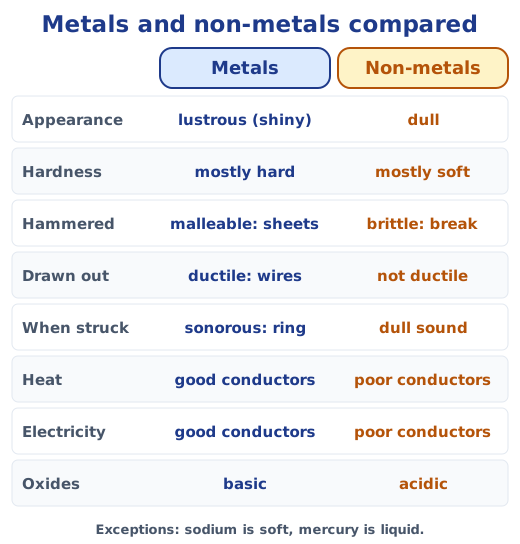
Metals such as copper, aluminium and iron are lustrous and hard. They are malleable (beaten into sheets), ductile (drawn into wires), sonorous (they ring) and good conductors of heat and electricity. Non-metals such as sulfur, and materials like coal, are dull, brittle and poor conductors. A few metals differ: sodium is soft and mercury is liquid.
Stuck on a question? Take a photo and Lagnever AI explains it step by step. Try it for 7 days for ₹2. Get it on Google Play
A visit to the ironsmith
Sudarshan, an ironsmith, heats an iron block in his coal furnace until it is red hot, then beats it with a hammer into the shape of an axe. Can other materials be shaped like this? Testing a few common materials answers the question and shows what makes metals special.
Lustre and hardness
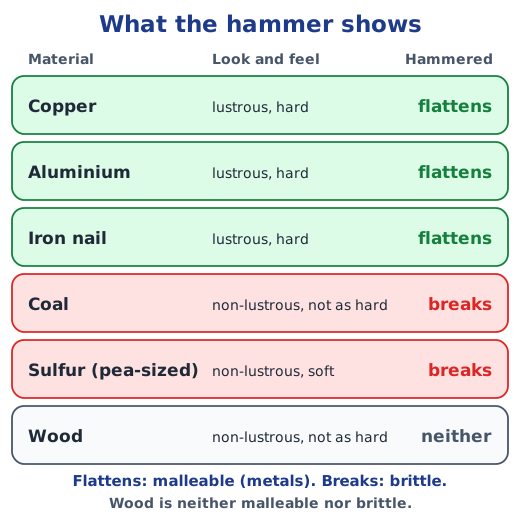
In Activity 4.1, an iron nail, bits of copper and aluminium, a lump of sulfur about the size of a pea, some coal and a block of wood are looked at and felt, and then hammered on a hard surface. Copper, aluminium and iron are lustrous, with the shine called metallic lustre, and they are hard. These are metals. Coal, sulfur and wood are dull, or non-lustrous, and not as hard. Some metals break the pattern: sodium and potassium can be cut with a knife, and mercury is a liquid at room temperature.
Malleability
Under the hammer, copper, aluminium and the iron nail flatten. The property of being beaten into thin sheets is malleability, and most metals have it. The silver foil on some sweets and the aluminium foil used to wrap food are made this way; gold and silver beat into sheets more easily than any other metal. Coal and sulfur shatter instead, so they are brittle. Wood neither flattens into a sheet nor breaks, so it is neither malleable nor brittle.
Ductility
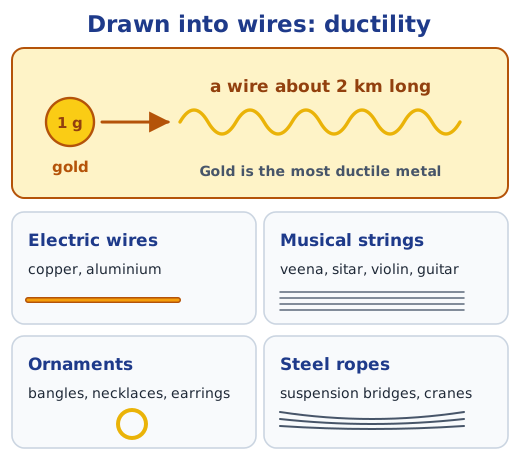
Metal wires are everywhere: copper and aluminium wires in electrical fittings, wire bangles, necklaces and earrings, the strings of a veena, sitar, violin or guitar, and the mesh of a tea strainer. The property of being drawn into wires is ductility, and it belongs mainly to metals; nobody has seen a wire of coal or sulfur. Gold is so ductile that a single gram can be pulled out into a wire about 2 kilometres long. Ropes of steel wire, steel being a mixture of iron and carbon, can hold heavy loads, so they are used in suspension bridges and cranes.
Sonority
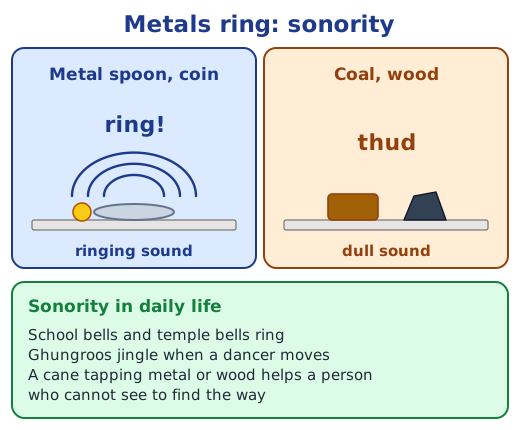
Drop a metal spoon and a coin, then some coal and a wooden block (Activity 4.2). The spoon and coin give a ringing sound; coal and wood give a dull one. The ability of metals to ring is sonority, so metals are sonorous. School bells, temple bells and ghungroos ring because of it, and a person who cannot see can tell metal from wood by the sound a walking stick makes on them.
Conduction of heat
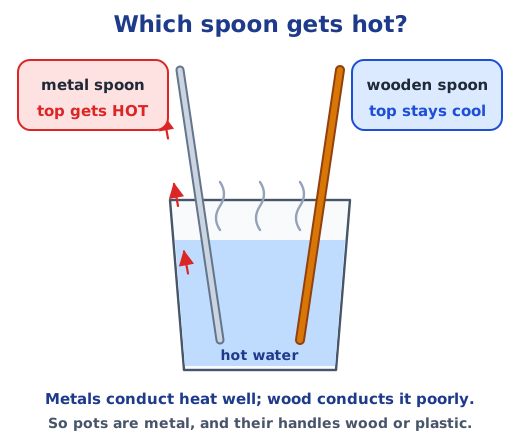
In Activity 4.3, two spoons of about the same size, one metal and one wooden, stand in a tumbler of hot water for a few minutes. The top of the metal spoon becomes hot, while the wooden spoon stays cool. Heat passing from one point of a material to another is conduction, and materials that pass heat on are conductors. Metals are good conductors of heat and wood a poor one, which is why cooking vessels are made of metal and their handles of wood or other poor conductors.
Conduction of electricity
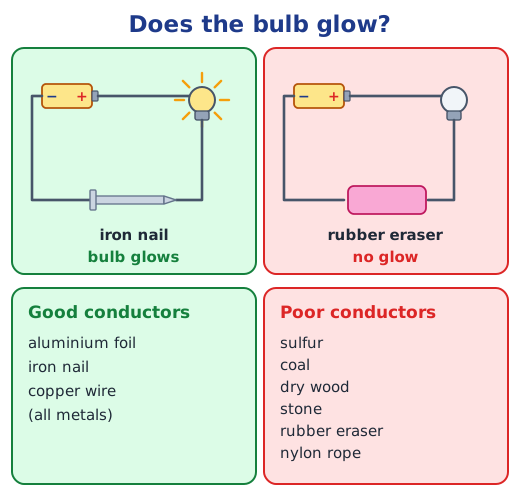
A tester circuit, a cell, a bulb and wires with a gap, can test materials (Activity 4.4). Aluminium foil, an iron nail and a copper wire make the bulb glow; sulfur, coal, dry wood, stone, a rubber eraser and nylon rope do not. Everything that lights the bulb is a metal. Materials that let electricity flow easily are good conductors of electricity; those that do not are poor conductors. That is why electricians use screwdrivers with plastic handles and wear rubber gloves and shoes: these poor conductors protect them from electric shock.
Metals and non-metals compared
Why it matters
These properties decide what each material is used for, from wires and pans to bells and foil. How metals react with air and water is covered in rusting and corrosion and oxides of metals and non-metals. Answers to every activity and question are in the NCERT solutions for Chapter 4; see all of the Chapter 4 notes.
Practice
-
Which word describes coal breaking into pieces when hammered?
Show answer
Answer: (c) Brittle
-
Which property makes metal wires possible?
Show answer
Answer: (a) Ductility
-
Why does an electrician wear rubber gloves?
Show answer
Answer: (b) Rubber is a poor conductor of electricity
-
A metal spoon and a wooden spoon stand in hot water. Which one gets hot at the top, and why?
Show answer
Answer: The metal spoon, because metals are good conductors of heat, so heat travels up it from the water. Wood is a poor conductor of heat, so the top of the wooden spoon stays cool.
-
Why are school bells made of metal?
Show answer
Answer: Metals are sonorous: when struck they give a loud ringing sound that carries far. A bell of wood or coal would only make a dull thud.
Questions students ask
What are the properties of metals?
Most metals are lustrous (shiny) and hard. They are malleable, so they can be beaten into thin sheets, and ductile, so they can be drawn into wires. They are sonorous, ringing when struck, and they are good conductors of heat and electricity. There are exceptions: sodium and potassium are soft, and mercury is a liquid.
What is the difference between malleability and ductility?
Malleability is the property of being beaten into thin sheets, as with aluminium foil or the silver foil on sweets. Ductility is the property of being drawn into wires, as with copper electrical wires. Gold has a lot of both: it beats into sheets very easily, and a single gram of it can be pulled out into a wire about 2 km long.
Are all metals solid and hard?
No. Sodium and potassium are metals soft enough to slice with a knife, and mercury, the metal once used in thermometers, is a liquid at room temperature. Most other common metals, such as iron, copper and aluminium, are hard solids.
Stuck on a question?
Take a photo and Lagnever AI explains it step by step. Try it for 7 days for ₹2.
Get it on Google Play Open in browser
For parents: after the trial, the plan renews monthly by UPI or card autopay. You can cancel anytime in the app.