
Rusting and corrosion of metals
Answer in short
Rusting is the formation of a brown deposit, rust, on iron. It happens only when iron meets both air and water (moist air): a nail in dry air, or in water with no air, does not rust. Rusting is one kind of corrosion; copper gets a green coating and silver a black one. Paint, oil, grease or zinc prevent it.
Stuck on a question? Take a photo and Lagnever AI explains it step by step. Try it for 7 days for ₹2. Get it on Google Play
Brown deposits on iron
Iron objects kept outdoors for a few days often develop brown deposits. Is it the air, the water, or both? Activity 4.5 sets up a fair test.
The three-bottle experiment
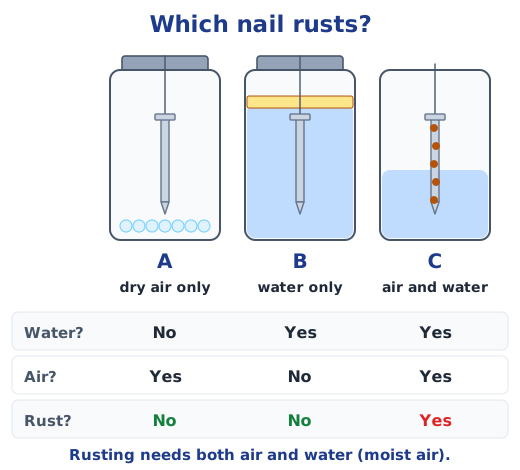
Three shining iron nails, cleaned with sandpaper if needed, are tied to threads and placed in three clean, dry bottles labelled A, B and C:
- Bottle A holds a nail and some silica gel, and is capped tightly. Silica gel dries the air, the way small pouches of it keep medicine bottles and shoe boxes dry. So this nail meets dry air only.
- Bottle B holds a nail completely covered by freshly boiled and cooled water, which has had its dissolved air driven out, with a layer of oil on top to stop air dissolving again. It is capped tightly. So this nail meets water only.
- Bottle C holds a nail partly dipped in water and is left open, so this nail meets both air and water.
The bottles stand undisturbed at room temperature for 8 to 10 days.
What the bottles show
The nails in A and B show no brown deposits, so dry air alone and water alone do not cause them. Only the nail in bottle C, in contact with both, develops brown deposits. So the presence of both air and water, that is moist air, is needed. The brown deposit is rust, and the process of rust forming on iron objects is rusting.
Corrosion of other metals
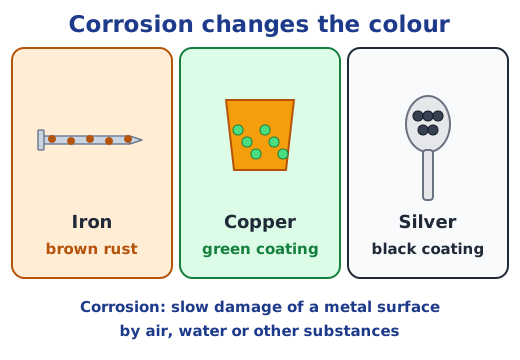
Iron is not the only metal that changes in the open air. Copper objects develop a green coating, and silver ornaments and utensils a black one. The gradual damage of metal surfaces by air, water or other substances is called corrosion; rusting is the corrosion of iron.
Preventing rust
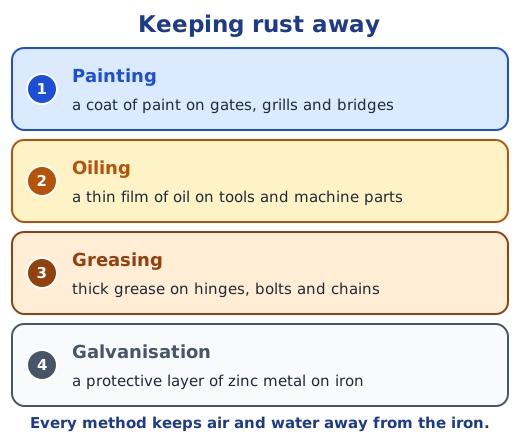
Rusting is a serious problem in India: every year a huge amount of money is spent to repair or replace iron structures damaged by rust. Since rust needs both air and water, the way to prevent it is to keep them away from the iron, by painting, oiling or greasing it, or by covering it with a thin protective layer of zinc metal, which is called galvanisation. These methods are studied in more detail in higher classes.
The Iron Pillar of Delhi
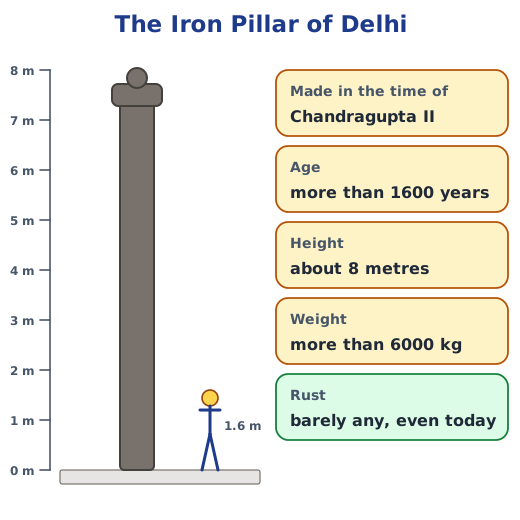
Ancient Indian metal workers knew how to make iron that resists rust. Delhi’s Iron Pillar dates from the reign of Chandragupta II, over 1600 years ago. It stands about 8 metres tall and weighs more than 6000 kilograms, and after centuries of wind, rain and harsh weather it still has barely any rust.
Why it matters
Bridges, railway lines, ships, tools and gates are made of iron, so stopping rust saves money and keeps people safe. The other properties of metals are explained in properties of metals and non-metals, and how metals and non-metals react with oxygen in oxides of metals and non-metals. Answers to every activity and question are in the NCERT solutions for Chapter 4; see all of the Chapter 4 notes.
Practice
-
In Activity 4.5, which bottle’s nail rusted?
Show answer
Answer: (c) C, open and partly in water
-
Why is freshly boiled and cooled water used in bottle B?
Show answer
Answer: (b) To remove dissolved air
-
What is coating iron with a layer of zinc called?
Show answer
Answer: (b) Galvanisation
-
Why is silica gel kept in bottle A?
Show answer
Answer: Silica gel takes up moisture and keeps the air dry, so the nail in bottle A meets dry air only. This tests whether air alone can make iron rust; it cannot.
-
Why does a bicycle chain need oiling?
Show answer
Answer: A film of oil keeps moist air away from the iron of the chain, so it does not rust. Without oil the chain would slowly rust and weaken.
Questions students ask
What is rusting?
Rusting is the formation of a brown deposit, called rust, on objects made of iron. Activity 4.5 shows that it needs both air and water: an iron nail in dry air or in water with no air stays shiny, while one in contact with both develops brown rust. So moist air is responsible for rusting.
What is the difference between rusting and corrosion?
Corrosion is the general name for the slow damage of metal surfaces by air, water or other substances. Rusting is the corrosion of iron, which forms brown rust. Other metals corrode in their own way: copper objects develop a green coating, and silver objects a black coating.
How can rusting be prevented?
By keeping air and water away from the iron. It can be painted, oiled or greased, or given a protective layer of zinc metal, which is called galvanisation. Rusting is a serious problem in India: every year a huge amount of money is spent to repair or replace iron structures damaged by rust.
Stuck on a question?
Take a photo and Lagnever AI explains it step by step. Try it for 7 days for ₹2.
Get it on Google Play Open in browser
For parents: after the trial, the plan renews monthly by UPI or card autopay. You can cancel anytime in the app.