
Oxides of metals and non-metals
Answer in short
When metals burn in air they combine with oxygen to form oxides that are basic: magnesium burns with a dazzling white flame into magnesium oxide, whose solution turns red litmus blue. Non-metals form acidic oxides: burning sulfur gives sulfur dioxide gas, which dissolves in water to form sulfurous acid that turns blue litmus red.
Stuck on a question? Take a photo and Lagnever AI explains it step by step. Try it for 7 days for ₹2. Get it on Google Play
Metals and the air
Iron rusts slowly in moist air, but some metals react with the oxygen of the air much faster, especially when heated. What they form, and how it differs from what non-metals form, gives another way to tell the two groups apart.
Burning magnesium
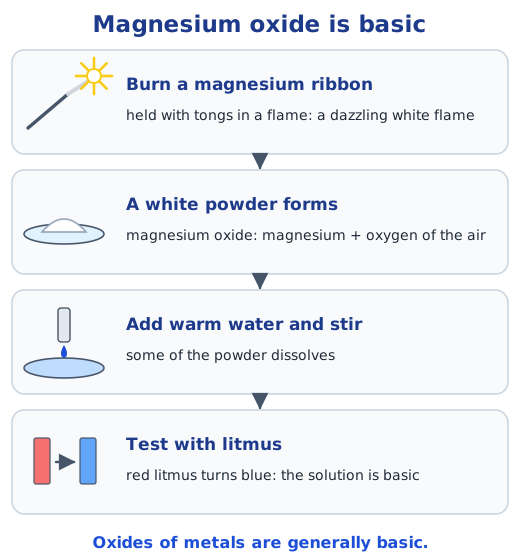
In Activity 4.6, which a teacher demonstrates while students wear protective glasses and stand back, a 3 to 4 cm magnesium ribbon is cleaned with sandpaper, held in tongs and lit in a spirit lamp or candle flame. It burns with a dazzling white flame and turns into a white powder, which is collected on a watch glass. It is magnesium oxide, formed when magnesium combines with oxygen from the air. A few drops of warm water are stirred into it, and the mixture is tested with litmus: it turns red litmus paper blue, so it is basic. Oxides of metals are generally basic. This burning is studied again in the chapter on physical and chemical changes.
Sodium: kept in kerosene
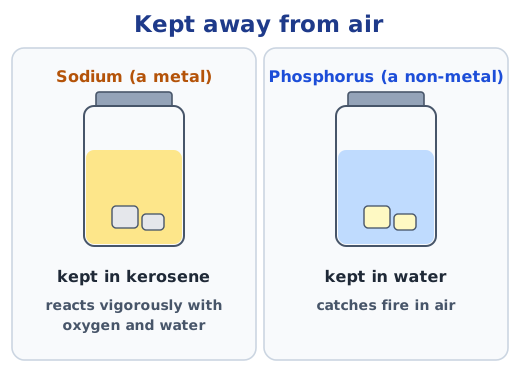
Sodium is a metal that reacts vigorously with oxygen and with water, giving out a lot of heat. To keep moisture and air away from it, it is stored under kerosene. Being a metal, sodium forms an oxide that is basic.
Burning sulfur
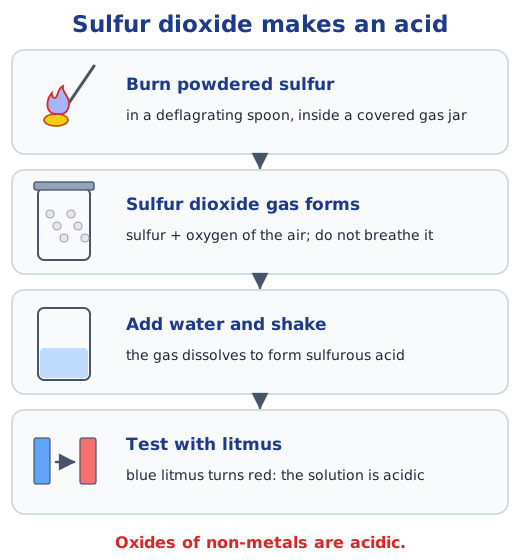
Activity 4.7 is also a teacher’s demonstration, done in a fume hood or a well-ventilated room because burning sulfur gives off harmful gases. Powdered sulfur is heated in a deflagrating spoon, a long-handled metal spoon for burning substances safely (a bottle cap wrapped in wire works too). As soon as it catches fire, the spoon is lowered into a gas jar, which is covered. After 3 to 4 minutes the spoon is removed, a little water is added, and the jar is closed and shaken to dissolve the gas. The solution turns blue litmus red, so it is acidic. Burning sulfur forms sulfur dioxide gas, and sulfur dioxide dissolved in water forms sulfurous acid.
Sulfur and water
In Activity 4.8, sulfur powder is added to a little water in a glass tumbler. Nothing happens: sulfur does not react with water. Non-metals generally do not react with water.
What makes a non-metal
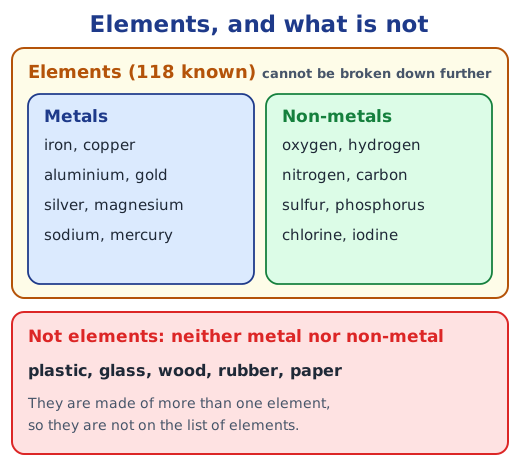
Sulfur and phosphorus behave differently from metals with air and water. Phosphorus catches fire in air, so it is stored under water. Such substances are usually soft and dull, are neither malleable nor ductile, do not ring when struck, and conduct heat and electricity poorly. They are non-metals, and their oxides are acidic. Oxygen, hydrogen, nitrogen and carbon are non-metals too. Plastic, glass, wood, rubber and paper are neither metals nor non-metals, because they are not elements. An element is a pure substance that cannot be split into anything simpler; about 118 are known, some natural and some made only in laboratories.
Non-metals we need
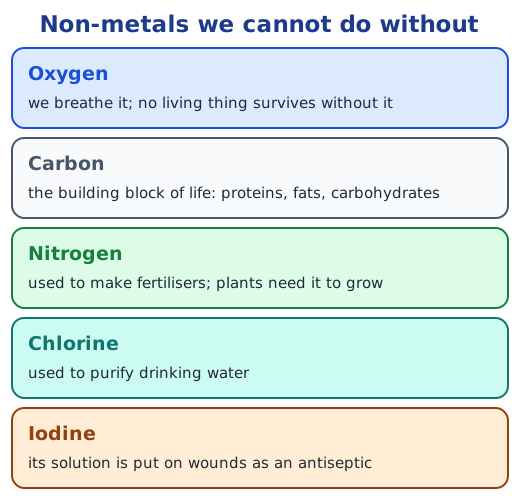
Metals catch the eye, but non-metals are just as important. We breathe oxygen and cannot survive without it. Carbon is the building block of all living things, a key part of proteins, fats and carbohydrates. Nitrogen is used to make fertilisers and chemicals and is a nutrient plants need to grow. Chlorine is used to purify water, and a solution of iodine is applied to wounds as an antiseptic.
Metals and alloys (a metal mixed with other metals or with a non-metal), such as steel, are used for utensils and tools and in almost every industry. Special metals serve special jobs: zirconium in atomic energy and titanium in aerospace. India recycles a lot of metal, above all iron and aluminium, to reduce waste.
Why it matters
Knowing how elements react with air and water tells us how to store them safely and how to use them. The physical properties of metals are covered in properties of metals and non-metals, and the slow reaction of iron with moist air in rusting and corrosion. Answers to every activity and question are in the NCERT solutions for Chapter 4; see all of the Chapter 4 notes.
Practice
-
What kind of flame does magnesium burn with?
Show answer
Answer: (b) A dazzling white flame
-
What forms when sulfur dioxide dissolves in water?
Show answer
Answer: (a) Sulfurous acid
-
Why is sodium stored in kerosene?
Show answer
Answer: (b) It reacts vigorously with oxygen and water
-
Predict the nature of the oxide of sodium.
Show answer
Answer: Basic. Sodium is a metal, and oxides of metals are generally basic, so a solution of its oxide would turn red litmus blue.
-
Does sulfur react with water?
Show answer
Answer: No. In Activity 4.8, sulfur powder added to water shows no reaction. Non-metals such as sulfur generally do not react with water.
Questions students ask
Are metal oxides acidic or basic?
Generally basic. When a magnesium ribbon burns, it combines with oxygen from the air to form magnesium oxide, a white powder. Mixed with warm water, it gives a solution that turns red litmus paper blue. Oxides of non-metals, such as sulfur dioxide, are acidic instead.
Why is phosphorus stored in water?
Phosphorus, a non-metal, catches fire when it is exposed to the air, so it is kept under water, which keeps the air away. In the same way sodium, a metal that reacts vigorously with oxygen and water and gives out a lot of heat, is kept under kerosene.
Why are non-metals important?
We breathe oxygen and cannot survive without it. Carbon is the building block of all living things, found in proteins, fats and carbohydrates. Nitrogen is used to make fertilisers and helps plants grow. Chlorine purifies drinking water, and a solution of iodine is put on wounds as an antiseptic.
Stuck on a question?
Take a photo and Lagnever AI explains it step by step. Try it for 7 days for ₹2.
Get it on Google Play Open in browser
For parents: after the trial, the plan renews monthly by UPI or card autopay. You can cancel anytime in the app.