
NCERT Solutions Class 7 Science Chapter 4: The World of Metals and Non-metals
Answers to every question in Chapter 4, The World of Metals and Non-metals, of Curiosity, the Class 7 Science textbook (Reprint 2026-27): the questions in the text, Activities 4.1 to 4.8 with Tables 4.1 to 4.3, the Holistic Lens and Dive Deeper boxes, all twelve questions of Let Us Enhance Our Learning and the Exploratory Projects. Page numbers follow the book (pages 41–56). Answers to activities give the results to expect; record your own observations. Short notes: Chapter 4 notes.
At the ironsmith’s (pages 41–42)
Can other metals be beaten into a flat shape too? Yes. Most metals are malleable: copper, aluminium, gold and silver can all be beaten into thin sheets, as with aluminium foil and the silver foil on sweets. Iron is heated first because red-hot iron is softer and easier to shape.
Activity 4.1 and Table 4.1 (pages 42–44)
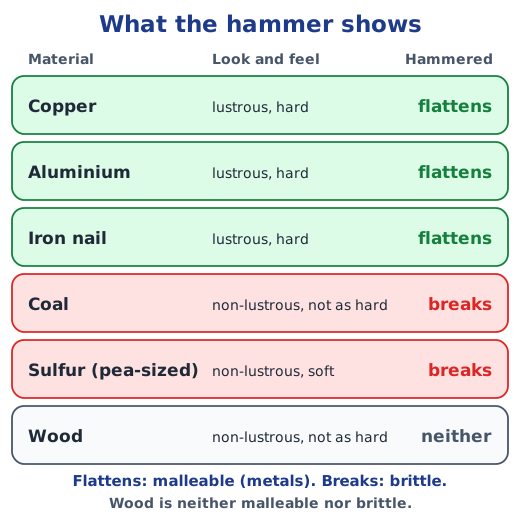
Table 4.1: appearance, hardness and the effect of hammering (written as a list):
- Piece of copper: lustrous; hard; flattens.
- Piece of aluminium: lustrous; hard; flattens.
- Iron nail: lustrous; hard; flattens.
- Piece of coal: non-lustrous; not as hard as metals; breaks into pieces.
- Lump of sulfur (pea-sized): non-lustrous; soft; breaks into pieces.
- Block of wood: non-lustrous; not as hard as metals; neither flattens nor breaks.
Which objects are lustrous and hard? Which become flat? Copper, aluminium and iron are lustrous and hard, and they flatten on beating: they are metals, and they are malleable. Coal and sulfur are brittle, and wood is neither malleable nor brittle.
Examples of metal sheets. Aluminium foil for wrapping food, the thin silver foil on some sweets, tin or steel sheets for roofs and trunks, and copper sheets for vessels.
Holistic Lens (page 44)
Why is copper generally thought to have been discovered before iron? Copper is sometimes found as a pure metal in nature, and it can be got from its ores at lower temperatures, so early people could find and work it with simple fires. Iron is almost never found pure, and getting it from its ores needs much hotter furnaces, which took a long time to develop. That is why the Harappans used copper and gold but hardly any iron.
Ductility (pages 44–45)
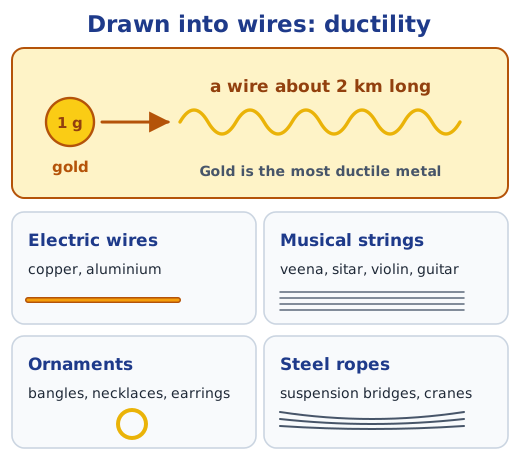
Where do you find the use of metal wires? Copper and aluminium wires in electrical fittings and cables, bangles, necklaces and earrings, the strings of a veena, sitar, violin or guitar, the mesh of a tea strainer, and steel ropes in suspension bridges and cranes.
Activity 4.2: Sonority (pages 45–46)
Is there a difference in the sound? Yes. The metal spoon and the coin make a ringing sound, while the piece of coal and the block of wood make a dull sound. Metals are sonorous.
Activity 4.3: Conduction of heat (pages 46–47)
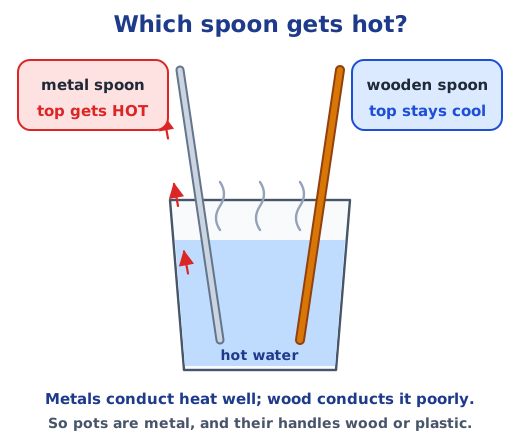
Which metals are used for cooking vessels, and why? Aluminium, copper, iron and stainless steel (made mostly of iron). They conduct heat well, so food cooks evenly, and they are strong and do not melt on a stove.
Which spoon gets hotter? What does this tell us? The metal spoon. Heat travels along the metal spoon from the hot water to its top, but hardly travels along the wooden spoon. Metals are good conductors of heat, and wood is a poor conductor.
Activity 4.4 and Table 4.2 (pages 47–48)
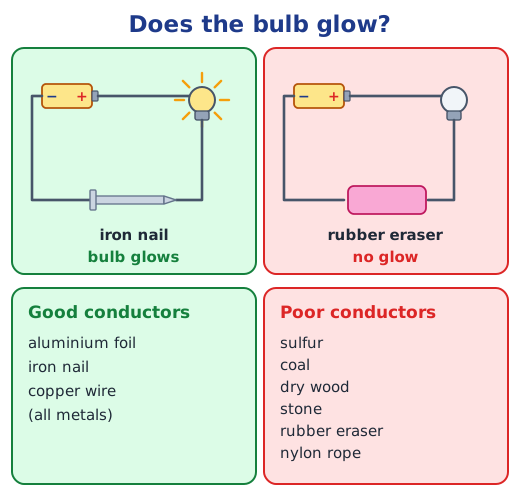
What is a screwdriver handle made of, and why do electricians wear rubber gloves and shoes? The handle is plastic, and gloves and shoes are rubber. Plastic and rubber are poor conductors of electricity, so they protect the electrician from an electric shock.
Table 4.2: conduction of electricity (written as a list):
- Aluminium foil: bulb glows; good conductor.
- Iron nail: bulb glows; good conductor.
- Lump of sulfur: does not glow; poor conductor.
- Copper wire: bulb glows; good conductor.
- Piece of coal: does not glow; poor conductor.
- Dry wood: does not glow; poor conductor.
- Stone: does not glow; poor conductor.
- Rubber eraser: does not glow; poor conductor.
- Nylon rope: does not glow; poor conductor.
Is there a pattern? Yes: every material that makes the bulb glow is a metal.
Activity 4.5 and Table 4.3 (pages 48–50)
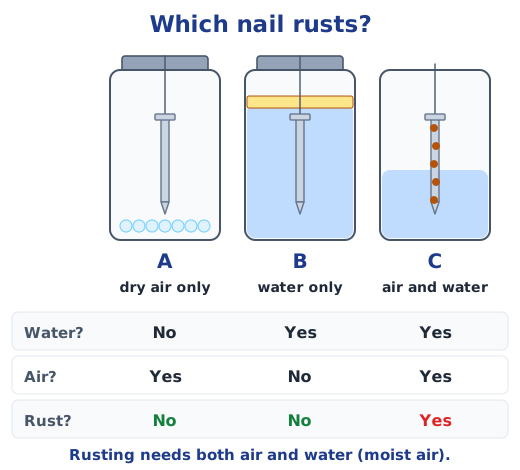
In which conditions does iron develop brown deposits? Only when it is in contact with both air and water.
Table 4.3 (written as a list):
- Bottle A: water, no; air, yes; no brown deposit.
- Bottle B: water, yes; air, no; no brown deposit.
- Bottle C: water, yes; air, yes; brown deposit (rust) on the nail.
What can you conclude? Dry air alone (A) and water alone (B) do not make iron rust; both air and water together (C), that is moist air, are needed.
Coatings on other metals. The green coating on copper objects and the black coating on silver objects are corrosion, the slow damage of metals by air, water or other substances.
Activity 4.6: Burning magnesium (page 51)
What do you observe? The ribbon burns with a dazzling white flame and turns into a white powder, magnesium oxide.
Is its solution acidic, basic or neutral? What does it do to litmus? It turns red litmus paper blue and leaves blue litmus blue, so it is basic.
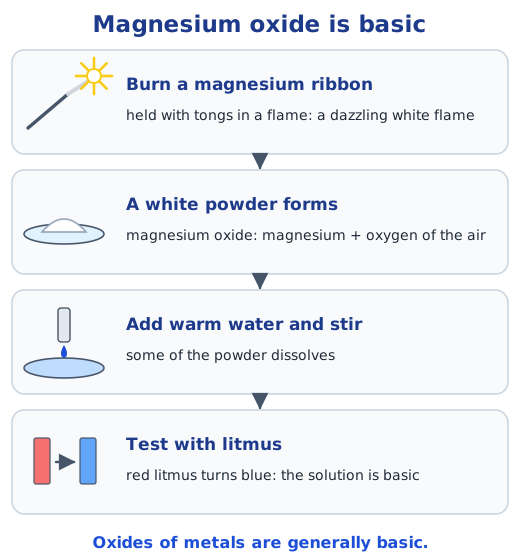
Predict the nature of sodium’s oxide (page 52). Basic, since sodium is a metal and metal oxides are generally basic.
Activities 4.7 and 4.8: Sulfur (pages 52–53)
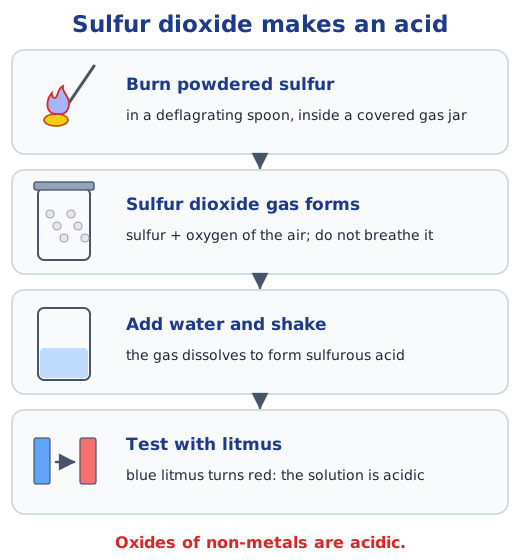
What do you observe when the solution from burnt sulfur is tested? It turns blue litmus paper red, so it is acidic: burning sulfur forms sulfur dioxide, which dissolves in water to form sulfurous acid.
Does sulfur behave in water the way metals do? No. Sulfur powder added to water shows no reaction.
Uses of oxygen (page 54)
Other uses of oxygen. Oxygen cylinders for patients in hospitals, and for mountaineers and divers; it is needed for fuels to burn in stoves and engines; and fish and other water animals use the oxygen dissolved in water.
Let Us Enhance Our Learning (pages 55–56)
1. (i) Aluminium. It is cheap, and its thin sheets fold easily into any shape.
2. (iv) Sodium. It reacts vigorously with water, giving out so much heat that it can catch fire; that is why it is kept in kerosene.
3. True or false, with reasons.
- (i) False. Aluminium and copper are metals, not non-metals.
- (ii) False. Metal oxides are basic, so their solutions turn red litmus blue; turning blue litmus red is what acidic solutions do.
- (iii) True. Oxygen is a non-metal, and we need it for respiration.
- (iv) False. Copper is chosen for vessels that boil water because it conducts heat well; its conduction of electricity has nothing to do with it.
4. Why are only a few metals suitable for jewellery? Jewellery has to stay shiny for years, be shaped into fine designs and be safe on the skin. Gold, silver and platinum are lustrous, very malleable and ductile, and they hardly react with air and water, so they keep their shine (silver slowly tarnishes black and needs polishing). Most other metals corrode, like iron, which rusts, or copper, which turns green, and some, like sodium, react dangerously. Precious metals are also rare and valuable.
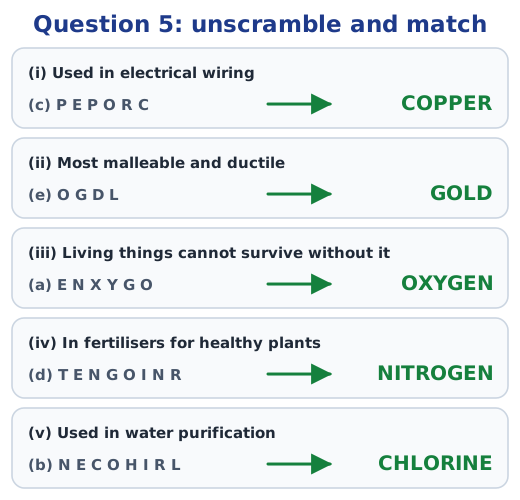
5. Matching the uses with the unscrambled names.
- (i) Used in electrical wiring: (c) PEPORC = COPPER
- (ii) Most malleable and ductile: (e) OGDL = GOLD
- (iii) Living organisms cannot survive without it: (a) ENXYGO = OXYGEN
- (iv) Fertilisers containing it make plants grow healthy: (d) TENGOINR = NITROGEN
- (v) Used in water purification: (b) NECOHIRL = CHLORINE
6. Oxygen with magnesium and with sulfur. Magnesium burns in oxygen with a dazzling white flame and forms magnesium oxide, a white powder; its solution in water is basic and turns red litmus blue. Sulfur burns in oxygen to form sulfur dioxide, a gas; dissolved in water it forms sulfurous acid, which is acidic and turns blue litmus red. So the metal forms a solid, basic oxide and the non-metal a gaseous, acidic one.
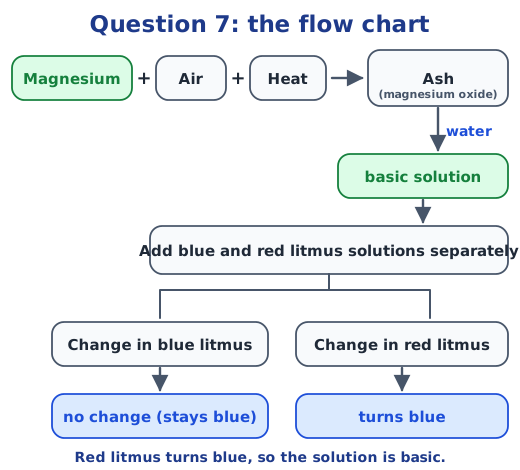
7. The completed flow chart. Magnesium + air + heat → ash (magnesium oxide) → with water → a basic solution → add blue and red litmus solutions separately → blue litmus: no change, it stays blue; red litmus: turns blue.
8. The material for a pan to boil water. Copper, with iron as the next choice. A pan must conduct heat well, be strong, be beaten into shape and not melt or burn on the flame. Copper is malleable and conducts heat very well, so water boils quickly. Iron also works, but it is heavier, heats more slowly and rusts. Sulfur and coal are brittle and poor conductors; plastic melts; wood and cardboard catch fire and conduct heat poorly.
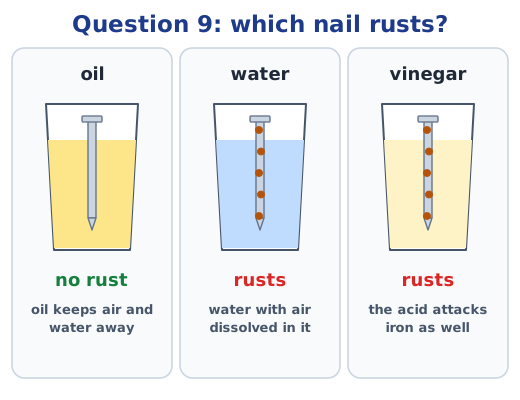
9. Nails in oil, water and vinegar. The nail dipped in oil will not rust, because the oil keeps both air and water away from the iron. The nail in water rusts, as water has air dissolved in it, and the nail in vinegar rusts too, since vinegar is mostly water and is acidic.
10. How properties decide uses.
- Malleable metals are beaten into foils, sheets and vessels; ductile metals are drawn into wires and strings.
- Metals conduct heat, so pots and pans are metal; they conduct electricity, so wires are copper or aluminium.
- Sonorous metals make bells and ghungroos; lustrous gold and silver make jewellery; strong iron and steel make tools, bridges and cranes.
- Non-metals are used for what they do: oxygen for breathing, carbon in every living thing, nitrogen in fertilisers, chlorine to purify water and iodine as an antiseptic.
11. Can sulfur replace zinc as a coating on iron? No. Zinc is a metal that can be spread as a thin, tough layer that sticks to iron. Sulfur is brittle and powdery and is not malleable, so it cannot form a strong, unbroken layer; it would crack and fall off and let moist air reach the iron. Burning or heating sulfur also gives sulfur dioxide, a harmful gas that forms an acid with moisture.
12. Why does an ironsmith heat iron before making tools? Heating makes the iron red hot and much softer, so it can be beaten into shape easily without cracking. Cold iron is hard and would not bend into the shape of an axe or a spade.
Exploratory Projects (page 56)
India’s metal art styles. Dhokra (brass casting) is made in Chhattisgarh, West Bengal, Odisha, Jharkhand and Madhya Pradesh; Bidriware, silver inlaid on a dark metal, in Bidar, Karnataka; Pembarthi brass work in Telangana; and Kamrupi bell metal and brass work in Assam. Make a collage of their photographs.
Where India’s metal ores are found. Iron ore: Odisha, Chhattisgarh, Jharkhand, Karnataka and Goa; gold: Karnataka; bauxite, the ore of aluminium: Odisha, Jharkhand, Chhattisgarh and Gujarat; copper: Rajasthan, Jharkhand and Madhya Pradesh. Mark these on an outline map of India from your atlas.
Metals and non-metals in a smartphone. Copper wiring carries current, gold plates the contacts because it does not corrode, aluminium makes a light frame, lithium and cobalt are used in the battery, tin is used to join parts, and silicon chips do the computing. The glass screen and plastic case are not elements.
Debate: more or fewer metals for comfort and luxury? For more: metals make strong, long-lasting and recyclable products, and modern life needs them. For fewer: mining damages forests and land, extracting metals uses a lot of energy and causes pollution, and ores will run out. A balanced view: use metals where they matter, recycle them and avoid waste.
Short notes and more practice are on the topic pages: properties of metals and non-metals, rusting and corrosion and oxides of metals and non-metals.
Practice
-
Which metal is stored in kerosene?
Show answer
Answer: (a) Sodium
-
Which unscrambled name is used in electrical wiring?
Show answer
Answer: (b) Copper
-
Three iron nails are dipped in oil, water and vinegar. Which one does not rust?
Show answer
Answer: (c) The one in oil
-
Why does an ironsmith heat iron before shaping it?
Show answer
Answer: Red-hot iron becomes softer, so it can be beaten into a new shape without cracking. Cold iron is hard and much more difficult to shape.
-
Can sulfur be used instead of zinc to coat iron against rust?
Show answer
Answer: No. Sulfur is brittle and powdery, so it cannot be spread into a thin, tough layer that stays on the iron; it would crack and fall off and let moist air reach the iron. It also burns to a harmful gas.
Stuck on a question?
Take a photo and Lagnever AI explains it step by step. Try it for 7 days for ₹2.
Get it on Google Play Open in browser
For parents: after the trial, the plan renews monthly by UPI or card autopay. You can cancel anytime in the app.