
Class 7 Science Chapter 5: Changes Around Us: Physical and Chemical Notes
This chapter in five lines
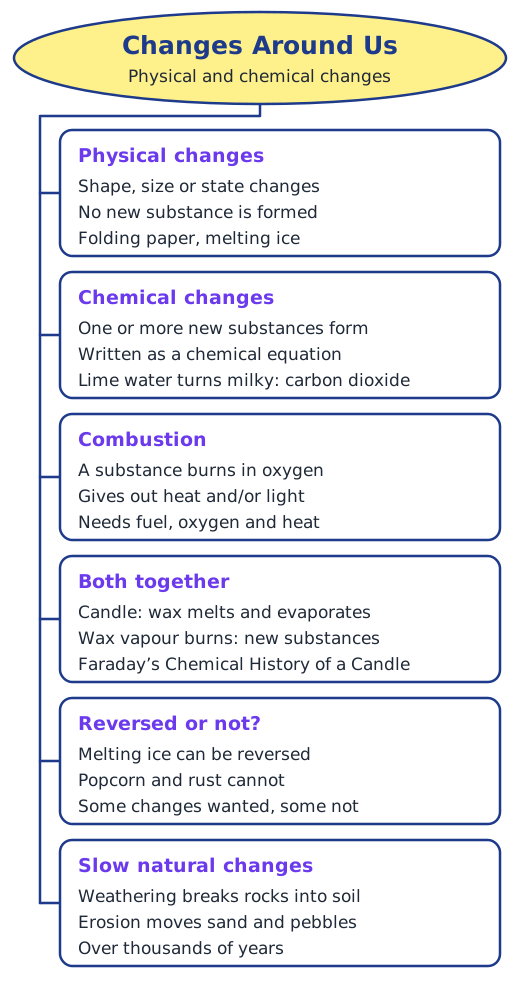
Changes Around Us sorts everyday changes into two kinds. In a physical change only shape, size or state changes and no new substance forms, as when ice melts. In a chemical change new substances form, as when lime water turns milky or iron rusts. The chapter also covers combustion, ignition temperature, reversible changes, weathering and erosion.
What is this chapter about?
The chapter opens with four students describing what they noticed: an ice cube that turned into water in half an hour, a rose bud that became a flower overnight, a bottle of cold water that is no longer cold, and a banana with more brown spots and a strong smell. Changes like these happen all around us, and we notice them by seeing, smelling, touching, hearing and tasting. The chapter asks whether such changes can be sorted into kinds, and finds two main kinds: physical and chemical.
Physical changes
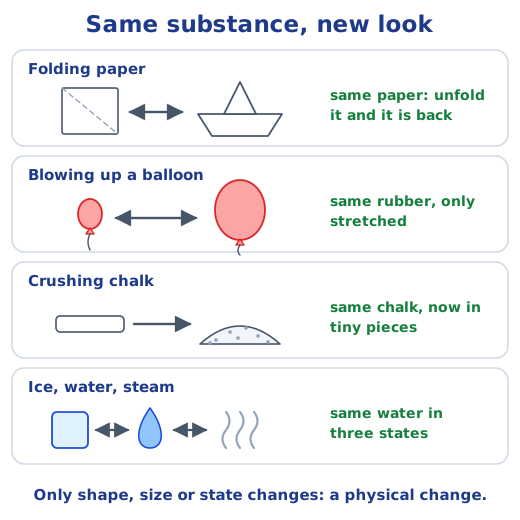
Fold a sheet of paper into a boat and unfold it: you get the same paper back. Let the air out of a balloon and it is the same rubber. Crush chalk into powder and it is still chalk, only in tiny pieces. Water too can be solid, liquid or gas and switch between these states. Each time the look changes, but no new substance forms. When only physical properties such as shape, size or state are altered, we call it a physical change. Read physical and chemical changes.
Chemical changes
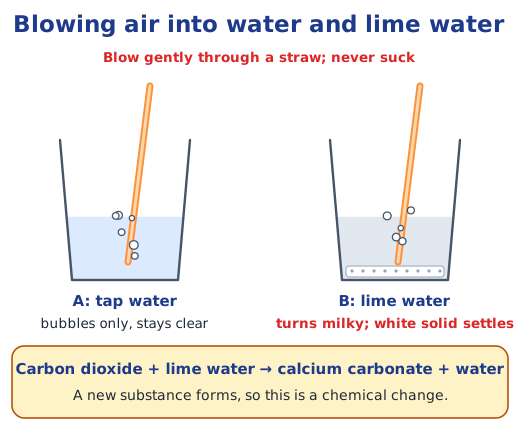
Blow air through a straw into tap water and you see only bubbles. Blow into lime water and it turns milky; left to stand, a white solid settles at the bottom. Something new has formed. A change that makes one or more new substances is a chemical change, and the process that forms them is a chemical reaction. Here, the carbon dioxide in our breath reacts with lime water (calcium hydroxide) to form calcium carbonate, a white substance that does not dissolve in water, and a little water. A reaction can be written in short as a chemical equation, and lime water turning milky is the test for carbon dioxide.
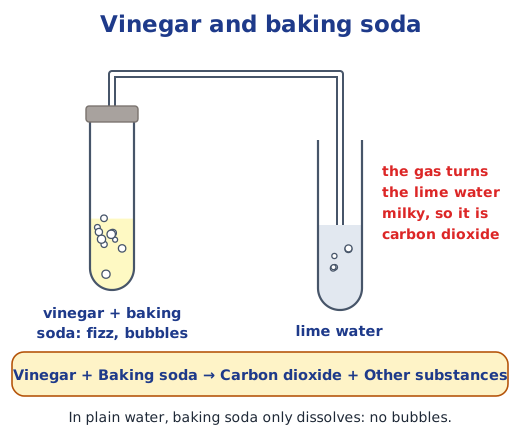
Put a little baking soda (sodium hydrogen carbonate) into vinegar or lemon juice and it fizzes and bubbles. Passed through fresh lime water, the gas turns it milky, so it is carbon dioxide: vinegar + baking soda → carbon dioxide + other substances. Baking soda in plain water, by contrast, just dissolves without bubbles.
Rusting and combustion
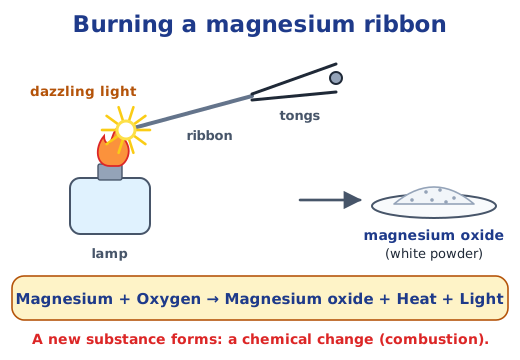
When iron rusts, a new brown substance, rust (iron oxide), forms, so rusting is a chemical change. A magnesium ribbon burns with a dazzling light and leaves a white powder, magnesium oxide: magnesium + oxygen → magnesium oxide + heat + light. When a substance reacts with oxygen and gives out heat and/or light, the reaction is combustion, and substances that burn this way, such as wood, paper, cotton and kerosene, are combustible substances. A candle covered with a glass tumbler soon goes out, because burning needs oxygen; lime water in the dish then turns milky, showing that carbon dioxide has formed from the wax’s carbon and the air’s oxygen. Fireflies give out light through a chemical change too, but without heat: this is bioluminescence.
Ignition temperature and the fire triangle
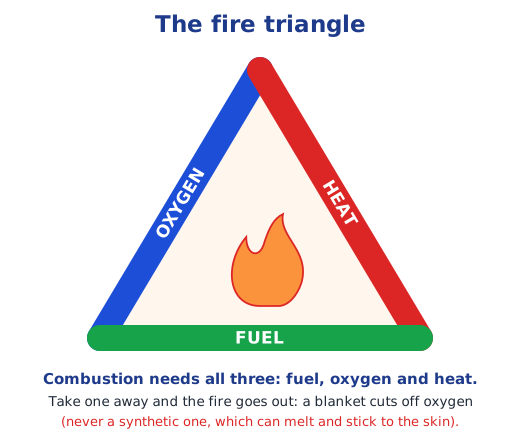
Paper can lie in the air for years without burning. A lighted matchstick sets it on fire almost at once, and sunlight focused by a magnifying glass makes it smoke and then catch fire, even without a flame. The paper burns once it is hot enough. The lowest temperature at which a substance catches fire is its ignition temperature. So combustion needs three things, the fire triangle: a combustible substance or fuel, oxygen, and heat that brings the fuel to its ignition temperature. That is why wrapping a blanket around a person whose clothes catch fire puts the fire out: it cuts off the air. A synthetic blanket must never be used, since it can melt and stick to the skin. Read combustion.
Both kinds in one process
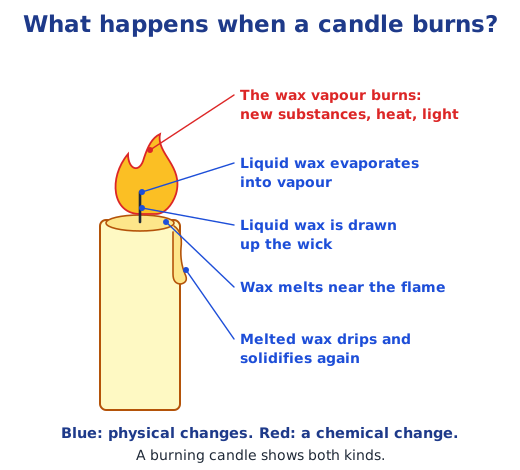
A burning candle shows both kinds of change. The flame’s heat melts the wax, which climbs the wick and turns into vapour; melted wax that drips down solidifies again. These are physical changes. The wax vapour then burns to make the flame, a chemical change. The scientist Michael Faraday found the candle such a good starting point that, in the nineteenth century, he gave a famous series of lectures, The Chemical History of a Candle, on melting, vaporisation and combustion.
Can changes be reversed?
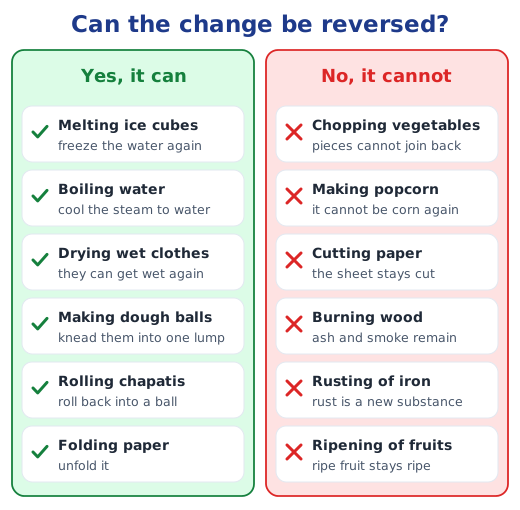
Some changes can be undone: melted ice can be frozen again, and water that evaporates can be condensed back into liquid water. Others cannot: chopped vegetables cannot return to their old size and shape, and popcorn cannot become corn again. Changes can also be desirable, like milk setting into curd, fruit ripening and food cooking, or undesirable, like iron rusting and stored food decaying. The same change can be both: decay spoils food, but it also turns kitchen waste into compost. Some changes caused by people have long-term effects: burning more fuel in vehicles adds carbon dioxide to the air, and drying paint releases substances that pollute it. Read reversible and irreversible changes.
Slow natural changes
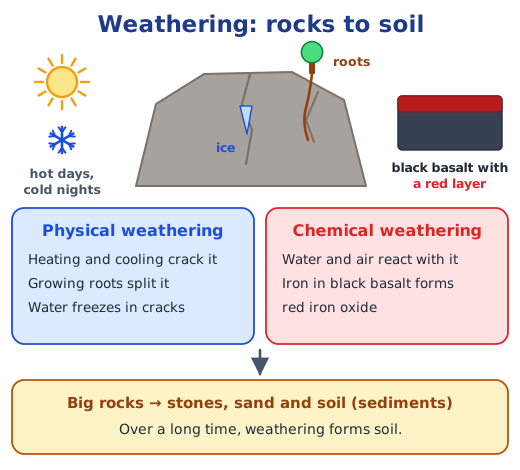
Heaps of sand, soil and stones at the foot of mountains, called sediments, form when rocks break up. Changes in temperature, growing roots and water freezing in cracks break rocks physically, while water and air can change them chemically: black basalt, which contains iron, can develop a red layer of iron oxide. Together these changes are weathering, and they slowly form soil. Erosion is the moving of pebbles, soil and sediments by wind and flowing water, a physical change; river pebbles grow smooth, and where water slows down the sediments settle and, over thousands of years, harden into new rock.
In a nutshell
A physical change alters only physical properties; a chemical change makes new substances and can be written as an equation. Combustion, cooking and rusting are chemical changes, and fire needs fuel, oxygen and heat. A change may or may not be reversible, and may be wanted or unwanted, and slow natural changes turn rocks into soil. Answers to every activity and question are in the NCERT solutions for Chapter 5.
Key terms
| Term | Meaning |
|---|---|
| Physical change | A change in which only physical properties such as shape, size or state change and no new substance is formed, like folding paper or melting ice. |
| Chemical change | A change that produces one or more new substances, like rusting, burning, or lime water turning milky. |
| Chemical reaction | The process through which new substances are formed in a chemical change. |
| Chemical equation | A short way of writing a chemical reaction: the starting substances on the left of an arrow and the new substances on the right. |
| Lime water | A solution of calcium hydroxide. It turns milky when carbon dioxide passes through it, so it is used to test for carbon dioxide. |
| Combustion | The chemical reaction of a substance with oxygen, giving out heat and/or light, such as burning wood or a magnesium ribbon. |
| Combustible substance | A substance that can undergo combustion, also called a fuel, such as wood, paper, cotton or kerosene. |
| Ignition temperature | The lowest temperature at which a substance catches fire. |
| Fire triangle | The three things combustion needs: a fuel, oxygen, and heat to bring the fuel to its ignition temperature. |
| Bioluminescence | Light made by a chemical change inside a living thing, without heat, as in fireflies. |
| Weathering | The physical and chemical changes that slowly break down rocks and, in the end, form soil. |
| Erosion | The moving of broken rock, soil and sediments from one place to another by wind and flowing water; it is a physical change. |
Topics in this chapter
Practice
-
Which of these is a chemical change?
Show answer
Answer: (c) Rusting of iron
-
What happens when you blow air into lime water through a straw?
Show answer
Answer: (b) It turns milky
-
Which gas turns lime water milky?
Show answer
Answer: (c) Carbon dioxide
-
What is the lowest temperature at which a substance catches fire called?
Show answer
Answer: (c) Ignition temperature
-
Which of these is NOT part of the fire triangle?
Show answer
Answer: (d) Water
-
When a candle burns, which change is chemical?
Show answer
Answer: (c) Wax vapour burning
Questions students ask
What are the main topics of Class 7 Science Chapter 5?
Physical changes, where only shape, size or state changes; chemical changes, where new substances form, with the lime water test and the reaction of vinegar and baking soda; rusting and combustion; ignition temperature and the fire triangle; the burning candle, which shows both kinds; changes that can or cannot be reversed; desirable and undesirable changes; and weathering and erosion.
Is Changes Around Us: Physical and Chemical in the new NCERT Class 7 book?
Yes. It is Chapter 5 of Curiosity, the Class 7 Science textbook (Reprint 2026-27), on pages 57 to 72. It follows The World of Metals and Non-metals, whose rusting and burning-magnesium activities it builds on, and comes before Adolescence: A Stage of Growth and Change.
How can you tell a physical change from a chemical change?
Ask whether a new substance has formed. In a physical change the material stays the same and only its shape, size or state changes: folded paper is still paper. In a chemical change new substances with different properties form, often with signs such as a new colour, gas bubbles, a new smell, or heat and light, as with rust, curd or ash.
Why is a burning candle both a physical and a chemical change?
The heat of the flame melts the wax, the liquid wax rises up the wick and evaporates, and wax that drips down solidifies again: these are physical changes. The wax vapour then burns in the flame, forming new substances and giving out heat and light, which is a chemical change. So one process has both kinds.
Stuck on a question?
Take a photo and Lagnever AI explains it step by step. Try it for 7 days for ₹2.
Get it on Google Play Open in browser
For parents: after the trial, the plan renews monthly by UPI or card autopay. You can cancel anytime in the app.