
Combustion
Answer in short
Combustion is the chemical reaction of a substance with oxygen, giving out heat and/or light, as when wood, paper or a magnesium ribbon burns. It needs three things, the fire triangle: a fuel, oxygen, and heat to bring the fuel to its ignition temperature, the lowest temperature at which it catches fire.
Stuck on a question? Take a photo and Lagnever AI explains it step by step. Try it for 7 days for ₹2. Get it on Google Play
What is combustion?
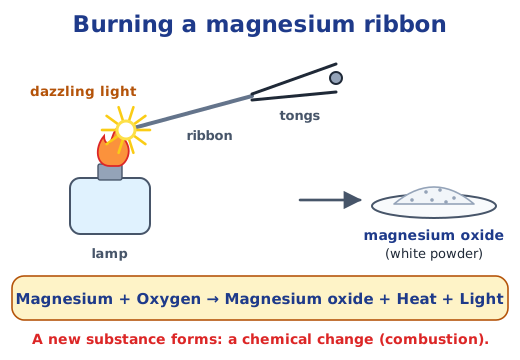
Recall burning a magnesium ribbon in the chapter on metals and non-metals. The ribbon burns with a dazzling light and leaves a white powder, magnesium oxide. A new substance forms, so it is a chemical change, and heat and light are given out as well. In short: magnesium + oxygen → magnesium oxide + heat + light. When a substance reacts with oxygen and gives out heat and/or light, the reaction is called combustion. Wood, paper, cotton and kerosene can burn like this, so they are combustible substances.
Burning needs oxygen
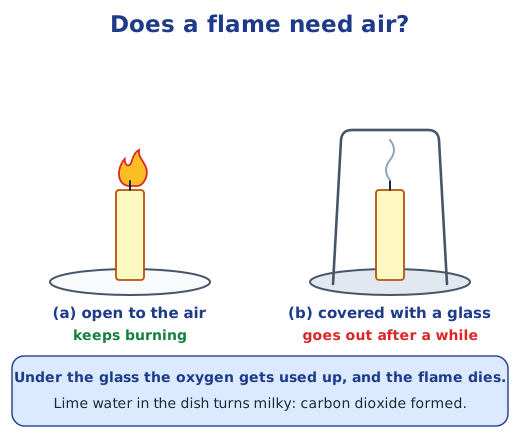
Activity 5.5 tests whether air is needed. Light two identical candles on petri dishes and cover one with a glass tumbler. The open candle keeps burning, but the covered one goes out after some time, because it gets no fresh supply of air. The part of the air that supports burning is oxygen. To confirm it, pour a little lime water into the dish under the tumbler: it turns milky, so carbon dioxide has formed. This carbon dioxide came from the carbon in the wax and the oxygen in the air, which shows that combustion uses oxygen.
Fire safety
If someone’s clothes catch fire, wrap a blanket or a thick cloth around the person at once. Without a fresh supply of air, the fire dies out. A synthetic blanket or cloth must never be used, because it can melt and stick to the skin.
Light without heat
On summer evenings you may see fireflies glowing in a garden or field. Their light comes from a chemical change too, but unlike a flame it gives no heat. Light made this way by living things is called bioluminescence.
Ignition temperature
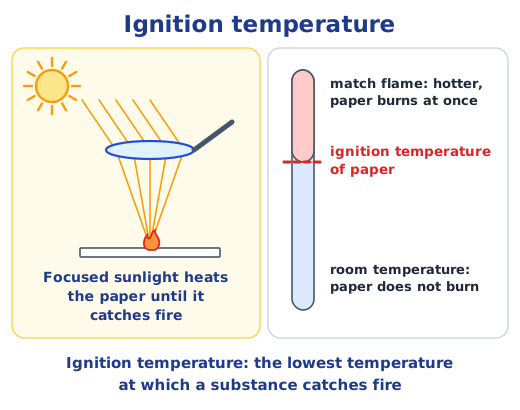
Paper burns easily, yet a sheet can lie in the open air for years and never catch fire. What else is needed? In Activity 5.6, which needs a teacher or an adult nearby, a lighted matchstick is brought to a piece of paper held in tongs, and the paper soon catches fire. Now focus sunlight on another piece with a magnifying glass, making the smallest, brightest spot, and hold it there. The paper starts to smoke and then catches fire, without any flame. The focused sunlight heats the paper, its temperature keeps rising, and at last it is hot enough to burn. The lowest temperature at which a substance catches fire is its ignition temperature. The matchstick flame was already hotter than that, which is why the paper caught fire almost at once.
The fire triangle
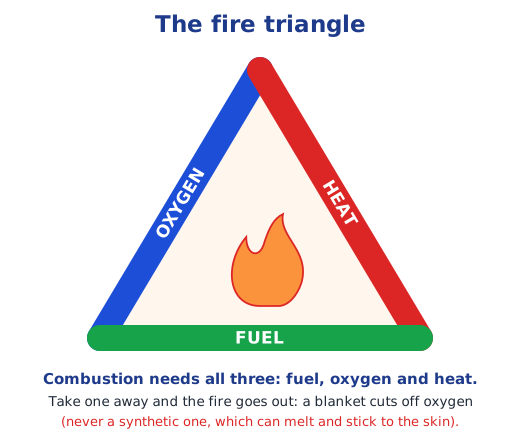
So combustion needs three things, shown as the fire triangle: a combustible substance, also called a fuel; oxygen; and heat that lets the fuel reach its ignition temperature. Remove any one side and the fire cannot continue, which is why a blanket that cuts off the air puts out burning clothes.
What a burning candle shows
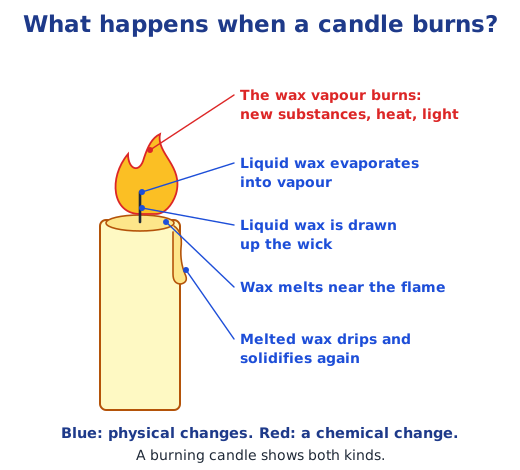
When a candle burns, the flame’s heat melts the wax, the liquid wax climbs the wick and turns into vapour, and melted wax that drips down solidifies again: all physical changes. The wax vapour then burns to produce the flame, a chemical change. So a burning candle shows physical and chemical changes together. In the nineteenth century the scientist Michael Faraday gave a series of lectures, The Chemical History of a Candle, using the candle to explain melting, vaporisation and combustion.
Why it matters
Understanding combustion helps us use fuels well and put out fires safely. How chemical changes differ from physical ones is explained in physical and chemical changes, and which changes can be undone in reversible and irreversible changes. Answers to every activity and question are in the NCERT solutions for Chapter 5; see all of the Chapter 5 notes.
Practice
-
Which of these is a combustible substance?
Show answer
Answer: (c) Kerosene
-
Why does a candle covered with a glass tumbler go out?
Show answer
Answer: (b) Its supply of air, and so oxygen, is cut off
-
What forms when a magnesium ribbon burns?
Show answer
Answer: (a) Magnesium oxide, a white powder
-
Why does a lighted matchstick set paper on fire almost at once?
Show answer
Answer: The matchstick flame is already hotter than the ignition temperature of paper, so the paper reaches that temperature almost immediately and starts to burn.
-
What three things does a fire need, and how can a fire be put out?
Show answer
Answer: A fuel, oxygen, and heat that brings the fuel to its ignition temperature. Taking away any one stops the fire; for example, wrapping a blanket around a person whose clothes are on fire cuts off the air.
Questions students ask
What is combustion?
Combustion is the chemical reaction of a substance with oxygen, which gives out heat and/or light. Burning wood, paper, kerosene or a magnesium ribbon are examples. Substances that can burn in this way are called combustible substances, or fuels.
What is ignition temperature?
It is the lowest temperature at which a substance catches fire. Paper in air at room temperature does not burn, but sunlight focused with a magnifying glass heats it until it smokes and catches fire, and a lighted matchstick, already hotter than the ignition temperature of paper, lights it almost at once.
What is the fire triangle?
It shows the three things combustion needs: a combustible substance or fuel, oxygen, and heat that lets the fuel reach its ignition temperature. If any one of the three is taken away, the fire cannot go on, which is why cutting off the air with a blanket puts out a fire.
Stuck on a question?
Take a photo and Lagnever AI explains it step by step. Try it for 7 days for ₹2.
Get it on Google Play Open in browser
For parents: after the trial, the plan renews monthly by UPI or card autopay. You can cancel anytime in the app.