
Physical and chemical changes
Answer in short
In a physical change only a substance’s shape, size or state changes and no new substance forms: folded paper is still paper and ice melts into water. In a chemical change one or more new substances form through a chemical reaction: lime water turns milky with carbon dioxide, iron rusts and magnesium burns to a white powder.
Stuck on a question? Take a photo and Lagnever AI explains it step by step. Try it for 7 days for ₹2. Get it on Google Play
Changes all around us
Ice melts, buds open, a cold bottle warms up and a banana grows brown spots and a strong smell. In Activity 5.1 you list more changes, from chopping vegetables and boiling water to burning wood, drying wet clothes and rolling dough into chapatis. Each one changes something: size, shape, smell, colour or another property. We notice them by looking, smelling, touching, listening and tasting. Sorting them into kinds starts with one question: does the change make a new substance?
Same substance, new look
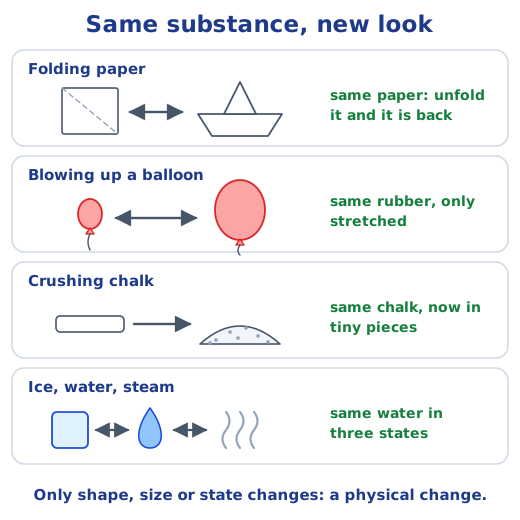
In Activity 5.2, fold sheets of paper into boats, birds and other objects, then unfold them: it is the same paper. Blow up a balloon and let the air out: it is the same rubber. Crush a piece of chalk: the powder is still chalk, though you cannot turn it back into a stick. Water, as you saw in Grade 6, can be solid, liquid or gas and changes from one state to another. In every case the appearance changes, but no new substance forms. A change that alters only physical properties, such as shape, size or state, is a physical change.
A new substance forms
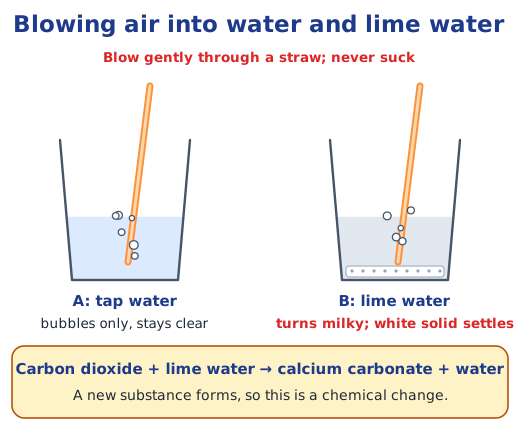
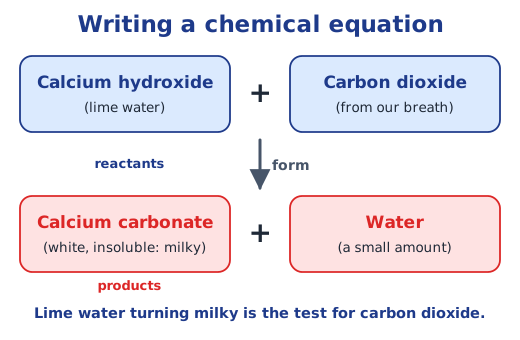
In Activity 5.3, fill one tumbler a quarter full with tap water and another with lime water, and blow into each through a separate straw. (Blow gently, and never suck.) The tap water only bubbles. The lime water turns milky, and after a while a white solid settles at the bottom: a new substance has formed. A change that makes one or more new substances is a chemical change, and the process that forms them is a chemical reaction. The carbon dioxide in our breath reacts with the lime water, calcium hydroxide, to give calcium carbonate, which does not dissolve in water and so makes the liquid milky, and a little water.
A reaction can be written in short as a chemical equation, with the starting substances before the arrow and the new ones after it. Lime water turning milky is also the standard test for carbon dioxide.
Vinegar and baking soda
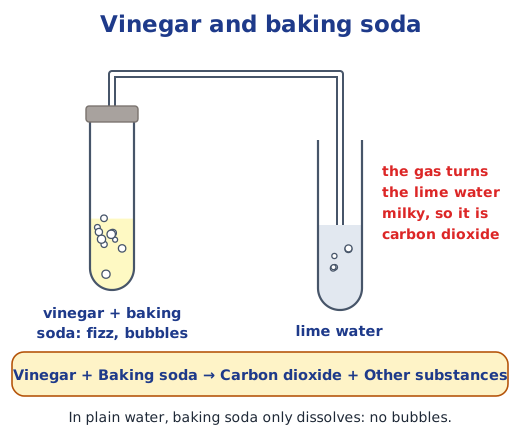
In Activity 5.4, pour a little vinegar or lemon juice into a test tube and drop in a little baking soda, which is sodium hydrogen carbonate. You hear fizzing and see bubbles of gas. Led into fresh lime water, the gas turns it milky, so it is carbon dioxide. Since a new substance forms, this is a chemical change too: vinegar + baking soda → carbon dioxide + other substances. Two small used bottles and a flexible straw work as well as test tubes. Now repeat it with baking soda and plain water: there are no bubbles, because the baking soda only dissolves, a physical change.
Rusting and burning
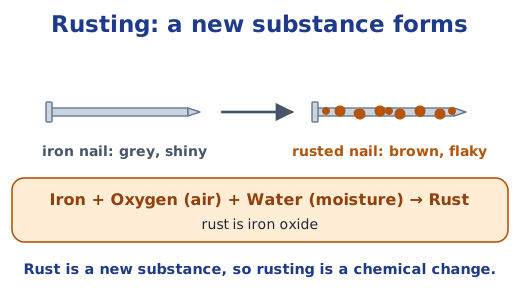
When iron is left in moist air, a new brown, flaky substance called rust, which is iron oxide, forms on it, so rusting is a chemical change. When a magnesium ribbon is burnt, it gives a dazzling light and turns into a white powder, magnesium oxide, another new substance. Cooking food, curdling milk and ripening fruit are chemical changes as well.
Telling them apart
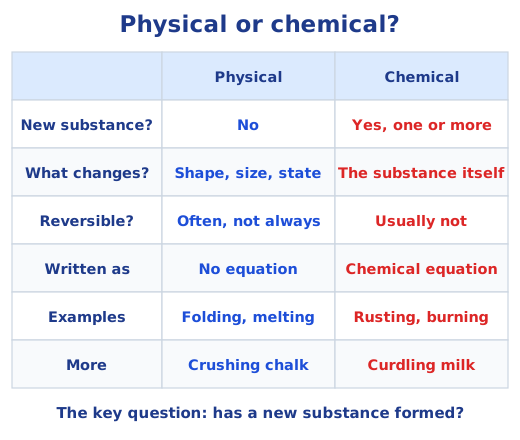
The surest test is to ask whether a new substance has formed. Signs such as a new colour, gas bubbles, a new smell, a solid appearing in a liquid, or heat and light being given out suggest a chemical change. Physical changes can often be undone, but not always: chopped vegetables stay chopped, yet they are still vegetables. Some processes include both kinds: in a burning candle the wax melts and evaporates, which is physical, and the wax vapour burns, which is chemical.
Why it matters
Knowing whether a change makes a new substance helps us cook, store food, prevent rust and stay safe with fire. How burning works is explained in combustion, and which changes can be undone in reversible and irreversible changes. Answers to every activity and question are in the NCERT solutions for Chapter 5; see all of the Chapter 5 notes.
Practice
-
Which of these is a physical change?
Show answer
Answer: (c) Crushing chalk into powder
-
What forms when carbon dioxide passes through lime water?
Show answer
Answer: (a) Calcium carbonate and water
-
Which pair gives carbon dioxide when mixed?
Show answer
Answer: (b) Baking soda and lemon juice
-
Is dissolving sugar in water a physical or a chemical change? Why?
Show answer
Answer: It is a physical change. The sugar spreads through the water, but no new substance forms, and if the water evaporates the sugar is left behind.
-
Give two signs that a chemical change may have taken place.
Show answer
Answer: A new colour, bubbles of a new gas, a new smell, a solid forming in a liquid, or heat and light being given out, as when lime water turns milky or vinegar fizzes with baking soda. The real test is whether a new substance has formed.
Questions students ask
What is a physical change? Give examples.
A physical change is one in which only physical properties such as shape, size or state change and no new substance is formed. Folding paper into a boat, letting the air out of a balloon, crushing chalk into powder and melting ice are examples: the paper, rubber, chalk and water stay the same materials.
What is a chemical change? Give examples.
In a chemical change, a chemical reaction produces one or more new substances. Lime water turning milky with carbon dioxide, vinegar fizzing with baking soda, iron rusting, magnesium burning, milk curdling and fruit ripening are all chemical changes.
Why does lime water turn milky with carbon dioxide?
Lime water is a solution of calcium hydroxide. Carbon dioxide reacts with it to form calcium carbonate, a white substance that does not dissolve in water, and a little water. The fine white particles make the liquid look milky and later settle at the bottom, which is why this is the test for carbon dioxide.
Stuck on a question?
Take a photo and Lagnever AI explains it step by step. Try it for 7 days for ₹2.
Get it on Google Play Open in browser
For parents: after the trial, the plan renews monthly by UPI or card autopay. You can cancel anytime in the app.