
Reversible and irreversible changes
Answer in short
A change is reversible if we can get the original object or substance back, as when melted ice is frozen again or steam condenses into water. It is irreversible if we cannot, as with chopped vegetables, popcorn or rust. Changes can also be desirable, like curd forming, or undesirable, like rusting, and slow natural changes form soil.
Stuck on a question? Take a photo and Lagnever AI explains it step by step. Try it for 7 days for ₹2. Get it on Google Play
Can we get it back?
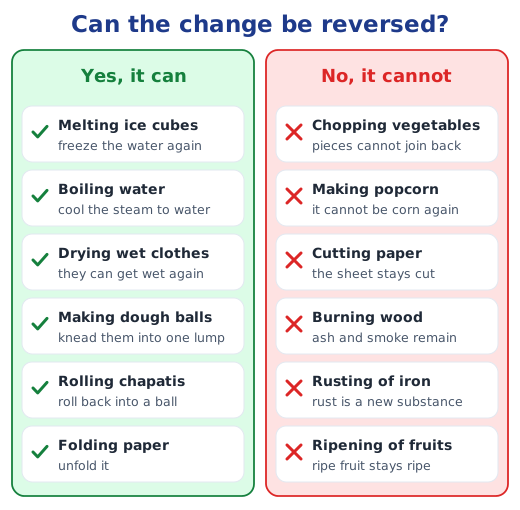
Once something has changed, can it return to its original form? In Activity 5.8 you go back over every change in the chapter and record, in Table 5.2, whether the original object or substance can be brought back. Melting ice cubes: yes. Chopping vegetables: no. Boiling water: yes. Making popcorn from corn: no.
Changes that can be reversed
If we can return to the object or substance we started with, the change can be reversed. When ice melts, the water can be frozen into ice again. When water evaporates, the vapour can be condensed back into liquid water. Folded paper can be unfolded, a rolled-up mat can be spread out, small balls of dough can be kneaded back together, and a chapati rolled from dough, before it is cooked, can be rolled back into a ball. Dissolved sugar or salt comes back when the water evaporates.
Changes that cannot be reversed
Other changes cannot be undone. Chopped vegetables cannot return to their size and shape, and popcorn cannot go back to being corn. Burnt wood leaves ash and smoke, ripe fruit does not turn raw again, and rusted iron stays rusted. So we can sort changes into two groups: reversible and irreversible. Most chemical changes in daily life cannot be reversed, but a physical change, such as cutting paper or crushing chalk, can also be impossible to undo.
Wanted and unwanted changes
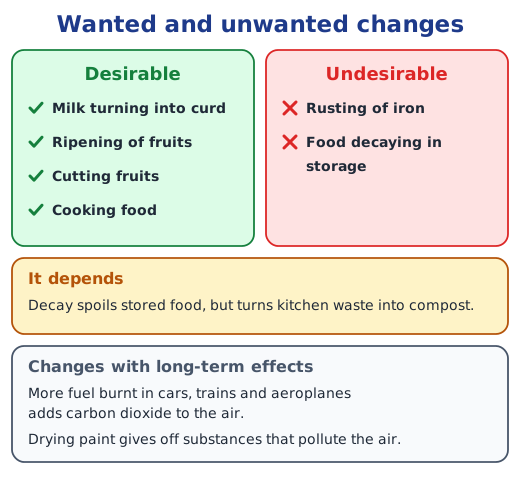
Many changes are useful. Milk sets into curd, fruits ripen, we cut fruit to eat it and we cook food: these are desirable changes. Others are undesirable: iron rusting, or food rotting while it is stored. A change that is unwanted in one situation can be wanted in another: the decomposition that spoils stored food also turns food waste into compost for plants.
Some changes caused by human activity build up over years and affect the environment for a long time. Using more and more fuel in cars, trains and aeroplanes is raising the amount of carbon dioxide in the air, and paint drying on walls, doors and furniture releases many substances by evaporation, polluting the air.
Weathering of rocks
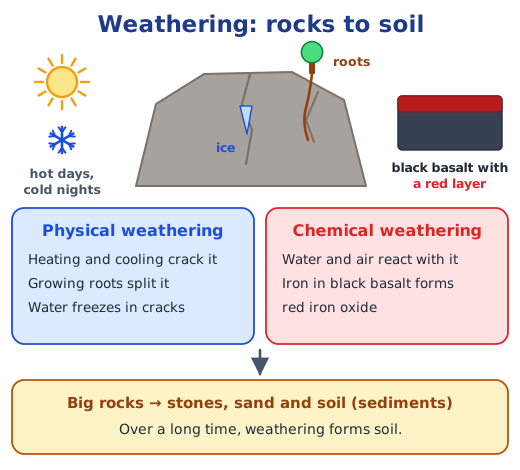
At the foot of mountains lie heaps of sand, soil and stones called sediments. They form when large rocks break into smaller pieces through physical changes: temperature changes in the climate, roots growing into cracks, and water freezing inside cracks all make rocks break. Water, or chemicals in water, can also react with rocks and change what they are made of. Black basalt, a rock that contains iron, can develop a red layer of iron oxide after long exposure to water or moist air. These physical and chemical changes together are called weathering, and in time they form soil.
Erosion
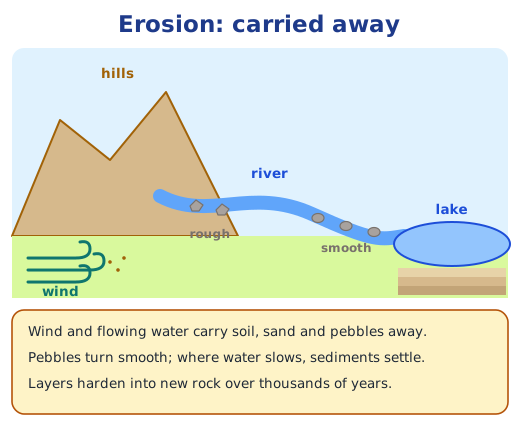
The fine sand on riverbeds and lake shores comes from pebbles, soil and sediments that wind and flowing water break up and carry away to new places. This process is erosion, and erosion during a landslide is a physical change. River pebbles look smooth because flowing water keeps rubbing them. Where water or wind slows down, as in a lake or the sea, the carried material settles to the bottom, and over time these sediments harden into new rocks. Such changes take thousands of years and cannot be reversed.
Why it matters
Knowing which changes can be reversed and which are wanted helps us store food, protect metals and look after soil and hillsides. The two main kinds of change are explained in physical and chemical changes, and burning in combustion. Answers to every activity and question, including Table 5.2, are in the NCERT solutions for Chapter 5; see all of the Chapter 5 notes.
Practice
-
Which change can be reversed?
Show answer
Answer: (c) Melting ice
-
Which of these is an undesirable change?
Show answer
Answer: (c) Rusting of a bicycle
-
What is the moving of soil, sand and pebbles by wind and flowing water called?
Show answer
Answer: (b) Erosion
-
Can dissolving salt in water be reversed?
Show answer
Answer: Yes. If the salt water is left in the sun or heated, the water evaporates and the salt is left behind, so we get the salt back.
-
How do rocks slowly turn into soil?
Show answer
Answer: Through weathering. Heating and cooling, growing roots and water freezing in cracks break rocks into smaller pieces, and water and air react with some rocks and change them chemically. Over a very long time the broken pieces become soil.
Questions students ask
What is a reversible change?
A change is reversible if the object or substance can be brought back to the form we started with. Melted ice can be refrozen, steam can be condensed back into water, and a folded sheet of paper can be unfolded. Many physical changes, especially changes of state, are reversible.
Are chemical changes reversible?
Usually not in everyday life. Burning wood, cooking food, curdling milk, ripening fruit and rusting form new substances, and we cannot simply turn them back into what we started with. But not every irreversible change is chemical: chopping vegetables is a physical change, yet the pieces cannot join again.
What is the difference between weathering and erosion?
Weathering breaks rocks down, through physical changes such as heating and cooling, growing roots and freezing water, and through chemical changes caused by water and air. Erosion moves the broken material, soil, sand and pebbles, from one place to another by wind and flowing water. Both are very slow and help form soil and new rocks.
Stuck on a question?
Take a photo and Lagnever AI explains it step by step. Try it for 7 days for ₹2.
Get it on Google Play Open in browser
For parents: after the trial, the plan renews monthly by UPI or card autopay. You can cancel anytime in the app.