
NCERT Solutions Class 7 Science Chapter 5: Changes Around Us: Physical and Chemical
Answers to every question in Chapter 5, Changes Around Us: Physical and Chemical, of Curiosity, the Class 7 Science textbook (Reprint 2026-27): the questions in the text, Activities 5.1 to 5.8 with Tables 5.1 and 5.2, the Science and Society box, all ten questions of Let Us Enhance Our Learning and the Exploratory Projects. Page numbers follow the book (pages 57–72). Answers to activities give the results to expect; record your own observations. Short notes: Chapter 5 notes.
The students’ changes (page 57)
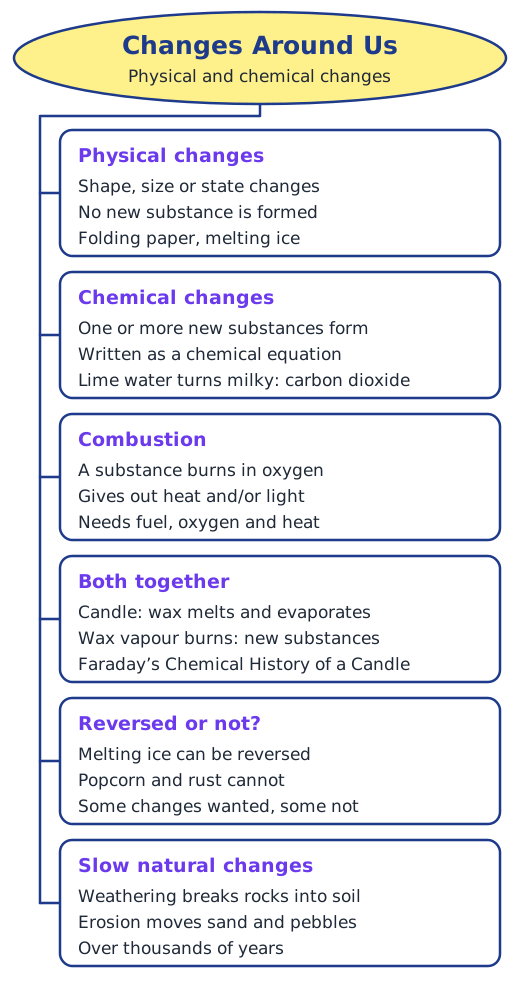
What kinds of changes are they talking about? The ice cube melting into water is a change of state. The bud opening into a flower is a change of growth in a living plant. The bottle of cold water warming up is a change of temperature. The banana getting more brown spots and a strong smell is ripening and then spoiling, in which new substances form. Some are physical changes and some chemical, and the chapter shows how to tell them apart.
Activity 5.1 and Table 5.1 (page 58)
Table 5.1: some changes observed around us (written as a list):
- Melting ice cubes: solid ice turns into liquid water.
- Chopping vegetables: size and shape change.
- Boiling water: bubbles form and water turns into steam.
- Making popcorn from corn: hard kernels burst into soft, white, bigger popcorn with a new smell.
- Cutting a piece of paper: size and shape change.
- Adding beetroot extract to water: the water turns red to pink as the colour spreads.
- Burning wood: wood turns into ash and smoke, giving out heat and light.
- Drying wet clothes: the water evaporates and the clothes become dry.
- Making small balls of dough: the shape of the dough changes.
- Rolling small balls of dough into chapatis: the balls become flat and round, so shape and size change.
- Any other: for example, milk setting into curd changes in taste, smell and thickness.
Other changes around you: leaves turning yellow, a candle burning, ice cream melting, bread being toasted, a puddle drying, an iron gate rusting and seeds sprouting.
Activity 5.2 (page 59)
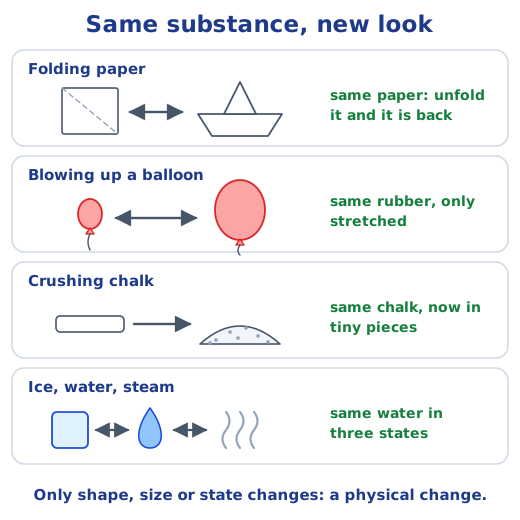
- A. Paper objects: unfolding them gives back the same paper, only with creases.
- B. Balloon: when the air escapes, you get the uninflated balloon back. When a blown-up balloon is pricked, it bursts into torn pieces of rubber, and the uninflated balloon cannot be got back.
- C. Chalk: the powder cannot be turned back into the chalk piece.
The similarity: in A, B and C the materials, paper, rubber and chalk, stay the same; only their shape or size changes. No new substance forms, so all of these are physical changes.
Activity 5.3 (page 60)
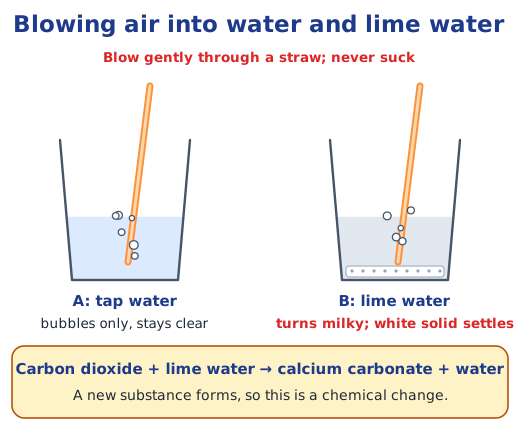
Do you notice any changes? Blowing into tap water (A) only makes bubbles; the water looks the same. Blowing into lime water (B) also makes bubbles, but the lime water turns milky, and after some time a white solid settles at the bottom. A new substance, calcium carbonate, has formed from the carbon dioxide in the breath, so this is a chemical change: calcium hydroxide (lime water) + carbon dioxide → calcium carbonate + water.
Activity 5.4 (page 61)
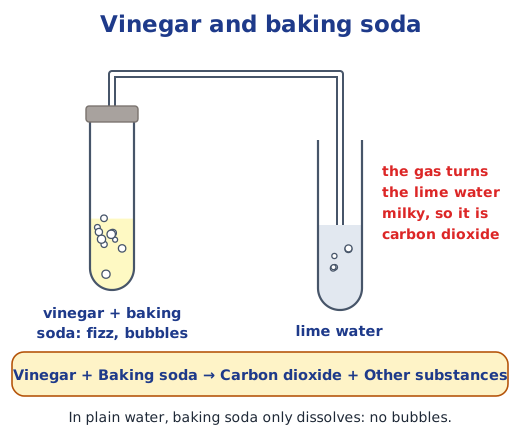
- Vinegar or lemon juice with baking soda: you hear fizzing and see bubbles of gas.
- The gas through fresh lime water: the lime water turns milky, so the gas is carbon dioxide. A new substance forms, so this is a chemical change.
- Baking soda with plain water: no bubbles form. The baking soda only dissolves, which is a physical change.
Rusting and burning magnesium (page 62)
Is burning a magnesium ribbon a physical or a chemical change? Chemical. A new substance, magnesium oxide, a white powder, forms, and heat and light are given out: magnesium + oxygen → magnesium oxide + heat + light. Rusting is chemical too, because rust (iron oxide) is a new substance.
Activity 5.5 (pages 62–63)
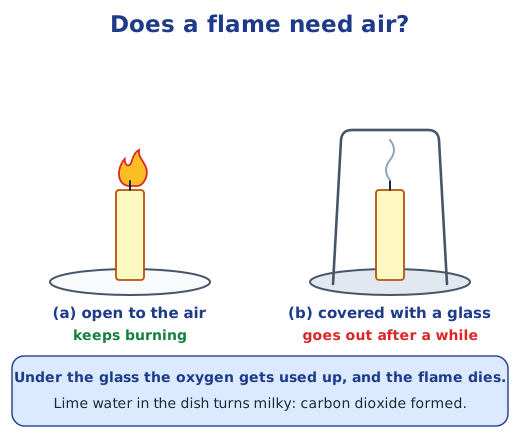
What happens to the candle flames? The uncovered candle keeps burning, while the one covered with a glass tumbler goes out after some time, because it gets no continuous supply of air, and burning needs oxygen. How can you test for carbon dioxide under the tumbler? Add a little lime water to the petri dish: it turns milky, showing that carbon dioxide formed from the carbon in the wax and the oxygen in the air.
Science and Society (page 63)
How do you put out a fire on a person’s clothes? Wrap a blanket or a cloth around the person. It cuts off the supply of air, so the fire goes out. Never use a synthetic blanket or cloth, which can melt and stick to the skin.
Activity 5.6 (page 64)
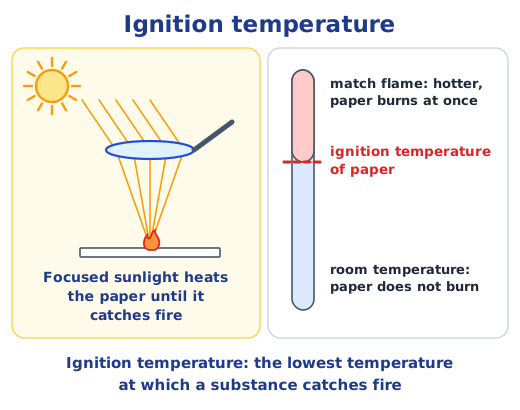
Do we need a fire to start burning? No. A lighted matchstick sets paper on fire quickly, but sunlight focused into a small bright spot by a magnifying glass also makes the paper smoke and then catch fire, with no flame. The paper burns once it reaches its ignition temperature, the lowest temperature at which it catches fire. The matchstick flame is already above that temperature, so it lights the paper almost at once. Combustion therefore needs a fuel, oxygen, and heat to reach the ignition temperature: the fire triangle.
Activity 5.7 (page 65)
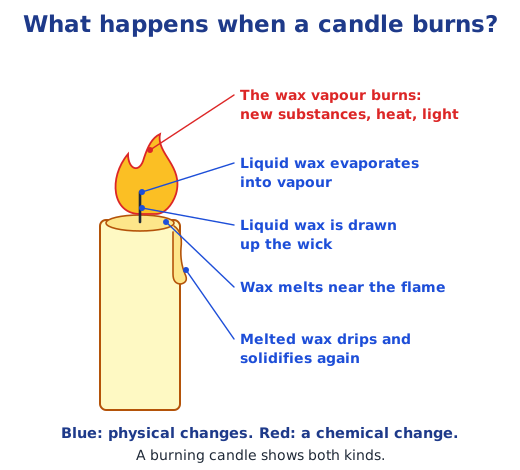
What changes occur when a candle burns? Each student is partly right. The wax melts near the flame; the liquid wax is drawn up the wick and evaporates in the heat; wax that flows down solidifies in different shapes. These are physical changes. The wax vapour burns to make the flame, forming new substances, which is a chemical change. So a burning candle shows physical and chemical changes together.
Activity 5.8 and Table 5.2 (page 66)
Table 5.2: can the change be reversed? (written as a list):
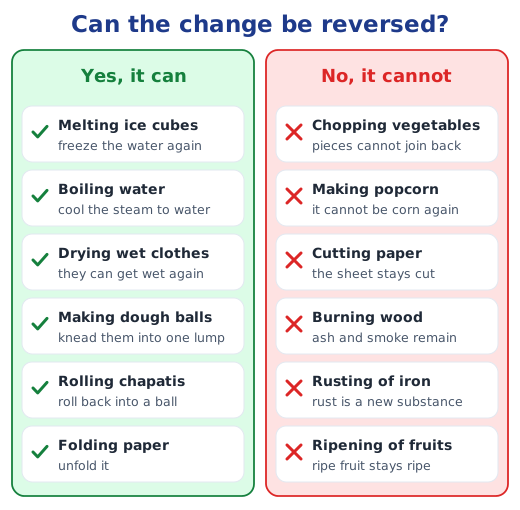
- Melting ice cubes: Yes, the water can be frozen again
- Chopping vegetables: No, the pieces cannot join back
- Boiling water: Yes, the steam can be condensed back into water
- Making popcorn from corn: No
- Cutting a piece of paper: No
- Adding beetroot extract to water: only partly; evaporating the water leaves the coloured part behind
- Burning wood: No
- Drying wet clothes: Yes
- Making small balls of dough: Yes
- Rolling small balls of dough into chapatis (before cooking): Yes
- Folding paper into objects: Yes
- Rusting of iron: No
Desirable changes (page 66)
Other desirable changes around you: seeds germinating, dough rising with yeast, rice and dal cooking, sugarcane juice boiled into jaggery, clay pots hardening in a kiln, and food being digested in our bodies.
Let Us Enhance Our Learning (pages 69–72)
1. (c) (i) and (iii). In a physical change the state may or may not change, and no new substance is formed. Forming a substance with different properties, (ii), and undergoing a chemical reaction, (iv), describe chemical changes.
2. Can these changes be reversed?
- (i) Stitching cloth to a shirt: can be reversed, mostly; the stitches can be unpicked and the pieces separated, though the cuts in the cloth stay. You may mark it “not sure”.
- (ii) Twisting a straight string: can be reversed; untwist it.
- (iii) Making idlis from a batter: cannot be reversed; steaming cooks the batter.
- (iv) Dissolving sugar in water: can be reversed; evaporate the water to get the sugar back.
- (v) Drawing water from a well: can be reversed; the water can be poured back.
- (vi) Ripening of fruits: cannot be reversed.
- (vii) Boiling water in an open pan: not sure. The steam could be condensed back into water, but in an open pan it escapes into the air, so we cannot easily get the same water back.
- (viii) Rolling up a mat: can be reversed; unroll it.
- (ix) Grinding wheat grains to flour: cannot be reversed.
- (x) Forming of soil from rocks: cannot be reversed.
Why are we not sure about some? Because only part of the change can be undone, as with stitching, or it can be undone in principle but not easily in practice, as with steam escaping from an open pan.
3. True or false.
- (i) True. The wax has to melt and then evaporate; it is the wax vapour that burns.
- (ii) False. Condensing water vapour is a change of state, so the correct statement is: collecting water vapour by condensing involves a physical change.
- (iii) True. Bacteria and fungi break the leaves down into new substances, so making compost is a chemical change.
- (iv) True. Carbon dioxide, a new substance, forms.
4. Fill in the blanks.
- (i) The brown deposits are due to rusting, and this is a chemical change.
- (ii) Folding a handkerchief is a physical change and can be reversed.
- (iii) A chemical process in which a substance reacts with oxygen with evolution of heat is called combustion, and this is a chemical change.
- (iv) Magnesium burnt in air produces magnesium oxide. The substance formed is basic in nature. Burning of magnesium is a chemical change.
5. Water to ice and water to steam. Both are physical changes. Only the state changes, from liquid to solid or from liquid to gas; ice, water and steam are all the same substance, water, and no new substance forms. Both can be reversed: ice melts back into water, and steam condenses back into water.
6. Is curdling of milk physical or chemical? Chemical. The milk turns into curd, which has a new taste, smell and thickness, because new substances form, and curd cannot be turned back into milk.
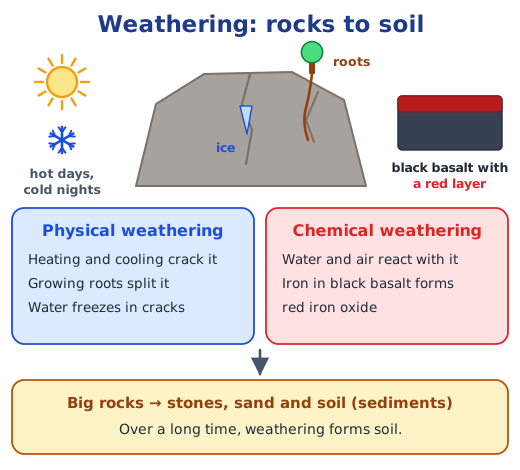
7. Forming soil from rocks: physical or chemical? Both. Wind, rain, heating and cooling, roots and freezing water break rocks into smaller pieces and carry them away: these are physical changes (weathering and erosion). Water and air also react with some rocks and change what they are made of, as when iron in basalt forms red iron oxide: a chemical change. Together they slowly form soil.
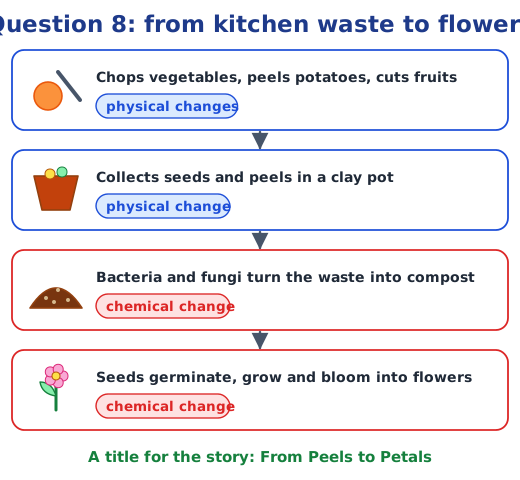
8. Eco-friendly Prithvi. Chopping vegetables, peeling potatoes and cutting fruits: physical changes. Collecting seeds, fruits and peels in a clay pot: physical change. The waste decomposing into compost through bacteria and fungi: chemical change. Seeds germinating, growing and blooming into flowers: chemical change. A title of your choice, for example: From Peels to Petals.
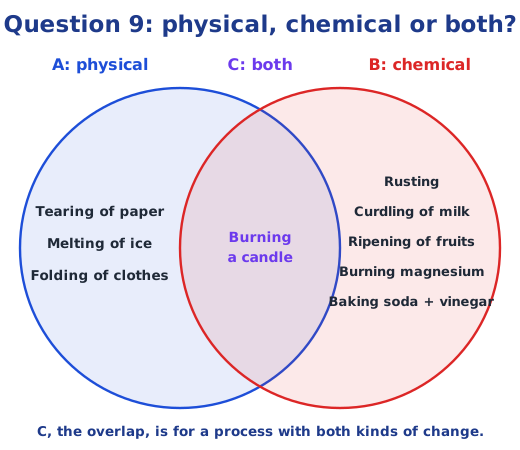
9. The Venn diagram.
- A (physical changes): tearing of paper, melting of ice, folding of clothes.
- B (chemical changes): rusting, curdling of milk, ripening of fruits, burning of magnesium, mixing baking soda with vinegar.
- C (both): the process of burning a candle.
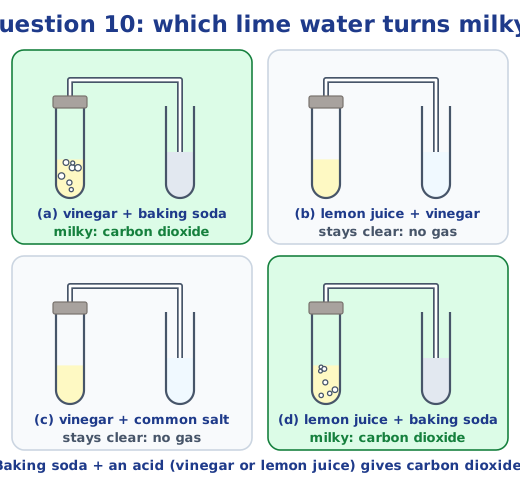
10. Which lime water turned milky? In (a), vinegar and baking soda, and (d), lemon juice and baking soda. Baking soda reacts with an acid, vinegar or lemon juice, to form carbon dioxide, which turns lime water milky. In (b), lemon juice and vinegar, both are acids and no carbon dioxide forms; in (c), vinegar and common salt give no carbon dioxide either, so the lime water stays clear.
Exploratory Projects (pages 71–72)
Invisible ink. As the lemon juice dries, its water evaporates and the message disappears; this is a physical change. On warming, the dried juice turns dark brown, because heat changes it into new substances, a chemical change. The browning cannot be reversed. (Do this only with an adult.)
Reducing landslides and rock erosion. Plant trees, shrubs and grass on slopes so that roots hold the soil; avoid cutting hillsides steeply for roads and buildings; build retaining walls and proper drains so that rainwater does not soak and loosen the slopes; stop unplanned mining and quarrying; use terrace farming on hills; and heed warnings in heavy rain.
Kitchen changes that can be reversed. Melting butter or ghee, freezing water into ice, dissolving sugar or salt, steam condensing on a lid, and rolling dough. These are physical changes. Cooking rice, boiling an egg and toasting bread cannot be reversed, because they are chemical changes.
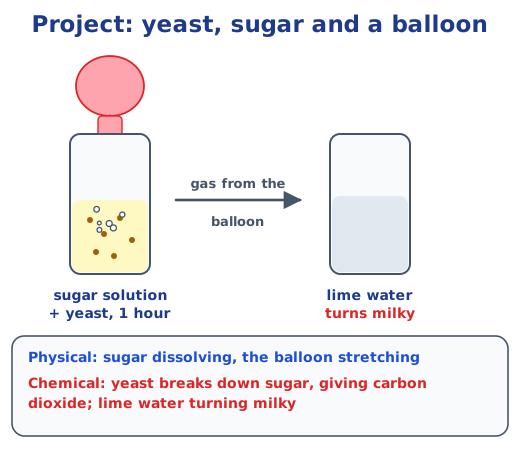
How yeast works. The balloon on the bottle of sugar solution and yeast slowly fills with gas. Shaken with fresh lime water, the gas turns it milky, so it is carbon dioxide: yeast breaks down the sugar and gives off carbon dioxide. In bread, these gas bubbles are trapped in the dough and make it fluffy and soft. Dissolving the sugar and the balloon stretching are physical changes; yeast breaking down sugar and the lime water turning milky are chemical changes.
Chameleons changing colour. Yes, the change can be reversed: a chameleon changes colour again and again, as special cells in its skin change how they reflect light. It is a change in a living animal, not a new substance like rust.
Short notes and more practice are on the topic pages: physical and chemical changes, combustion and reversible and irreversible changes.
Practice
-
Which of these changes can be reversed?
Show answer
Answer: (b) Freezing water into ice
-
What does lime water test for?
Show answer
Answer: (b) Carbon dioxide
-
Fireflies make light without heat. What is this called?
Show answer
Answer: (b) Bioluminescence
-
Is cooking an egg a physical or a chemical change?
Show answer
Answer: A chemical change. Heat changes the runny egg into a firm solid with a new texture and taste; new substances form, and the cooked egg cannot become raw again.
-
Why are river pebbles smooth?
Show answer
Answer: Flowing water keeps rolling them and rubbing them against sand and other stones, which wears away their sharp edges over a long time. This is part of erosion, a physical change.
Stuck on a question?
Take a photo and Lagnever AI explains it step by step. Try it for 7 days for ₹2.
Get it on Google Play Open in browser
For parents: after the trial, the plan renews monthly by UPI or card autopay. You can cancel anytime in the app.