
Class 7 Social Science Chapter 12: Understanding Markets Notes
This chapter in five lines
Understanding Markets explains that a market is any place, physical or online, where buyers and sellers agree on a price. Prices are settled by bargaining and by demand and supply. Markets can be physical or online, domestic or international, wholesale or retail; goods pass from producers through wholesalers and retailers to us; and the government sets rules while quality marks help consumers choose.
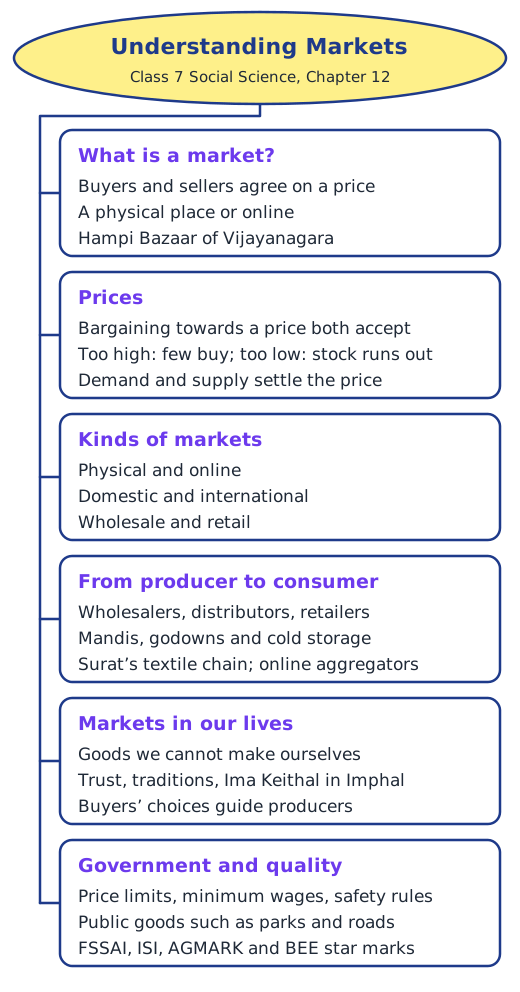
What is this chapter about?
The chapter opens with the 18th-century economist Adam Smith, who linked a society’s prosperity to the markets that grow up when people need goods and services they cannot make for themselves. A busy market picture shows vegetables, fruit, clothes, groceries, phones and fridges, all made through the primary, secondary and tertiary activities studied in Grade 6, and asks how they reach us. The four Big Questions ask what markets are and how they work, what role they play in people’s lives, what the government does in them, and how consumers can judge quality.
What is a market?
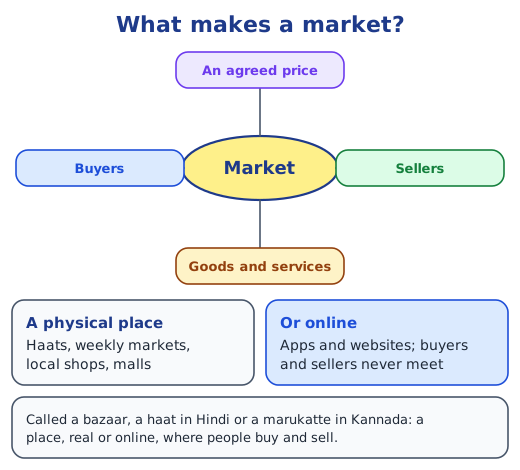
A market is wherever people come together to buy and sell goods, called a bazaar, a haat in Hindi or a marukatte in Kannada. It may be physical or online. Through markets, people and businesses meet their needs, things needed to stay alive, like food, water, shelter and clothes, and their wants, things desired but not essential. In the 16th century, Hampi Bazaar in Karnataka, opposite the Virupaksha temple, was one of the richest markets of the Vijayanagara Empire. Read types of markets.
How prices are set
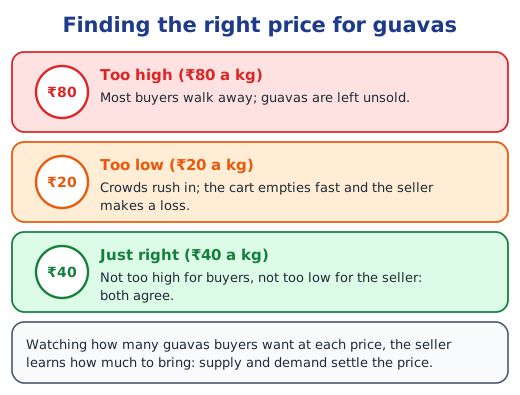
A sale happens only when buyer and seller agree on a price, often after bargaining. In the book’s example, guavas at ₹80 a kg drive buyers away, at ₹20 the seller sells out at a loss, and at about ₹40 both agree. Over time, demand, what buyers want, and supply, what sellers offer, settle a price that suits both. Read how markets set prices.
Kinds of markets
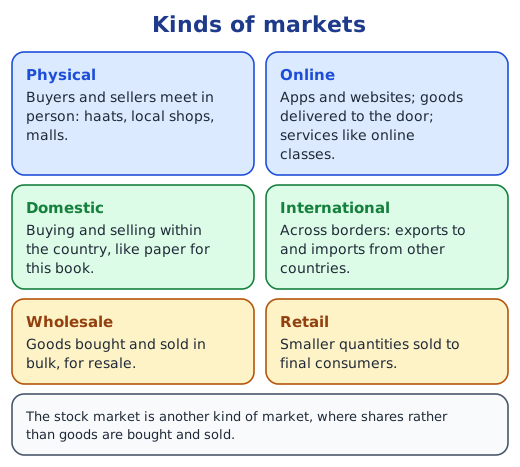
Markets come in pairs. Physical markets, from weekly haats to malls, need buyers and sellers to meet, while online markets work through apps and websites. Domestic markets trade within the country and international markets across borders, through exports and imports. Wholesale markets deal in bulk for resale, and retail markets sell small quantities to final consumers.
How goods reach us
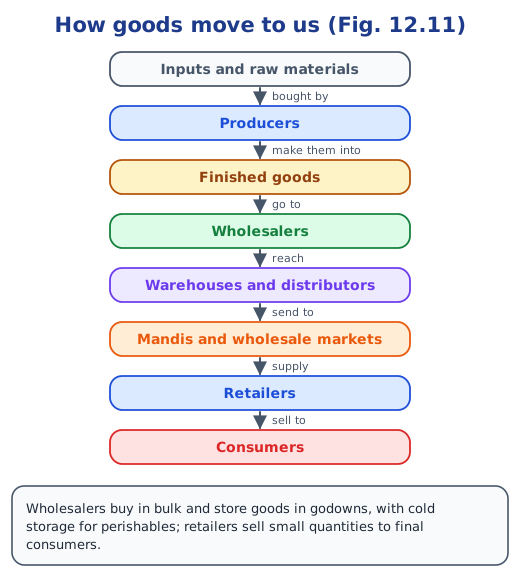
The book’s new flow chart, Fig. 12.11, traces goods from inputs and raw materials to producers and finished goods, then to wholesalers, warehouses and distributors, mandis and wholesale markets, retailers and finally consumers. Wholesalers store produce in godowns, with cold storage for perishables; distributors reach far-off retailers; and online, aggregators take orders, pack goods and deliver them. In Surat, cotton passes through markets for fabric, dyed cloth and finished garments.
Markets in our lives
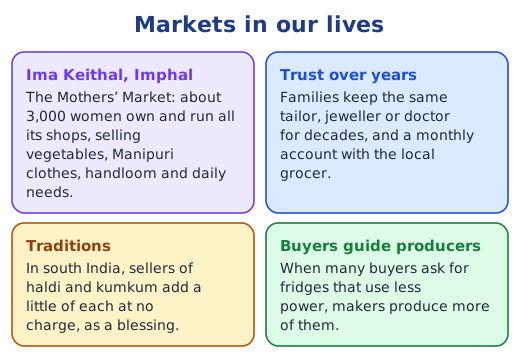
Markets let us get what we cannot make ourselves, but they do more. Buyers’ choices guide producers, as when demand for power-saving fridges leads makers to produce them. Families trust the same tailor or grocer for decades, sellers of haldi and kumkum in south India add a little at no charge as a blessing, and Ima Keithal in Imphal, run by about 3,000 women, is both a livelihood and a meeting place of cultures.
The government and quality
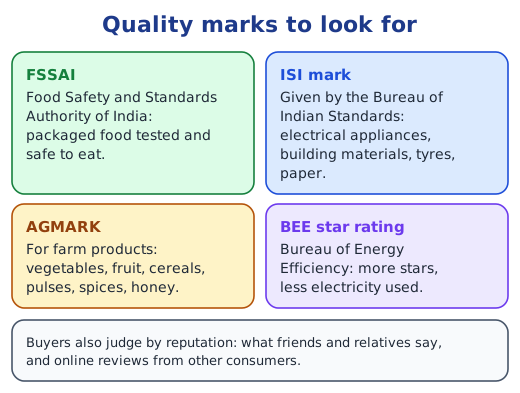
Where markets alone do not work well, the government steps in: it sets maximum prices for essentials such as lifesaving drugs, minimum prices for crops and minimum wages, enforces quality and safety, limits harm such as plastic pollution, checks weights and measures and provides public goods. Consumers can check labels and look for the FSSAI, ISI and AGMARK marks and BEE star ratings. Read role of government in markets.
Before we move on
Markets bring buyers and sellers together at a price set by demand and supply. A chain of manufacturers, wholesalers, distributors and retailers brings goods to us, and markets are also places where people meet and share ideas and traditions. The government keeps markets fair and safe, and consumers can judge quality through certification marks and reviews. Answers to every question are in the NCERT solutions for Chapter 12.
Key terms
| Term | Meaning |
|---|---|
| Market | Any place, physical or online, where buyers and sellers exchange goods or services; also called a bazaar or haat. |
| Price | The sum a buyer agrees to pay and a seller agrees to accept for a good or service. |
| Needs and wants | Needs are what we must have to stay alive, like food, water, shelter and clothes; wants are things we would like but can live without. |
| Demand | How much of a product buyers want and can afford to buy at a certain price at a certain time. |
| Supply | How much of a product sellers want and are able to sell at a certain price at a certain time. |
| Export and import | Selling goods or services to buyers in another country, and buying goods or services from other countries. |
| Wholesaler | A trader who buys goods in bulk from producers and sells them to retailers for resale. |
| Retailer | A shopkeeper who sells goods in small quantities to final consumers. |
| Distributor | A person or business that carries goods from manufacturers and wholesalers to retailers. |
| Aggregator | A website or app that brings together offers from many sellers and sells them to consumers in one place. |
| Public goods | Goods and services, such as parks, roads and policing, that are open to all and that markets would not supply for profit. |
| Certification marks | Marks such as FSSAI, ISI, AGMARK and the BEE star rating that show a product meets set standards. |
Topics in this chapter
Practice
-
What must buyers and sellers agree on to complete a transaction?
Show answer
Answer: (b) A price
-
In the guava example, which price was just right?
Show answer
Answer: (b) ₹40 a kg
-
A trader who buys in bulk from producers and sells to shops is a:
Show answer
Answer: (c) Wholesaler
-
Which mark shows that packaged food is safe to eat?
Show answer
Answer: (b) FSSAI
-
Ima Keithal, a market run by women, is in:
Show answer
Answer: (b) Imphal
-
Which of these is a public good?
Show answer
Answer: (b) A public park
Questions students ask
What are the main topics of Class 7 SST Chapter 12?
What a market is and how buyers and sellers settle prices; demand and supply; physical, online, domestic, international, wholesale and retail markets; how goods move from producers to consumers, with Surat’s textile market as an example; the role of markets in people’s lives; the government’s role; and how consumers can judge quality.
Is Understanding Markets in the new NCERT Class 7 Social Science book?
Yes. It is Chapter 12 of Exploring Society: India and Beyond, the Class 7 Social Science textbook Part 1 (Reprint 2026-27), on pages 247 to 272, in the theme Economic Life Around Us. It is the last chapter of Part 1.
How are prices decided in a market?
Buyers and sellers bargain until they reach a price both accept. Over time, the amount sellers offer and the amount buyers want, that is supply and demand, settle a price that pays the seller enough and that the buyer can afford.
How can consumers check the quality of a product?
By reading the label for the net quantity, dates, ingredients and maker’s details; by looking for marks such as FSSAI on food, ISI on appliances, AGMARK on farm products and BEE stars on electrical goods; and by asking friends and reading online reviews.
Stuck on a question?
Take a photo and Lagnever AI explains it step by step. Try it for 7 days for ₹2.
Get it on Google Play Open in browser
For parents: after the trial, the plan renews monthly by UPI or card autopay. You can cancel anytime in the app.