
NCERT Solutions Class 7 Social Science Chapter 12: Understanding Markets
Answers to every question in Chapter 12, Understanding Markets, of Exploring Society: India and Beyond, the Class 7 Social Science textbook Part 1 (Reprint 2026-27): the Big Questions, the opening question, all eight Let’s Explore activities, every Think About It and the other questions in the text, and all ten Questions and activities. Page numbers follow the book (pages 247–272). Short notes: Chapter 12 notes.
The Big Questions (page 247)
1. What are markets and how do they function? A market is any place, physical or online, where buyers and sellers exchange goods and services. It works when they agree on a price, through bargaining and, over time, through demand and supply, with wholesalers, distributors and retailers carrying goods from producers to consumers.
2. What is the role of markets in people’s lives? They let us get goods and services we cannot make ourselves, give people work and income, send signals to producers about what to make, and build relationships and traditions.
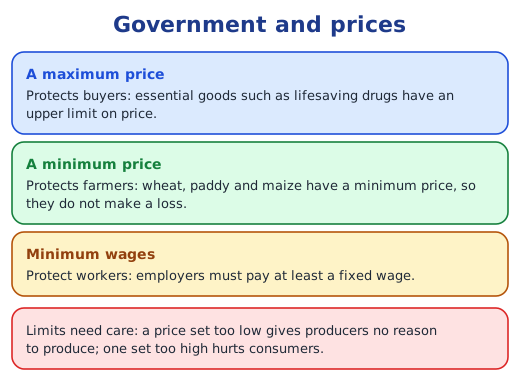
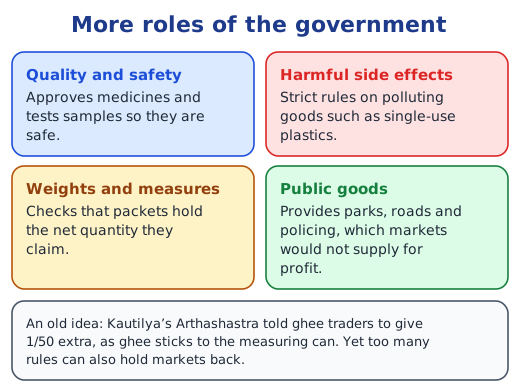
3. What role does the government play in markets? It sets some prices and minimum wages, enforces quality and safety standards, limits harmful effects such as pollution, checks weights and measures, and provides public goods.
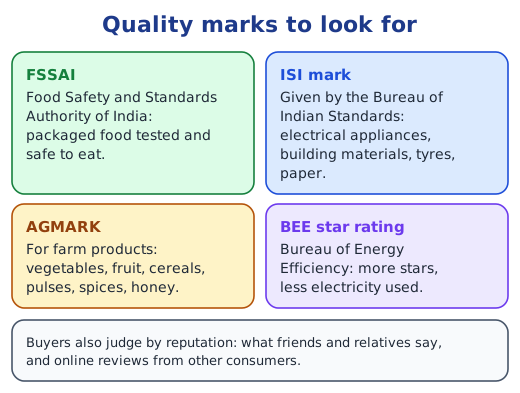
4. How can consumers assess quality? By reading labels, looking for certification marks such as FSSAI, ISI, AGMARK and BEE stars, and by word of mouth and online reviews.
Opening question: how do these goods reach us? Through a chain of markets: producers sell to wholesalers, who pass goods through warehouses, distributors and mandis to retailers, from whom we buy; online sellers deliver to our doors.
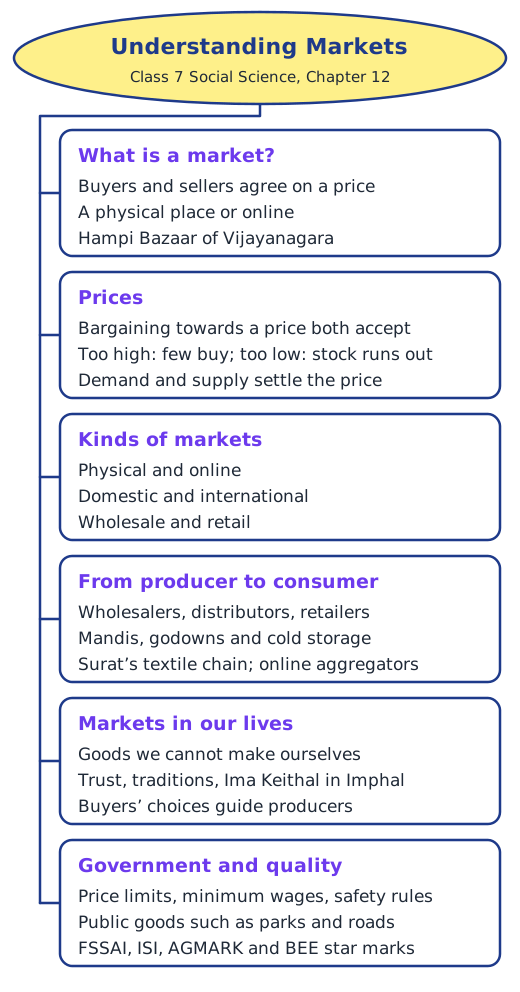
Let’s Explore (page 251): Hampi Bazaar
At its peak the bazaar would have been crowded and noisy, with long rows of stalls, grain and oil in heaps, silk and cotton on display, animals and caged birds, craftsmen making gold jewellery in the street, merchants weighing gems, and pilgrims from the Virupaksha temple mixing with traders from far away. Old markets in our states (examples): Chandni Chowk in Delhi, Johari Bazaar in Jaipur, Laad Bazaar near the Charminar in Hyderabad and Devaraja Market in Mysuru. Like them, today’s markets bring sellers of many goods together; but today’s markets also use shops in malls, electric lights, fixed prices, cards and UPI, and goods come from much farther away.
Let’s Explore (pages 251–252): a guava skit
Sample dialogue. Buyer: How much are the guavas? Seller: ₹60 a kg, fresh from the farm today. Buyer: That is a lot; the cart down the road sells at ₹40. Seller: Those are small ones. Look at these, sweet and firm. I can give them at ₹55. Buyer: I will take two kilos at ₹45. Seller: Make it ₹50 and I will add one extra guava. Buyer: Done. The bargaining included offers and counter-offers, comparing with other sellers, praising quality and a small extra to close the deal.
Think About It (page 252)
Markets with little bargaining: malls, supermarkets, chemists, petrol pumps and online stores, where prices are printed (MRP) or fixed for everyone, goods are standard, and there are too many buyers for each to bargain.
Think About It (page 254)
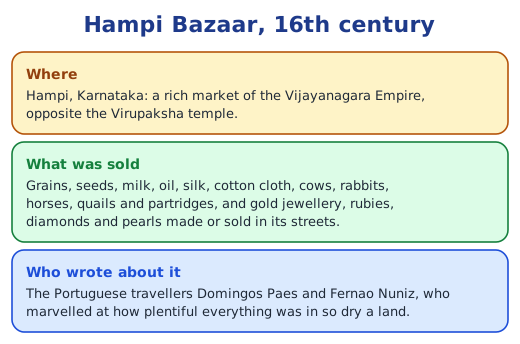
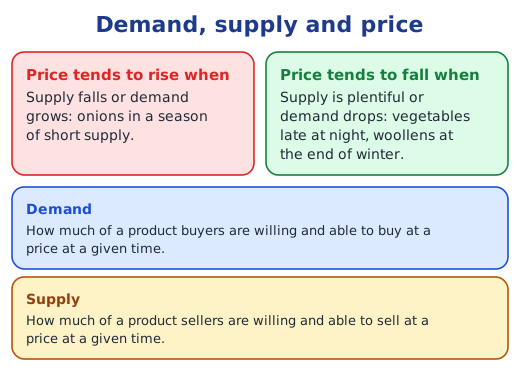
Vegetables cheaper late at night: they spoil quickly, sellers want to sell them before going home rather than carry them back, and fewer buyers are left, so sellers cut prices. Woollens discounted at the end of winter: demand falls as the weather warms, shops need space for the next season’s stock, and storing unsold woollens for a year costs money.
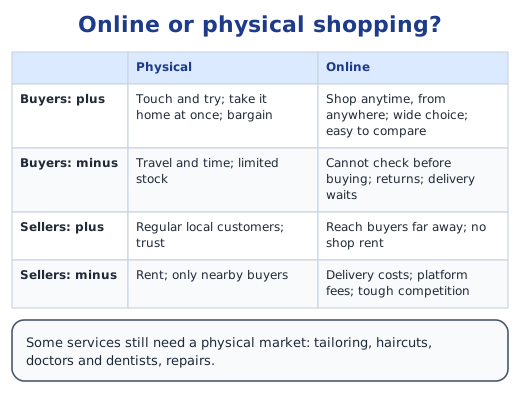
Think About It (page 255)
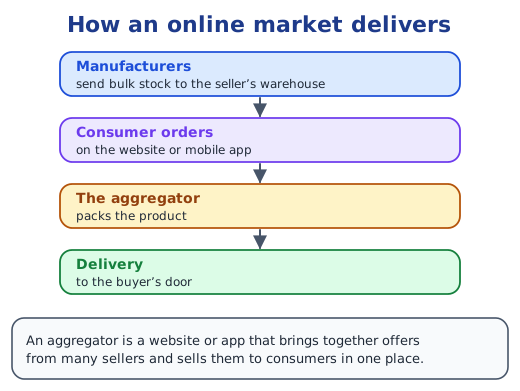
Pros and cons of online and physical shopping, for buyers and sellers, are compared in the table below. Other services that need a physical market: haircuts, doctors’ and dentists’ check-ups, repairs by plumbers and electricians, vehicle servicing and physiotherapy.
Let’s Explore (page 257): the flow of goods
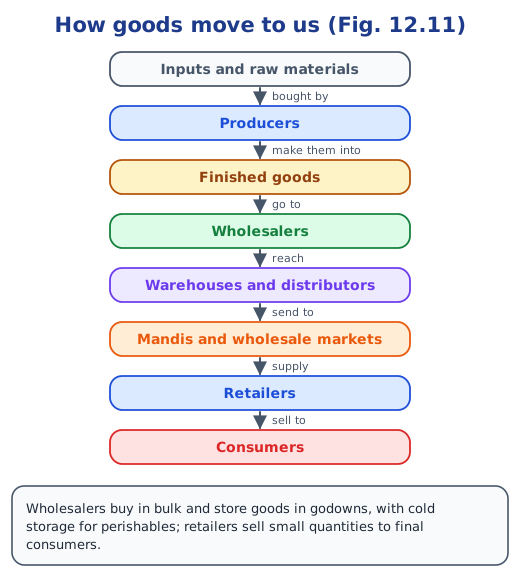
The flow in Fig. 12.11: inputs and raw materials are bought by producers, who make them into finished goods; these go to wholesalers, reach warehouses and distributors, are sent to mandis and wholesale markets, and are supplied to retailers, who sell to consumers. Wholesalers buy in bulk, store goods, judge how much retailers need and keep supply steady; retailers sell small quantities near our homes and make goods easy to get.
Let’s Explore (page 262): tracing a product
Sample: a packet of tea. Tea is grown and plucked on an estate in Assam, processed in the estate factory, sold at a tea auction to a packing company, packed and branded, sent to a distributor, and supplied to the grocer, who sells it to us. Your own chart will depend on the product and shop you choose.
Don’t Miss Out (page 262): Surat
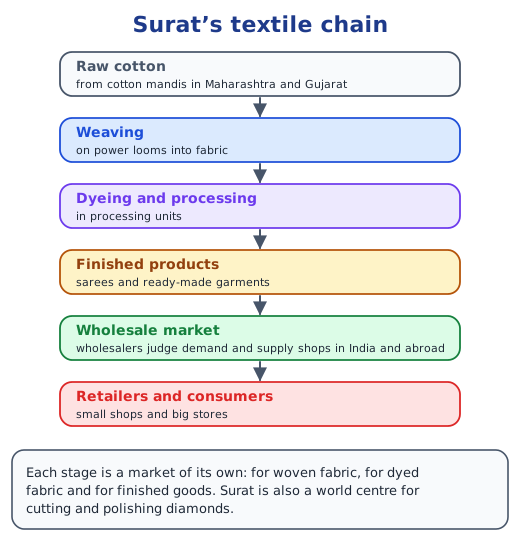
On the map (Fig. 12.24) the port, highway and railway lines run into the city. They helped Surat become a trading hub by bringing raw cotton and other inputs in cheaply and quickly, and by carrying textiles and diamonds out to the rest of India and, through the port, to other countries.
Think About It (page 263)
Life without markets: each family would have to grow or make almost everything it needs. If farmers stopped bringing rice, wheat, dal, vegetables and fruit to market, town dwellers would go hungry and farmers would earn nothing; if Surat’s cloth makers could not buy cotton, the looms would stop and workers would lose their jobs. Products without a ready market: original paintings, rare antiques, specialised machines and some handicrafts; with few buyers, sellers struggle to sell and to set a price, and buyers struggle to find them. Ways artists find buyers today: online marketplaces and their own websites, social media, exhibitions and galleries, art fairs, and orders from people who know their work.
Let’s Explore (page 263): energy-saving fridges
When many consumers ask for fridges that use less electricity, retailers order more of them from wholesalers and distributors, who order more from producers. Producers then design and make energy-saving models and buy inputs such as better compressors and insulation, so the whole network in Fig. 12.11 shifts towards these fridges.
Let’s Explore (page 265): customs in markets
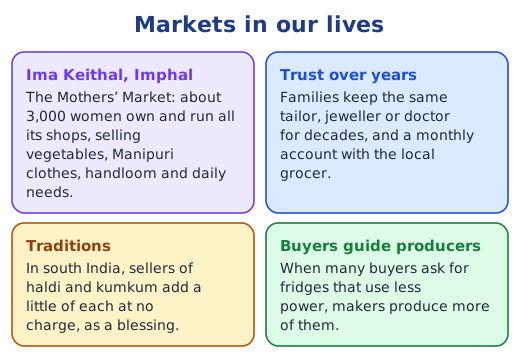
Samples: vegetable sellers adding a handful of coriander and green chillies at no charge; sweet shops giving regular customers a taste during festivals; a shopkeeper offering tea to a customer who has bought from the shop for years; and the first sale of the day being treated as auspicious.
Let’s Explore (page 266): onions
When supply comes down, the price of onions rises, because many buyers compete for fewer onions. If suppliers hold back onions, prices rise even more and families suffer. The government can release onions from its stocks, allow imports, limit how much traders may store to stop hoarding, act against hoarders, and sell onions at fair prices through its outlets.
Think About It (page 267)
The Arthashastra rule shows that protecting buyers is an old idea: ghee traders had to give one-fiftieth extra to make up for ghee sticking to the measure. Other areas where the government is involved (examples): railway fares, cooking-gas and fertiliser prices, electricity tariffs, banking rules, school fees in some states, and food grains sold through ration shops. Where it could do less (for discussion): paperwork and licences that slow down small shops and new businesses. Families’ views will differ.
Think About It (page 268): marbles
Qualities to look for: the right size and weight for the game, hard glass without cracks, a smooth and perfectly round shape that rolls straight, a good grip, attractive colours, and enough marbles within ₹150.
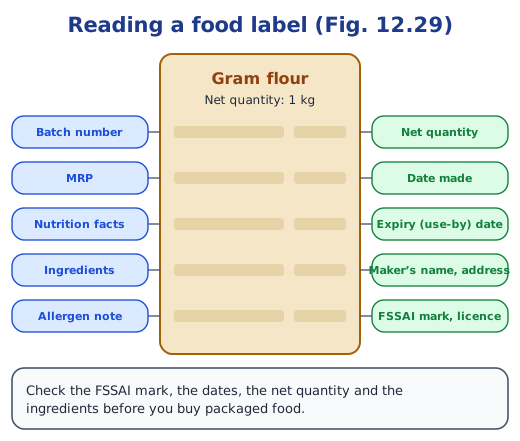
The gram flour packet: check the FSSAI mark and licence number, the date of manufacture and expiry date, the net quantity, the ingredients (pure gram flour), the allergen note, the MRP, the batch number and the maker’s name and address, and see that the packet is sealed.
Let’s Explore (page 269): BEE star labels
A sample chart, in increasing order of energy efficiency: an old television (2 stars), the air conditioner (3 stars), the refrigerator (4 stars), the ceiling fan (5 stars). Your chart will depend on the devices at home. Word of mouth (page 269): many families buy a mixer, phone or school bag because a friend or relative recommended it after using it.
Questions and activities (pages 271–272)
1. A market has buyers and sellers, goods or services, and a price both agree on, usually paid in money, at a physical place or online. On a recent visit (sample): at a vegetable market there were many sellers with carts and stalls, buyers comparing prices and bargaining, prices changing with freshness and the time of day, payment by cash and UPI, and wholesalers unloading sacks for the shops.
2. Adam Smith linked prosperity to markets that arise because people need goods and services they cannot make themselves. The chapter shows this: farmers sell grain and buy cloth; Surat’s weavers buy cotton and sell sarees across the world; Hampi Bazaar made Vijayanagara rich; and Ima Keithal supports thousands of families. Each person specialises, and markets let them exchange, so everyone is better off.
3. As the seller buys more guavas, the farmer will see demand rising and may raise the price. He will likely plan for the next season by planting more trees, caring for them better or growing better varieties. If many farmers do the same, supply will rise, and the price may come down again until it settles.
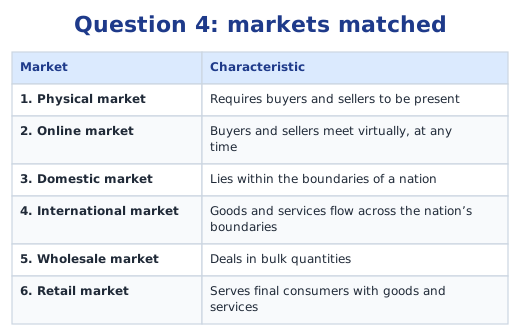
4. 1, physical market: requires buyers and sellers to be present. 2, online market: buyers and sellers deal virtually, at any hour. 3, domestic market: lies within the nation’s boundaries. 4, international market: goods and services flow across the nation’s boundaries. 5, wholesale market: deals in bulk quantities. 6, retail market: serves final consumers.
5. Luxury cars, designer handbags, original paintings, rare jewellery and medicines for rare diseases cost a lot even though few people buy them. Reasons: very limited supply, high costs of materials and skilled labour, long research for new medicines, brand value and exclusivity, and buyers who are willing to pay for rarity.
6. The family may have paid more for cleanliness and neat packing, the comfort and convenience of buying everything in one place, fixed prices without bargaining, trust in the store, or simply because the lady felt annoyed after the refusal. So, yes: hygiene, convenience, trust, time, comfort and feelings all affect buying and selling, not just price.
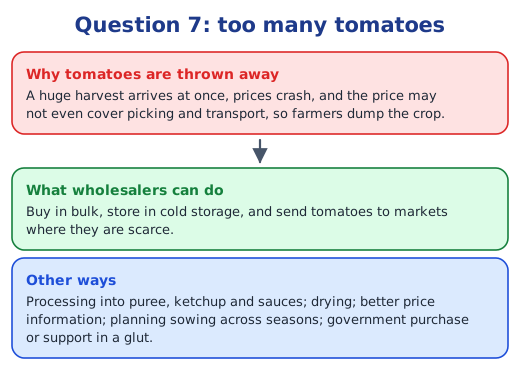
7. When a huge harvest reaches the market at once, supply far exceeds demand, prices crash, and the price may not even cover picking and transport, so farmers dump the crop. Wholesalers can buy in bulk, keep tomatoes in cold storage and send them to markets where they are scarce. Other ways: processing into puree, ketchup and sauces, drying, better price information, spreading sowing over seasons, and government purchase or support in a glut.
8. At a school carnival (sample), students run food stalls, games, craft and plant sales and a book swap. They fix prices on a chart, offer combo deals, give discounts near closing time, use coupons, and bargain politely with friends and parents; the money often goes to a cause chosen by the class.
9. Sample: packaged atta (FSSAI), an electric iron (ISI), honey (AGMARK), a ceiling fan (BEE stars) and a helmet (ISI). Products without a logo may include loose vegetables and fruit, handmade crafts and snacks from small local makers, because certification is not required for every product or small makers have not applied for it; some unmarked goods may also be fakes, so buyers should be careful.
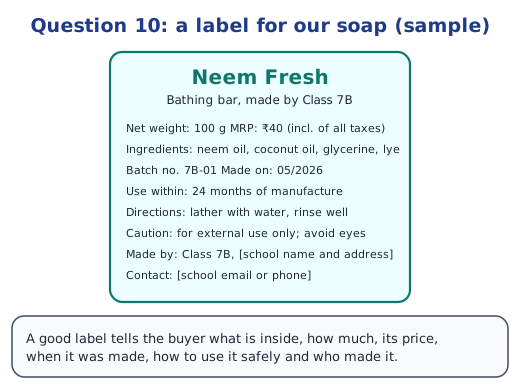
10. A soap label should give the product’s name and brand, net weight, MRP, ingredients, batch number, date of manufacture, a use-within date, directions for use, cautions such as ‘for external use only’, and the maker’s name, address and contact details.
Short notes and more practice are on the topic pages: types of markets, how markets set prices and role of government in markets.
Practice
-
A market where buyers and sellers meet virtually and can trade at any time is:
Show answer
Answer: (b) An online market
-
Which agency’s mark appears on packaged food?
Show answer
Answer: (c) FSSAI
-
Most of India’s imported palm oil comes from:
Show answer
Answer: (b) Malaysia, Indonesia and Thailand
-
Why might a family pay ₹40 a kg for beans at a super bazaar instead of ₹30 at a cart?
Show answer
Answer: For reasons beyond price: neat packing, cleanliness, convenience of buying everything in one place, fixed prices without bargaining, and perhaps after a disagreement with the cart seller.
-
What do more stars on a BEE label mean?
Show answer
Answer: That the appliance needs less power, which lowers the electricity bill and is better for the environment.
Stuck on a question?
Take a photo and Lagnever AI explains it step by step. Try it for 7 days for ₹2.
Get it on Google Play Open in browser
For parents: after the trial, the plan renews monthly by UPI or card autopay. You can cancel anytime in the app.