
How markets set prices
Answer in short
In a market, buyers and sellers bargain until they agree on a price; if they cannot agree, no sale happens. If a seller asks too much, buyers walk away; too little, and stock runs out at a loss. Over time, the quantity sellers offer and the quantity buyers want, supply and demand, settle a price that suits both.
Stuck on a question? Take a photo and Lagnever AI explains it step by step. Try it for 7 days for ₹2. Get it on Google Play
Buyers, sellers and price
Every market has buyers and sellers, and a sale happens only when both agree on a price: the sum a buyer will pay and a seller will accept. Often they negotiate, or bargain, to reach a price both accept, just as two classmates acting out a guava sale might do in a skit. In some markets, such as malls, supermarkets, chemists and online stores, prices are printed or fixed, so there is little bargaining.
The guava example
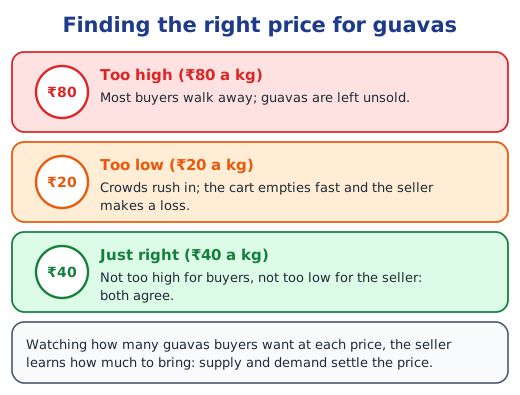
Imagine a seller who wants ₹80 a kg for guavas. A buyer who finds this too high offers a lower price; the seller may refuse an offer that brings no profit; and the two bargain until they meet, or no sale takes place. The book shows three cases. At ₹80, most buyers walk away and guavas are left unsold. At ₹20, crowds rush in, the cart empties fast and the seller makes a loss. Over time the price settles near ₹40, not too high for the buyer and not too low for the seller. From these cases the seller learns roughly how many guavas buyers want, and brings about that many next time.
Demand and supply
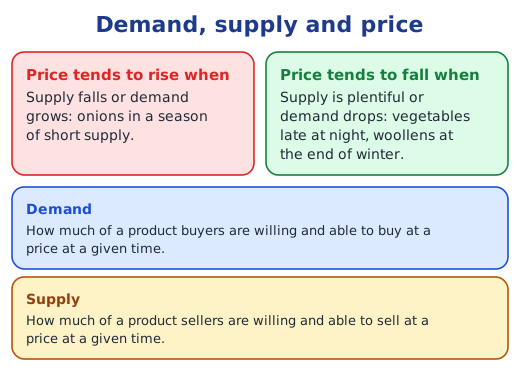
When there are many buyers and sellers, two forces settle the price. Demand is the quantity buyers are willing and able to buy at a price at a given time; supply is the quantity sellers are willing and able to sell. Together, the amount offered and the amount wanted fix a price high enough for sellers and low enough for buyers. That is why vegetables get cheaper late at night, when sellers want to clear stock that will spoil, and why woollens are discounted at the end of winter, when few people want them. When the supply of onions falls in some seasons, their price rises; if sellers hold back stock, the government may have to act, as described in role of government in markets.
When there is no ready market
Some products have few buyers and sellers. Aakriti, a professional artist, paints in oils on canvas; people admire her work, but she struggles to find buyers and to decide what price to ask. Unlike guavas, artwork has few local buyers and sellers, so its price is hard to judge. Today artists can reach buyers through online stores, social media, exhibitions and art fairs, and by taking orders directly.
More than buying and selling
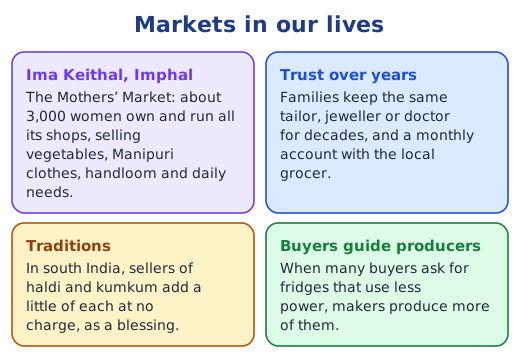
Markets also carry signals. When many consumers ask for refrigerators that use less electricity, retailers and wholesalers order more of them, and producers start making energy-saving models, which benefits society too. Markets build trust as well: families keep the same tailor, jeweller or doctor for decades, and many settle a monthly account with the local grocer. Ima Keithal, the Mothers’ Market of Imphal, where about 3,000 women own and run every shop, gives thousands of families an income and brings people of different communities together. In south India, sellers of haldi and kumkum add a little of each at no charge, as a sign of good wishes.
Why it matters
Understanding how prices form helps us shop wisely, bargain fairly and see why prices change with the seasons. The kinds of markets are in types of markets, and the government’s part in role of government in markets. Answers to every question are in the NCERT solutions for Chapter 12; see also the full Chapter 12 notes.
Practice
-
At ₹80 a kg in the guava example, what happens?
Show answer
Answer: (b) Most buyers walk away
-
Woollens are sold at a discount at the end of winter mainly because:
Show answer
Answer: (b) demand for them falls
-
Where is bargaining least common?
Show answer
Answer: (c) A mall with printed prices
-
Why are vegetables cheaper late at night at a weekly market?
Show answer
Answer: Vegetables spoil quickly and the seller wants to sell them before packing up, while fewer buyers remain, so the seller lowers the price to clear the stock.
-
How do buyers’ choices change what producers make?
Show answer
Answer: When many buyers ask for something, such as fridges that use less electricity, retailers and wholesalers order more of it and producers make more of it, which can also benefit society.
Questions students ask
What is price?
Price is the sum of money at which a buyer agrees to buy, and a seller agrees to sell, a particular good or service. A transaction is completed only when the two agree on it, often after bargaining.
How do demand and supply affect prices?
Demand is how much buyers are willing and able to buy at a price; supply is how much sellers are willing and able to sell. When supply falls or demand rises, as with onions in a short season, prices tend to rise; when supply is plentiful or demand drops, prices tend to fall.
Why do some products not have a ready market?
Some goods, such as an artist’s oil paintings, have few local buyers and sellers, so it is hard to find buyers or to know what price to ask. Artists today reach buyers through online shops, social media, exhibitions and art fairs.
Stuck on a question?
Take a photo and Lagnever AI explains it step by step. Try it for 7 days for ₹2.
Get it on Google Play Open in browser
For parents: after the trial, the plan renews monthly by UPI or card autopay. You can cancel anytime in the app.