
Role of government in markets
Answer in short
The government steps in where markets alone may not work well. It sets maximum prices for essentials like lifesaving drugs, minimum prices for crops like wheat, and minimum wages; ensures quality and safety; limits harm such as plastic pollution; checks weights and measures; and provides public goods. Marks such as FSSAI, ISI, AGMARK and BEE stars help consumers judge quality.
Stuck on a question? Take a photo and Lagnever AI explains it step by step. Try it for 7 days for ₹2. Get it on Google Play
Why the government steps in
Markets work through demand from buyers and supply from sellers, but sometimes this does not work well. So the government watches how consumers and producers deal with each other and helps keep prices fair.
Controlling prices
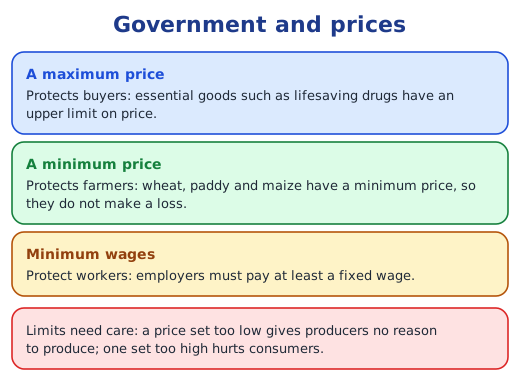
The government fixes the price of some goods. To protect buyers, it sets a maximum price for a number of essentials, such as lifesaving medicines. To protect farmers from losses, it sets a minimum price at which essential crops such as wheat, paddy and maize can be sold, and it sets minimum wages so that employers pay workers fairly. Such limits need care: a price that is too low leaves producers no reason to produce, and one that is too high hurts consumers. When onions run short and prices shoot up, the government can, for example, release stocks it holds, allow imports and act against hoarding.
Quality, safety and fair measure
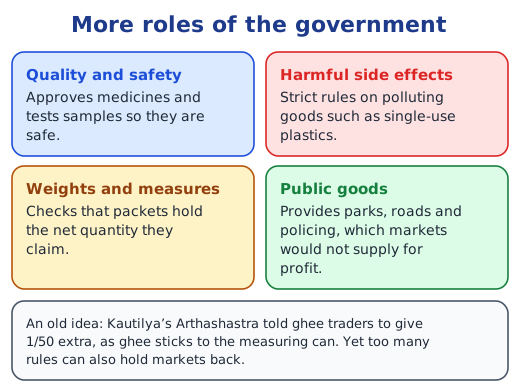
The government protects consumers from unfair practices by making manufacturers follow quality and safety standards. New medicines, for example, need official approval, and samples are tested to check that each drug meets quality standards and is safe. Some markets also cause harm beyond the buying and selling, such as single-use plastics that pollute and endanger health, so the government makes strict rules to limit such effects. It also checks weights and measures, so that a packet holds the net quantity it claims. The idea is old: Kautilya’s Arthashastra told ghee traders to give buyers one-fiftieth extra, called manasrava, because some ghee sticks to the measuring can. Yet too many rules can also make it hard for markets to work.
Public goods
Producers make and sell things for profit, but some goods and services, such as public parks, roads and policing, would not be supplied that way. The government provides these public goods, which are open to all and whose use today does not reduce what is left for the future, along with welfare provisions that citizens have a right to.
How consumers judge quality
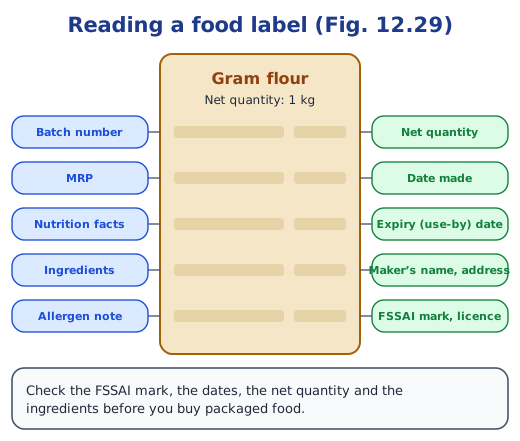
Consumers must judge quality too. Buying marbles for a match with ₹150, you might think about price, size, strength and colour. On a packet of gram flour, the label shows the batch number, MRP, net quantity, dates of manufacture and expiry, nutrition facts, ingredients, an allergen note, the maker’s name and address, and the FSSAI mark with a licence number.
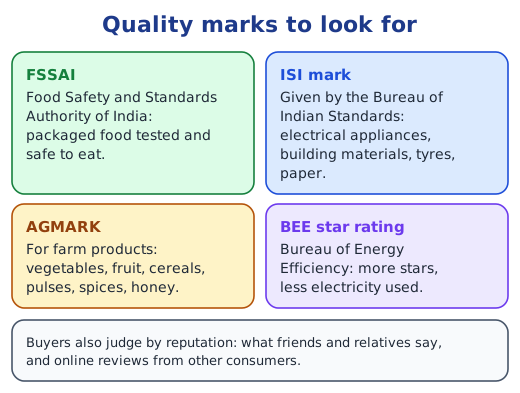
Government agencies certify that products meet minimum standards. The FSSAI (Food Safety and Standards Authority of India) mark shows that food has been tested and is safe to eat. The ISI mark, from the Bureau of Indian Standards, appears on electrical appliances, building materials, tyres and paper. AGMARK certifies farm products such as vegetables, fruit, cereals, pulses, spices and honey. On the BEE star rating of the Bureau of Energy Efficiency, more stars mean less electricity used, which saves money and helps the environment. Buyers also go by reputation, through word of mouth from friends and relatives, and by online reviews.
Why it matters
The government’s rules and the quality marks protect our health and our money, but they work only if we, as consumers, read labels and choose with care. How prices form is in how markets set prices, and the kinds of markets in types of markets. Answers to every question are in the NCERT solutions for Chapter 12; see also the full Chapter 12 notes.
Practice
-
Which of these has an upper limit on its price?
Show answer
Answer: (b) Lifesaving drugs
-
The ISI mark is given by the:
Show answer
Answer: (b) Bureau of Indian Standards
-
AGMARK is found on:
Show answer
Answer: (b) Farm products like honey and spices
-
Why does the government provide public goods?
Show answer
Answer: Because producers would not supply goods such as public parks, roads and policing for profit, yet everyone needs them, and using them today does not reduce what is available for the future.
-
Name four things to check on a packet of gram flour.
Show answer
Answer: Any four: the FSSAI mark and licence number, net quantity, date of manufacture, expiry date, ingredients, allergen note, MRP, batch number, and the maker’s name and address.
Questions students ask
What is the role of the government in markets?
It controls some prices, such as maximum prices for lifesaving drugs and minimum prices for wheat, paddy and maize; sets minimum wages; makes sure goods meet quality and safety standards; limits harmful effects such as pollution from single-use plastics; checks weights and measures; and provides public goods such as parks, roads and policing.
What do FSSAI, ISI, AGMARK and BEE stars mean?
The FSSAI (Food Safety and Standards Authority of India) mark shows food has been tested and is safe to eat. The ISI mark of the Bureau of Indian Standards appears on appliances, building materials, tyres and paper. AGMARK certifies farm products. The BEE star rating shows energy efficiency: more stars, less electricity used.
Did rulers protect consumers in ancient India?
Yes. Kautilya’s Arthashastra told traders in ghee to give buyers one-fiftieth extra, called manasrava, to make up for the ghee that sticks to the measuring can, so that buyers were not cheated.
Stuck on a question?
Take a photo and Lagnever AI explains it step by step. Try it for 7 days for ₹2.
Get it on Google Play Open in browser
For parents: after the trial, the plan renews monthly by UPI or card autopay. You can cancel anytime in the app.