
Types of markets
Answer in short
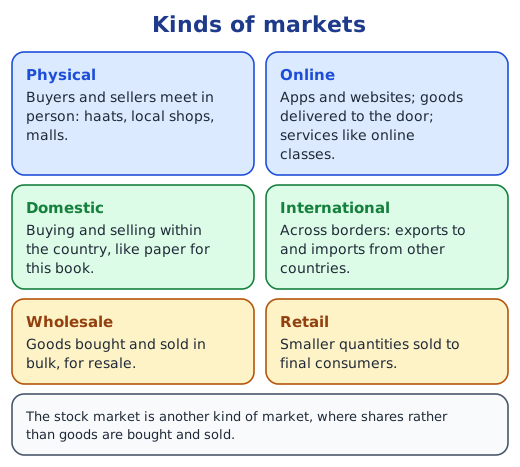
Markets are of many types. Physical markets need buyers and sellers to meet, while online markets work through apps and websites. Domestic markets trade within a country and international markets across borders, through exports and imports. Wholesale markets deal in bulk for resale, and retail markets sell smaller quantities to final consumers.
Stuck on a question? Take a photo and Lagnever AI explains it step by step. Try it for 7 days for ₹2. Get it on Google Play
What is a market?
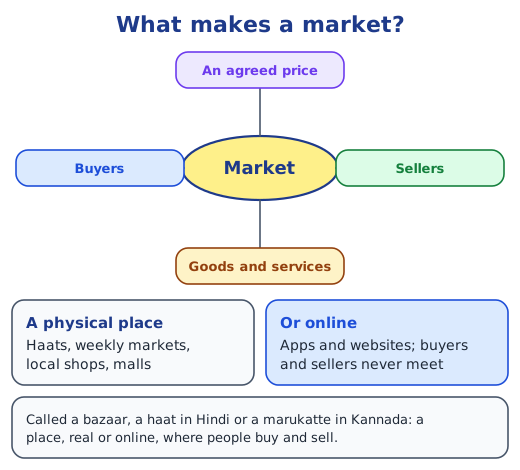
A market is wherever people come together to buy and sell goods. It may be called a bazaar, a haat in Hindi or a marukatte in Kannada, and it can be a physical place or, more and more, online. Through markets, individuals, households and businesses get the goods and services they need and want. Needs are things we must have to stay alive, like food, water, shelter and clothes; wants are things we would like but can do without. Markets also connect people, traditions and ideas.
Hampi Bazaar
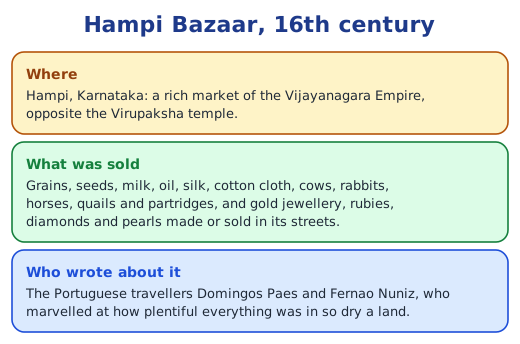
In the 16th century, Hampi Bazaar in Karnataka, opposite the Virupaksha temple, was one of the richest markets of the Vijayanagara Empire, a centre of booming trade. Foreign visitors were amazed. The Portuguese traveller Domingos Paes praised Hampi as the most plentifully supplied city in the world, with grains, seeds, milk, oil, silk, cows, rabbits, horses, quails and partridges on sale. Another Portuguese visitor, Fernao Nuniz, wrote of craftsmen at work in the streets, of jewels, rubies, diamonds and pearls, cotton cloth and heaps of grass and straw, and wondered how so dry a land could hold so much.
Physical and online markets
In a physical market, buyers meet sellers in person and pay for goods or services: weekly markets and haats with vendors and carts, local markets with shops and street-food stalls, and malls. In an online market, buyers and sellers need not meet and may be thousands of kilometres apart, trading through apps or websites. People order books, clothes, furniture, groceries and electronics for delivery to the door, manufacturers buy components as inputs, and services such as online classes are bought and paid for online. Some services, such as tailoring, still need a physical market. The stock market, where shares rather than goods are traded, is another kind, explained in shares and the stock market.
Domestic and international markets
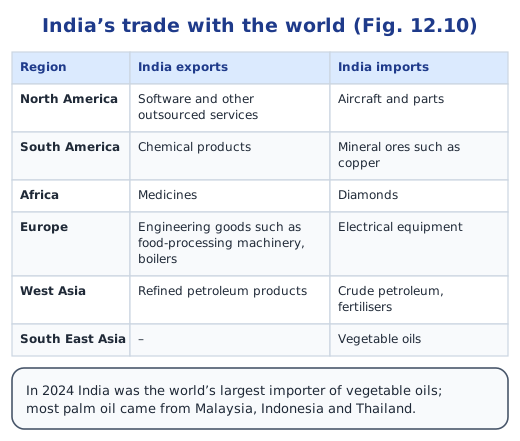
A domestic market is one where buying and selling happen within the country, like the paper for this textbook, bought from paper mills across India. An international market lies beyond a nation’s borders: sellers export their products to other countries, and buyers import goods made abroad. Fig. 12.10 shows India sending software and other services to North America, chemicals to South America, medicines to Africa, engineering goods to Europe and refined petroleum to West Asia, and buying aircraft, copper ore, diamonds, electrical equipment, crude petroleum, fertilisers and vegetable oils. In 2024 India imported more vegetable oil than any other country, most of its palm oil coming from Malaysia, Indonesia and Thailand.
Wholesale and retail
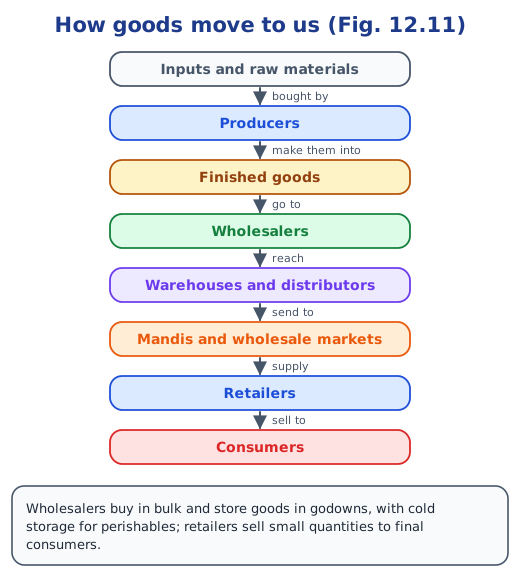
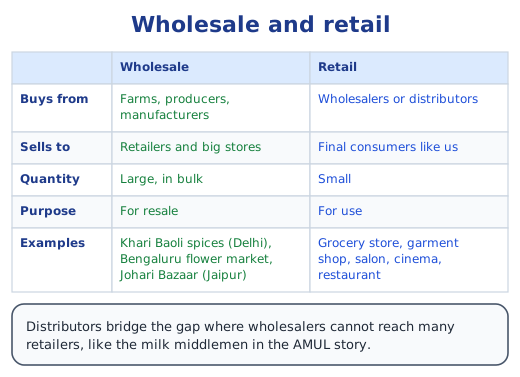
In physical markets, wholesalers buy goods in bulk from producers, such as grain, vegetables and fruit straight from farms, and keep them in large warehouses called godowns, with cold storage for perishables, before bringing them to markets called mandis. There are wholesale markets for spices and dry fruits (Khari Baoli, Old Delhi), flowers (Bengaluru), gems and jewellery (Johari Bazaar, Jaipur), and for chemicals, electronics and building materials. Wholesalers supply retailers, the shops near our homes, which sell smaller quantities to final consumers; salons, cinemas and restaurants are retailers of services. Where distance or terrain makes many retailers hard to reach, distributors fill the gap. Online, manufacturers send stock to the warehouse of an aggregator, which takes orders, packs the goods and delivers them.
Surat: a chain of markets
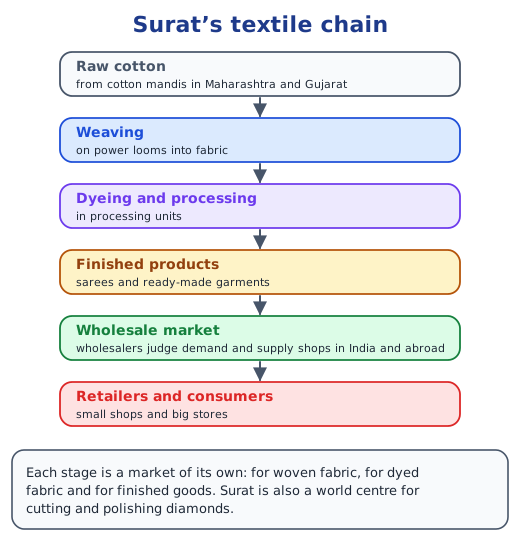
Surat in Gujarat, which the chapter calls Asia’s oldest textile market, shows a supply chain at work. Raw cotton arrives from cotton mandis in Maharashtra and other parts of Gujarat, and thousands of units weave it on power looms, dye and process it, and make it into sarees and ready-made garments, each stage with its own market. Wholesalers then judge how much retailers need and supply shops across India and abroad, keeping the flow steady. Surat also has the world’s largest diamond industry, where about 15 lakh artisans cut and polish diamonds, and its west-coast ports, roads and railways have helped it trade since the 16th century.
Why it matters
Knowing the kinds of markets, and the chain behind every product, helps us see how a sari from Surat or a bag of rice reaches our homes and why each link adds to the price. How prices are decided is in how markets set prices, and the government’s part in role of government in markets. Answers to every question are in the NCERT solutions for Chapter 12; see also the full Chapter 12 notes.
Practice
-
Hampi Bazaar was a market of which empire?
Show answer
Answer: (b) Vijayanagara
-
Selling goods to a buyer in another country is called:
Show answer
Answer: (b) Export
-
Johari Bazaar in Jaipur is a market for:
Show answer
Answer: (c) Gems and jewellery
-
What does an aggregator do?
Show answer
Answer: It is a website or app that brings together offers from many sellers. Manufacturers send stock to its warehouse, consumers order online, and it packs and delivers the product.
-
Why are distributors needed?
Show answer
Answer: Because wholesalers may find it hard to reach many retailers spread over long distances or difficult terrain; distributors carry goods from manufacturers and wholesalers to those retailers.
Questions students ask
What are the different types of markets?
Markets can be physical, where buyers and sellers meet, or online, through apps and websites; domestic, within a country, or international, across borders; and wholesale, dealing in bulk for resale, or retail, selling smaller quantities to final consumers. The stock market, where shares are traded, is another kind.
What is the difference between wholesale and retail markets?
A wholesale market deals in large quantities: wholesalers buy from farms and manufacturers and sell to retailers for resale, as at the Khari Baoli spice market in Delhi. A retail market sells small quantities to final consumers, as in grocery stores, garment shops and salons.
Why is Surat famous as a market?
Surat in Gujarat is a textile hub, which the chapter calls Asia’s oldest textile market. Raw cotton from Maharashtra and Gujarat is woven, dyed and made into sarees and garments in thousands of units, and wholesalers send them across India and abroad. Surat also has a huge diamond-cutting and polishing industry.
Stuck on a question?
Take a photo and Lagnever AI explains it step by step. Try it for 7 days for ₹2.
Get it on Google Play Open in browser
For parents: after the trial, the plan renews monthly by UPI or card autopay. You can cancel anytime in the app.