
The varna–jati system
Answer in short
The varna–jati system was the two-fold way Indian society was organised. A jati was a community tied to an occupation, with skills passed down the generations. Varna, a concept from the Vedic texts, named four groups: Brahmins, Kshatriyas, Vaishyas and Shudras. The system was more flexible early on and later grew rigid, causing inequality and discrimination.
Stuck on a question? Take a photo and Lagnever AI explains it step by step. Try it for 7 days for ₹2. Get it on Google Play
Why societies form groups
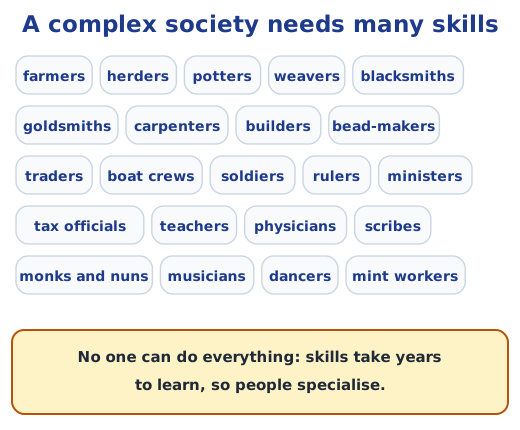
As a civilisation grows, its society becomes more complex, and it begins to organise itself into groups based on class, occupation or other criteria. A city of the 1st millennium BCE needed people for governance and administration, religion and education, trade and town-planning, farming, crafts and the arts. No one can learn every skill, and many take years to master, so people specialise, and those who share a skill tend to form a group that trains the next generation.
Harmony or inequality?
In an ideal society, all these groups would support one another and work in harmony. In practice, divisions often bring inequality: some groups gain more wealth, power or influence than others. People have long dreamed of equality, yet hardly any society, perhaps none, has ever fully reached it.
Jati: community and occupation
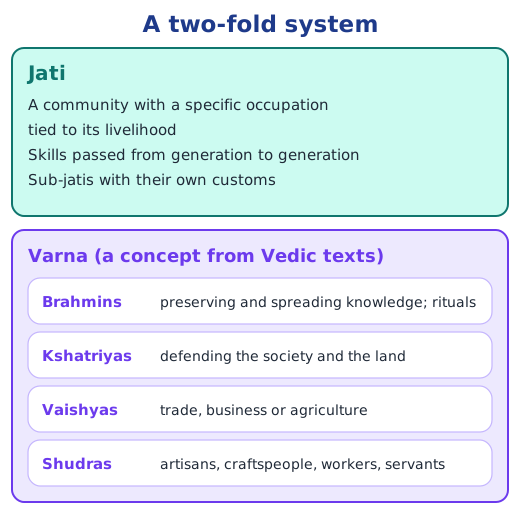
Indian society had a two-fold structure. Its first part was the jati: a community whose members shared a particular occupation, one bound up with how they earned a living. The skills that marked out a jati, in farming, metalwork, trade or a craft, usually passed from parents to children. A jati was often further divided into sub-jatis, and each developed its own customs and traditions, for instance about marriage, rituals or food habits.
Varna: four groups from the Vedic texts
The second part was varna, a concept that emerged from the Vedic texts. It described four varnas. Brahmins were to keep knowledge alive, pass it on and perform rituals. Kshatriyas were meant to protect society and its territory, going to war when necessary. Vaishyas were to increase the society’s wealth through trade, business or agriculture. Shudras made up the artisans and craftspeople, as well as labourers and servants.
Where the word ‘caste’ comes from
The English word caste comes from the Portuguese word casta. Portuguese travellers who came to India in the 16th century CE used it while trying to make sense of Indian society. Scholars still use it in different ways: a few apply it to the varnas, most to the jatis, and some to the whole varna–jati system.
Flexible at first, rigid later
Historical evidence, from both texts and inscriptions, shows that in the early period individuals and whole communities changed occupations when circumstances demanded. A long drought or a natural disaster might push a farming community to move to a city and find new work, and some Brahmins took up trade or even military service. This complex system gave society a structure and organised its work, the economy included, which lent it some stability.
Later, though, the system hardened. It led to inequalities and to discrimination against the lower jatis and against communities left outside the varna–jati system, a process studied in higher classes. Scholars broadly agree that the system was more flexible in earlier periods and grew more rigid over time, especially during British rule. It was an important mechanism in Indian society, but not the only one; others are explored in later chapters.
Why it matters
The varna–jati system has deeply shaped Indian society, and understanding how it began and changed helps us think about equality today. The cities and states of this age are described in the mahajanapadas and the Second Urbanisation. Answers to every question, including the Let’s Explore on professions, are in the NCERT solutions for Chapter 4; see all of the Chapter 4 notes.
Practice
-
From which language does the English word ‘caste’ come?
Show answer
Answer: (b) Portuguese
-
According to the Vedic texts, which varna was meant to protect society and its land?
Show answer
Answer: (b) Kshatriyas
-
What is a sub-jati?
Show answer
Answer: (a) A smaller division of a jati, with its own customs
-
Why does a complex society divide itself into groups?
Show answer
Answer: No one can master every skill, and many skills take years to learn, so people specialise in ruling, farming, crafts, trade, teaching and so on. Groups that share a skill pass it on and work together, and the society needs all of them.
-
Give one example from the chapter showing that the system was flexible in early times.
Show answer
Answer: After a long drought or some other disaster, a farming community might have to leave for a city and find new work; some Brahmins also took up trade or even soldiering.
Questions students ask
What is the difference between varna and jati?
A jati was a community of people with a specific occupation tied to their livelihood, such as farming, metalwork, trade or a craft, and it was often divided into sub-jatis with their own customs. Varna was a concept from the Vedic texts that described four groups by their role: Brahmins, Kshatriyas, Vaishyas and Shudras.
Where does the word caste come from?
It comes from the Portuguese word casta, used by Portuguese travellers in the 16th century CE as they tried to make sense of Indian society. Scholars use it in different ways: a few take caste to mean varna, most take it to mean jati, and others apply it to the whole varna–jati system.
Did the varna–jati system always stay the same?
No. Texts and inscriptions show that in the early period people and communities changed occupations when circumstances demanded. Scholars broadly agree that the system was more flexible in earlier times and grew more rigid later, especially under British rule, leading to inequality and discrimination against the lower jatis and excluded communities.
Stuck on a question?
Take a photo and Lagnever AI explains it step by step. Try it for 7 days for ₹2.
Get it on Google Play Open in browser
For parents: after the trial, the plan renews monthly by UPI or card autopay. You can cancel anytime in the app.