
NCERT Solutions Class 7 Social Science Chapter 4: New Beginnings: Cities and States
Answers to every question in Chapter 4, New Beginnings: Cities and States, of Exploring Society: India and Beyond Grade 7 Part 1 (Reprint 2026-27): the Big Questions, every Let’s Explore and Think About It, and all four questions and activities. Page numbers follow the book (pages 67–81). Answers that ask for your own views are given as samples to adapt. Short notes: Chapter 4 notes.
The Big Questions (page 67)
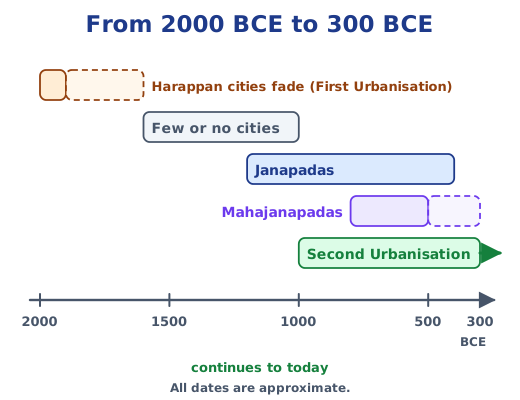
1. What is meant by ‘Second Urbanisation of India’? It is the second great phase of city life in India. The first, the Harappan (Indus or Sindhu-Sarasvati) civilisation, broke up in the early 2nd millennium BCE, and for about a thousand years there were hardly any cities. In the 1st millennium BCE new cities rose in the Ganga plains, in some areas of the Indus basin and nearby regions and slowly spread across the Subcontinent. Because city life has continued without a break since then, this phase still goes on today.
2. Why were the janapadas and mahajanapadas an important development in India’s early history? They were the first organised states after the Harappan age. Their capitals became fortified cities, many of which are still living cities, so they led the Second Urbanisation. They developed ways of governing with assemblies, including some of the world’s earliest republics. Their age brought iron tools and weapons, the first coins, long trade routes, and the spread of late Vedic, Buddhist and Jain ideas, and it prepared the ground for the empires that followed.
3. What kind of system of governance did they evolve? Each janapada had a raja who was expected to take advice from an assembly, the sabha or samiti, and, according to some texts, the assembly could remove an incompetent ruler. The mahajanapadas expanded these ideas in two ways. Some, such as Magadha, Kosala and Avanti, were in effect monarchies: the raja had the final say, usually inherited the post, and was helped by ministers and a council of elders. Others, at least Vajji and Malla, were ganas or sanghas: the assembly made the big decisions by discussion and, if needed, by vote, and even selected the raja. These are called early republics.
Think About It (page 70)
Why are so many mahajanapadas in the Ganga plains? The book suggests three reasons: the fertile soil of the Ganga plains let agriculture grow and support more people; iron ore was available in the mountains and hills nearby, for tools and weapons; and new trade networks were forming that connected the region. Rivers also made travel and trade by boat easier.
Let’s Explore (page 70)
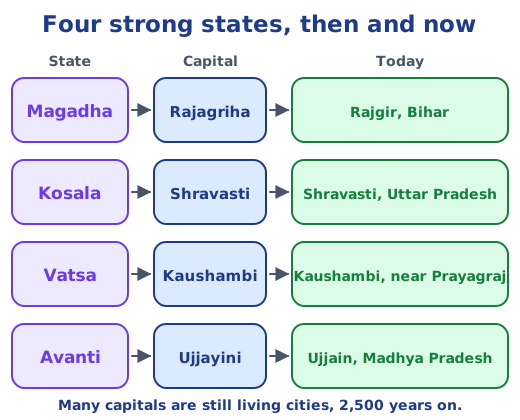
The four most powerful states and their capitals. Magadha’s capital was Rajagriha, today Rajgir in Bihar; Kosala’s was Shravasti, in Uttar Pradesh; Vatsa’s was Kaushambi, near Prayagraj; and Avanti’s was Ujjayini, today Ujjain in Madhya Pradesh. All four can be matched with places of today. (Extra: other capitals on the map also survive, such as Mathura, Vaishali, Champa near Bhagalpur, Kushinara, now Kushinagar, Indraprastha, within Delhi, and Takshashila, now Taxila in Pakistan.)
Names common to this map and the Grade 6 map of regions in the Mahabharata. Names found on both include Gandhara, Kosala, Magadha, Anga and Avanti; Kashi, shown on the Grade 6 map, is also in the usual list of 16, though this book’s map does not label it. Check your Grade 6 map for more: the Mahabharata story also features the Kurus, the Panchalas, Matsya and Chedi. This suggests that these regions and their peoples were well established and remembered over many centuries, and that the epic preserves memories of the lands that became the mahajanapadas.
Let’s Explore (page 74)
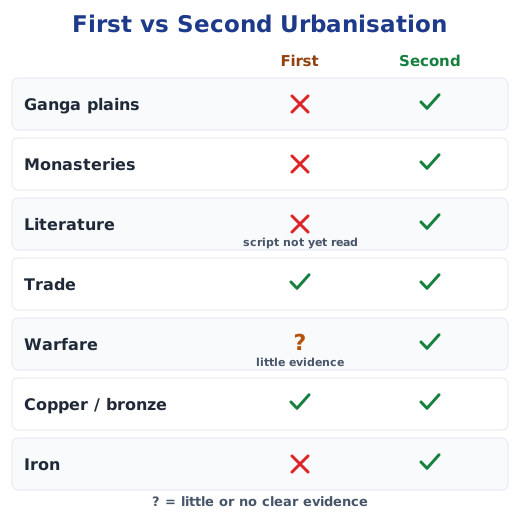
Comparing the First and Second Urbanisation.
- Ganga plains: First, No (the Harappan cities lay mainly in the Indus–Sarasvati region and Gujarat); Second, Yes.
- Monasteries: First, No; Second, Yes (Buddhist and Jain monks and nuns).
- Literature: First, No (they had writing, but no literature we can read); Second, Yes (late Vedic, Buddhist, Jain and, in the south, Tamil).
- Trade: Yes for both.
- Warfare: First, No clear evidence; Second, Yes (some evidence of wars between mahajanapadas).
- Copper or bronze: Yes for both.
- Iron: First, No; Second, Yes.
(Extra: a few late Harappan sites did reach the western edge of the Ganga–Yamuna region, but the Harappan cities were not in the Ganga plains.)
Let’s Explore (page 76)
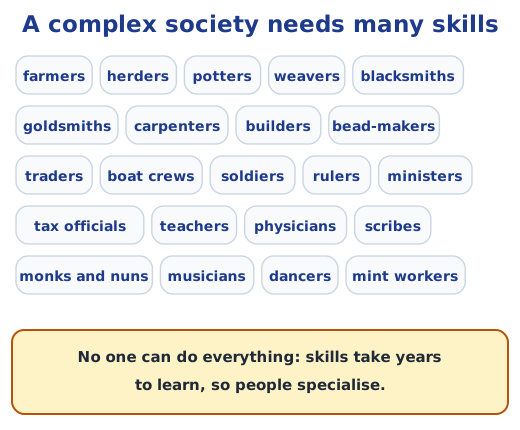
Why should a complex society divide itself into such groups? Possible factors: many skills take years to learn, so people specialise and do their work better; families and communities pass skills on to the young; groups depend on and exchange with one another, since farmers feed artisans and artisans make tools for farmers; a large city needs organisation, with people to govern, defend, trade and teach; extra food from farming lets some people do other work; and a group gives its members support and identity.
Other professions in a complex society of the 1st millennium BCE. Potters, weavers, dyers, blacksmiths, goldsmiths, coppersmiths, carpenters, builders, bead-makers, shell-workers and gem-cutters; traders, caravan leaders, boat crews and sailors; soldiers, charioteers, elephant keepers and gatekeepers; ministers, tax collectors and scribes; teachers, physicians, priests, monks and nuns; musicians, dancers, painters and sculptors; mint workers who made coins; herders, fishers and farmers.
Think About It (page 78)
Inequality and equality. A sample answer to adapt: Once, a classmate was left out of a team game because of where they lived; we talked to our teacher, and the next day everyone played together. I think equality is desirable, because every person deserves the same dignity and chances, talent can come from anyone, and a fair society is more peaceful. Initiatives that have lessened inequality include the Constitution of India, which gives everyone equality before the law and abolishes untouchability; school mid-day meals that children of all backgrounds share; and reformers such as Savitribai and Jyotirao Phule, who opened schools for girls and for children of every community.
Questions and activities (page 81)
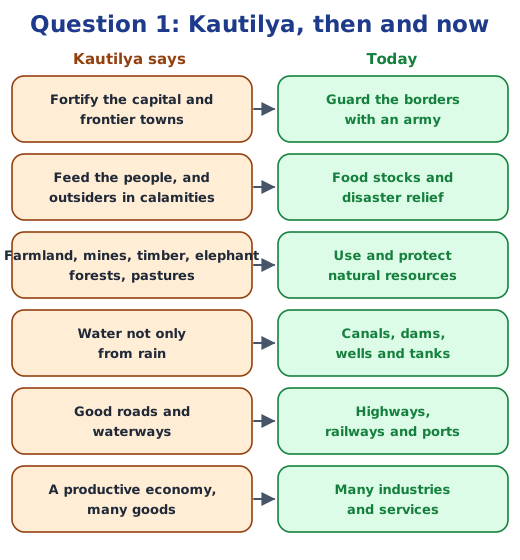
1. Kautilya’s advice: is it very different today? Kautilya says a kingdom should fortify its capital and frontier towns; produce enough food for its people and for outsiders in a calamity; have farmland, mines, timber and elephant forests and good pastures; not depend on rain alone for water; have good roads and waterways; and have a productive economy with many goods. Today a country guards its borders with armed forces; keeps grain stocks and sends disaster relief, even to other countries; uses and protects its natural resources; builds canals, dams, wells and tanks; lays highways and railways and develops ports; and builds industries and services. So the goals are much the same; the methods have changed, and modern states also aim at democracy, rights, education, health and protecting the environment.
2. According to the text, how were rulers chosen in early Vedic society? The text shows that a raja was not meant to rule alone or arbitrarily. Each clan had an assembly, the sabha or samiti (words that first appear in the Vedas), mostly of elders, whose advice a good ruler was expected to take, and according to some texts it could remove an incompetent ruler. In the monarchies the post was usually hereditary, passing to the son of the previous raja. But in the gana or sangha states, Vajji and Malla, the assembly itself selected the raja, after discussion and, if needed, a vote.
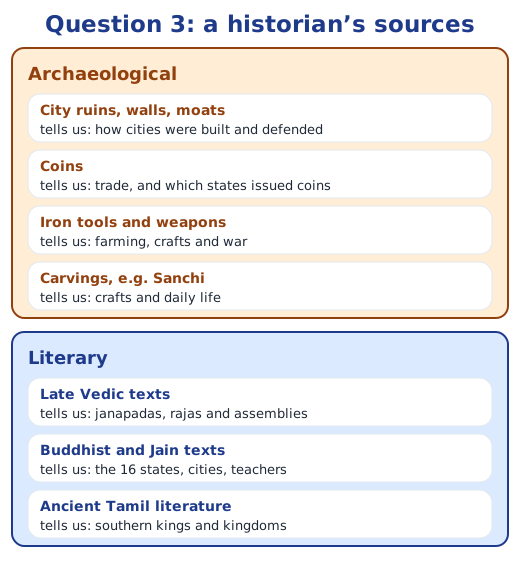
3. Sources for a historian of the mahajanapadas.
- Archaeological sources: ruins of cities such as Rajgir and Kaushambi show their size and buildings; walls, moats and gateways, as at Shishupalgarh, show how cities were defended; punch-marked coins show trade and which states issued money; iron tools and weapons show farming, crafts and war; workshop remains such as the shell and gem industries at Kodumanal show crafts; and carvings like the later Sanchi panel of a smithy show how people worked.
- Literary sources: late Vedic texts describe janapadas, rajas and assemblies; Buddhist and Jain texts list the 16 mahajanapadas and describe cities, rulers, republics and teachers; texts on statecraft such as Kautilya’s Arthashastra show ideas of how a kingdom should be run; and the most ancient Tamil literature names the southern kingdoms and their kings.
Each kind checks the other: excavations confirm cities that the texts describe, and texts tell us names, beliefs and events that objects cannot.
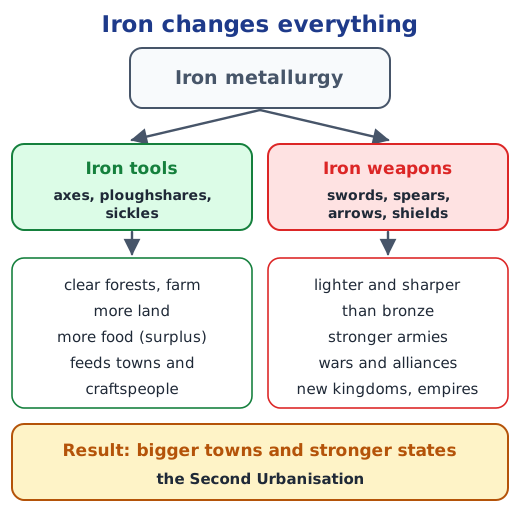
4. Why was iron metallurgy so important for the growth of cities? Iron axes and ploughshares let farmers clear forests and plough more land in the Ganga plains, so they grew extra food. That surplus could feed people who did not farm: craftspeople, traders, soldiers, officials and teachers living in towns. Iron tools also helped carpenters and builders. Iron weapons, lighter and sharper than bronze ones, made stronger armies that protected towns and trade routes and helped states grow. Iron ore in nearby hills helps explain why so many mahajanapadas grew in the Ganga plains, and smiths became a specialised craft group, as a carving at Sanchi shows. Imagine a village that gets its first iron plough: it grows more grain, sells some in the town, and buys pots, cloth and tools in return, and the town grows too.
For revision, see the Chapter 4 notes, or read the topics in detail: the mahajanapadas, the Second Urbanisation and the varna–jati system.
Practice
-
Which mahajanapada capital lay near today’s Prayagraj?
Show answer
Answer: (c) Kaushambi
-
In the gana or sangha states, who chose the raja?
Show answer
Answer: (b) The assembly
-
Which of these is literary evidence about the mahajanapadas?
Show answer
Answer: (b) Buddhist texts
-
Name the four most powerful mahajanapadas and their capitals.
Show answer
Answer: Magadha (Rajagriha, today Rajgir), Kosala (Shravasti), Vatsa (Kaushambi, near Prayagraj) and Avanti (Ujjayini, today Ujjain).
-
Write two differences between the First and the Second Urbanisation.
Show answer
Answer: The First, the Harappan civilisation, used copper and bronze but not iron, while the Second used iron. The Second was centred on the Ganga plains and left literature we can read, while the First lay mainly in the Indus–Sarasvati region and its script cannot yet be read.
Stuck on a question?
Take a photo and Lagnever AI explains it step by step. Try it for 7 days for ₹2.
Get it on Google Play Open in browser
For parents: after the trial, the plan renews monthly by UPI or card autopay. You can cancel anytime in the app.