
The Second Urbanisation
Answer in short
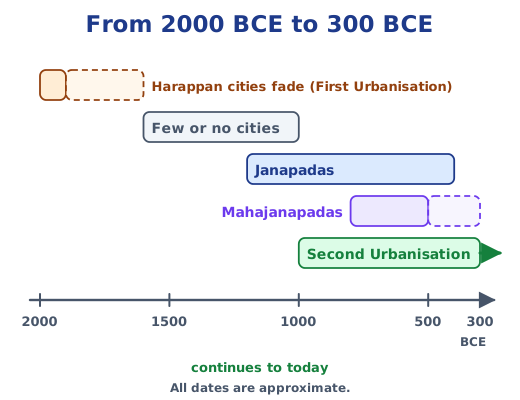
The Second Urbanisation is the new age of cities that began in India in the 1st millennium BCE, about a thousand years after the Harappan cities faded. It started in the Ganga plains, in some areas of the Indus basin and nearby regions, grew with iron tools, coins and trade routes, and spread across the Subcontinent. It continues today.
Stuck on a question? Take a photo and Lagnever AI explains it step by step. Try it for 7 days for ₹2. Get it on Google Play
When the first cities faded
India’s first cities belonged to the Harappan, or Indus, or Sindhu-Sarasvati, civilisation, which we call the First Urbanisation. In the early 2nd millennium BCE it broke up. Some cities were abandoned; in others people stayed but went back to village life, because the whole urban order had vanished: large public and private buildings, crowded streets and markets, specialised workers such as metalsmiths, potters and weavers, writing, sanitation, administration and a state with a ruling class. For about a millennium urban life was absent from India, apart perhaps from a few towns in the north.
A new age of cities
In the 1st millennium BCE, cities rose again, first in the Ganga plains, in some areas of the Indus (Sindhu) basin and the regions around them, and then, step by step, across the Subcontinent. This is India’s Second Urbanisation. It never stopped: the towns and cities we live in today continue it. Its rise went hand in hand with the janapadas and mahajanapadas, whose capitals became its first big cities.
How do we know?
Two kinds of sources tell us about these cities. Archaeology has excavated many of them, revealing walls, moats, gateways, coins and tools at sites such as Rajgir, Kaushambi and Shishupalgarh. Literature describes them: late Vedic, Buddhist and Jain texts are full of references to the new towns, and the most ancient Tamil literature names the southern kingdoms and their kings. One source confirms what the other says.
Iron changes everything
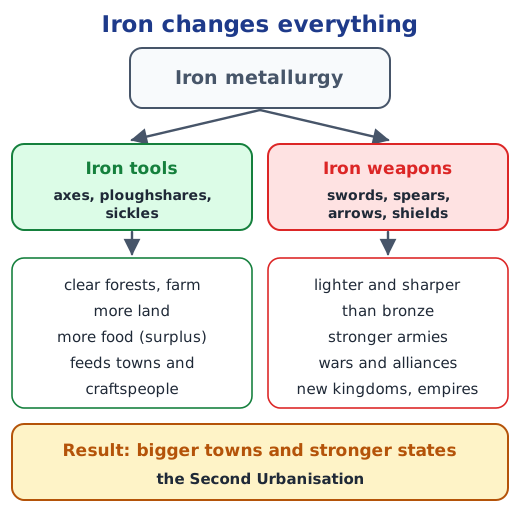
Urbanisation needs technology. The Harappans had mastered copper and bronze; the Second Urbanisation ran on iron. In several regions of India, people had perfected ways of extracting and shaping iron from the early 2nd millennium BCE, and by the end of that millennium iron tools were widespread. With iron axes and ploughs, farmers could clear forests and farm on a bigger scale, and the extra food could feed towns. For weapons too, iron beat bronze: iron swords, spears, arrows and shields were lighter and sharper. There is some evidence of wars between neighbouring mahajanapadas, though no one can tell how frequent they were, and wars as well as alliances later gave rise to new kingdoms and empires.
The first coins
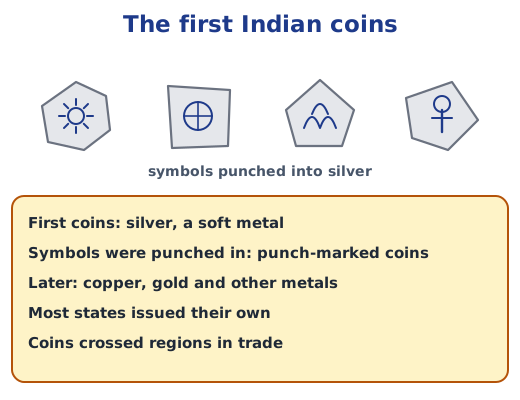
Growing trade needed money, so the first Indian coins appeared. They were pieces of silver, a metal soft enough for symbols to be stamped into it with punches, which is why we call them punch-marked coins. Copper, gold and other metals were used for coins later on. Each mahajanapada usually minted its own, yet people also used coins from nearby regions, and before long coins changed hands across regions and with lands abroad.
Two urban ages compared
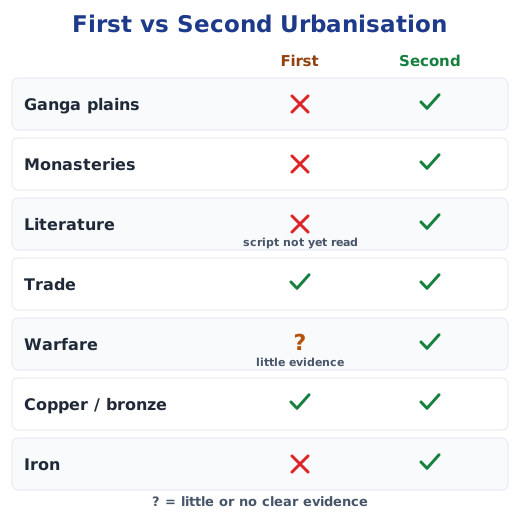
Comparing the two phases shows what was new. The Second Urbanisation was centred on the Ganga plains, had Buddhist and Jain monasteries, left literature we can read and used iron. Both phases traded and both used copper and bronze. There is little clear evidence of warfare in Harappan times, while the mahajanapadas fought one another.
Roads, ports and new regions
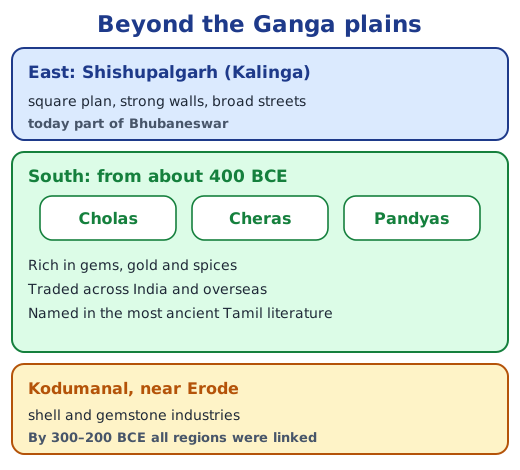
Routes opened for trade, pilgrimage and military campaigns. The Uttarapatha ran from the northwest across the Ganga plains to eastern India, and the Dakshinapatha went from Kaushambi over the Vindhya hills to the south. Side roads reached busy ports on both coasts. In the east, Shishupalgarh, the capital of Kalinga, had a strict square plan, massive walls and broad streets. In the south, cities arose from about 400 BCE, along with the Chola, Chera and Pandya kingdoms, which traded gems, gold and spices across India and overseas. Around 300 or 200 BCE, nearly the whole Subcontinent, the Northeast included, was linked.
Why it matters
The Second Urbanisation began the story of Indian cities that continues today. The states that led it are described in the mahajanapadas, and how its society was organised in the varna–jati system. Answers to every question, including the comparison table, are in the NCERT solutions for Chapter 4; see all of the Chapter 4 notes.
Practice
-
Which metal brought the big change in technology during the Second Urbanisation?
Show answer
Answer: (c) Iron
-
Why are the first Indian coins called punch-marked coins?
Show answer
Answer: (b) Symbols were punched into soft silver
-
Which city, capital of Kalinga, had a square plan and broad streets?
Show answer
Answer: (a) Shishupalgarh
-
How do we know that cities existed in the 1st millennium BCE?
Show answer
Answer: From excavations that have uncovered the remains of these cities, with their walls, moats, coins and tools, and from late Vedic, Buddhist and Jain texts, which often mention them.
-
Why did iron help cities grow?
Show answer
Answer: Iron tools let farmers clear and plough more land and grow extra food to feed towns and craftspeople. Iron weapons, lighter and sharper than bronze ones, made stronger armies, which helped states grow, protect trade and build bigger towns.
Questions students ask
What is meant by the Second Urbanisation of India?
It is the second phase of city life in India. The first, the Harappan civilisation, broke up in the early 2nd millennium BCE, and for about a thousand years there were hardly any cities. In the 1st millennium BCE new cities rose in the Ganga plains, in some areas of the Indus basin and nearby regions, and city life spread across the Subcontinent. It continues today.
How was the Second Urbanisation different from the First?
The First, the Harappan civilisation, was centred on the Indus and Sarasvati region, used copper and bronze, and left a script no one can yet read. The Second began in the Ganga plains, used iron, produced literature we can read, had Buddhist and Jain monasteries, and issued coins. Both had busy trade.
When did cities begin in south India?
In the southern regions, cities began to appear from about 400 BCE, though recent excavations claim signs of trade even earlier. Around this time three kingdoms arose: the Cholas, the Cheras and the Pandyas. Sites such as Kodumanal, near Erode in Tamil Nadu, had shell and gemstone industries.
Stuck on a question?
Take a photo and Lagnever AI explains it step by step. Try it for 7 days for ₹2.
Get it on Google Play Open in browser
For parents: after the trial, the plan renews monthly by UPI or card autopay. You can cancel anytime in the app.