
The mahajanapadas
Answer in short
The mahajanapadas were the large states of north and central India in the 1st millennium BCE. Clans first settled on territories called janapadas, each led by a raja; by the 8th or 7th century BCE some had merged into mahajanapadas. The usual list names 16, led by Magadha, Kosala, Vatsa and Avanti, with fortified capitals.
Stuck on a question? Take a photo and Lagnever AI explains it step by step. Try it for 7 days for ₹2. Get it on Google Play
From clans to janapadas
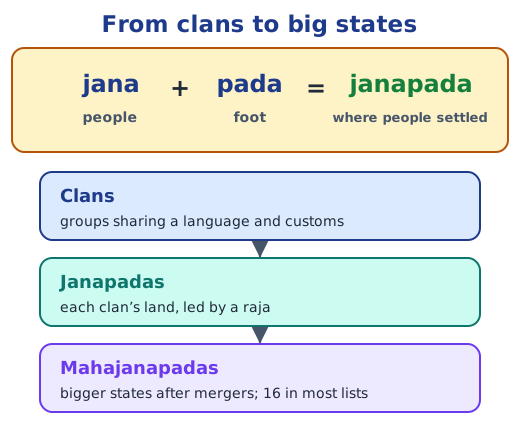
After the Harappan cities faded, the regional cultures of north India slowly reorganised themselves. Late in the 2nd millennium BCE, people formed clans, groups that probably shared a language and customs, and each clan became tied to a territory of its own, led by a raja, or ruler. Such a territory was a janapada. The Sanskrit word joins jana, people, and pada, foot: a janapada is where the people set foot, that is, where they settled down.
Sixteen great states
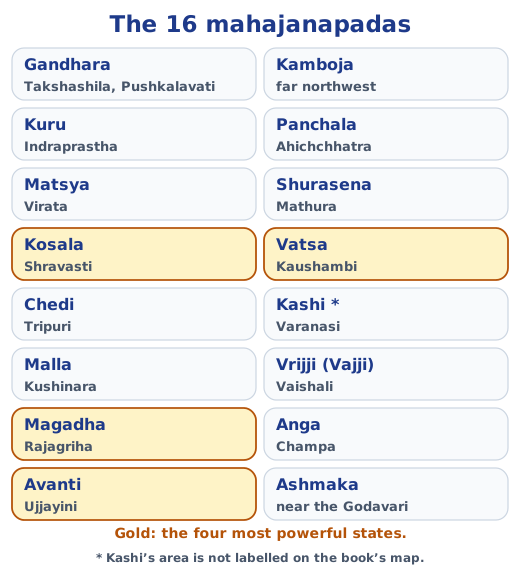
As trade networks spread and linked the janapadas, they grew. By the 8th or 7th century BCE some had merged, and the bigger states that resulted were called mahajanapadas. Ancient texts list them differently, but the most frequent list has 16: Anga (capital Champa), Magadha (Rajagriha), Kashi, Kosala (Shravasti), Vajji or Vrijji (Vaishali), Malla (Kushinara), Chedi, Vatsa (Kaushambi), Kuru (Indraprastha), Panchala (Ahichchhatra), Matsya (Virata), Shurasena (Mathura), Ashmaka, Avanti (Ujjayini), Gandhara (Takshashila and Pushkalavati) and Kamboja. They spread from Gandhara in the far northwest across to Anga in the east, and down to Ashmaka, near the Godavari in central India. A few more states may have existed, and some smaller janapadas carried on independently. (Extra: the book’s map does not label Kashi, the area around Varanasi.)
Why so many in the Ganga plains?
On the map, many mahajanapadas crowd into the Ganga plains. The book suggests three reasons. The fertile plains let agriculture grow and feed more people. Iron ore could be found in the mountains and hills nearby, and iron made better tools and weapons. And new trade networks were forming across the region, carrying goods between the states.
The four strongest states
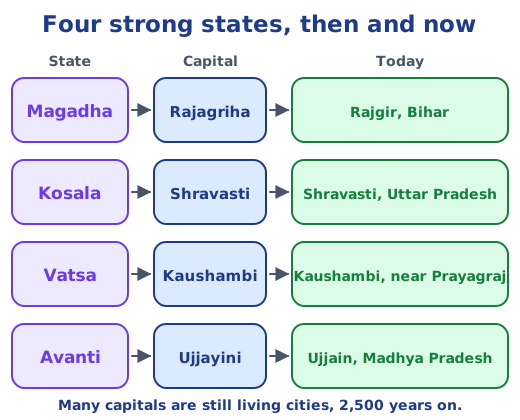
The most powerful mahajanapadas were Magadha, Kosala, Vatsa and Avanti. Their capitals still exist. Rajagriha, Magadha’s capital, is Rajgir in Bihar; Shravasti, the capital of Kosala, is in Uttar Pradesh; Kaushambi, Vatsa’s capital, is near Prayagraj; and Ujjayini, the capital of Avanti, is Ujjain in Madhya Pradesh. Ruins of a big building at Rajgir and of a complex at Kaushambi are pictured in the book.
Fortified capitals
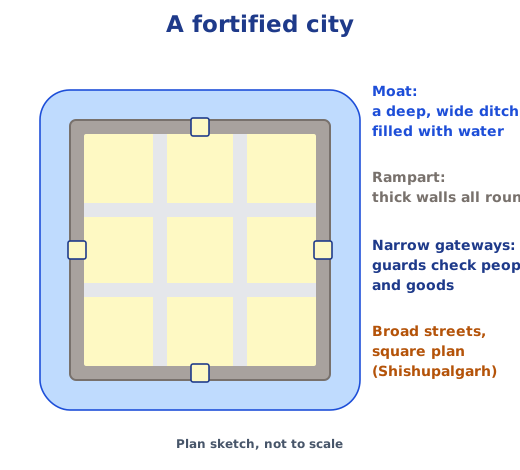
Most capitals were large cities with strong defences. A thick wall, the rampart, ran around the city, and outside it lay a moat, a deep, wide ditch filled with water. The gateways through the walls were deliberately kept narrow so that guards could check people and goods coming in or going out. At Shishupalgarh in Odisha, a gateway still shows this narrowing, with the moat outside. Remarkably, most of these ancient capitals are living cities today, often around 2,500 years old.
How they were ruled
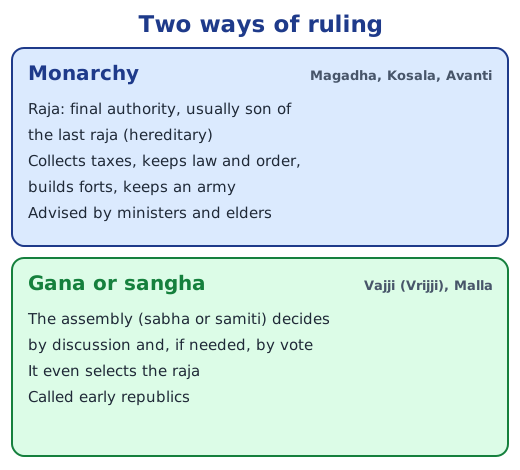
Every janapada had an assembly, the sabha or samiti, probably made up mostly of clan elders. A good raja was expected to take its advice, and according to some texts an assembly could even remove an incompetent ruler. The mahajanapadas built on these ideas in two ways. Some, such as Magadha, Kosala and Avanti, were in effect monarchies: the raja held final authority, and the post was usually hereditary. In Vajji and Malla, the assembly held more power, settled matters by discussion or vote, and selected the raja. These gana or sangha states are called early republics.
Why it matters
The mahajanapadas were the first organised states of their time, the 1st millennium BCE, and their cities carried India into its Second Urbanisation. How that new city life grew, with iron, coins and trade, is explained in the Second Urbanisation, and how society was organised in the varna–jati system. Answers to every question are in the NCERT solutions for Chapter 4; see all of the Chapter 4 notes.
Practice
-
Which city was the capital of Magadha?
Show answer
Answer: (b) Rajagriha
-
Why were the gateways in the city walls kept narrow?
Show answer
Answer: (b) So that guards could control the movement of people and goods
-
Which mahajanapada lay farthest to the northwest?
Show answer
Answer: (b) Gandhara
-
Give three reasons why so many mahajanapadas grew up in the Ganga plains.
Show answer
Answer: The fertile plains let farming grow; iron ore was available in the nearby hills and mountains; and new trade networks connected the region.
-
What did the raja of a monarchy such as Magadha do?
Show answer
Answer: The raja had the final say, helped by ministers and a council of elders, and usually inherited the post. The raja collected taxes, kept law and order, had the capital fortified and kept an army to defend the land or fight neighbours.
Questions students ask
What is the difference between a janapada and a mahajanapada?
A janapada was the territory of one clan, led by a raja; janapadas formed late in the 2nd millennium BCE. A mahajanapada, literally a great janapada, was a bigger state formed when some janapadas merged, by the 8th or 7th century BCE. A few smaller janapadas carried on independently beside them.
What were the 16 mahajanapadas?
The most common list names Anga, Magadha, Kashi, Kosala, Vajji (Vrijji), Malla, Chedi, Vatsa, Kuru, Panchala, Matsya, Shurasena, Ashmaka, Avanti, Gandhara and Kamboja. They stretched from Gandhara in the far northwest across to Anga in the east, and south to Ashmaka near the Godavari.
Which mahajanapadas were republics?
At least two: Vajji, also called Vrijji, and its neighbour Malla. In these gana or sangha states the assembly, the sabha or samiti, held more power. It decided important matters by discussion and, if needed, by vote, and even selected the raja, so scholars call them early republics.
Stuck on a question?
Take a photo and Lagnever AI explains it step by step. Try it for 7 days for ₹2.
Get it on Google Play Open in browser
For parents: after the trial, the plan renews monthly by UPI or card autopay. You can cancel anytime in the app.