
Class 7 Social Science Chapter 4: New Beginnings: Cities and States Notes
This chapter in five lines
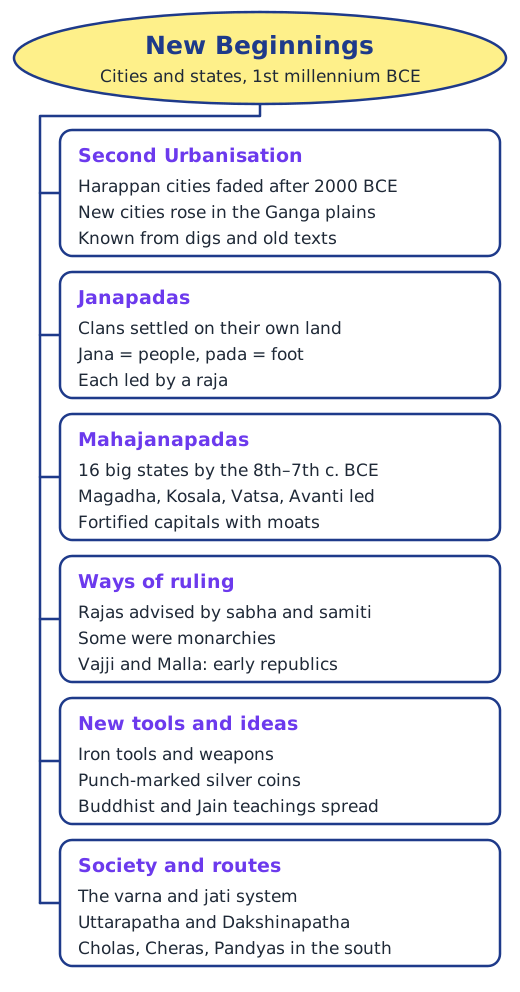
New Beginnings: Cities and States tells how, about a thousand years after the Harappan cities faded, a Second Urbanisation began in the 1st millennium BCE, centred on the Ganga plains. Clans settled as janapadas, and some merged into mahajanapadas with fortified capitals. Assemblies, early republics, iron tools, the first coins and the varna–jati system shaped this age.
What is this chapter about?
The chapter opens with advice from Kautilya’s Arthashastra, an ancient text on statecraft: a kingdom should fortify its capital and its frontier towns, feed its people and help outsiders in a calamity, use its farmland, mines, forests and pastures, not rely only on rain, keep good roads and waterways, and have a productive economy. That advice suits a world of cities and states, and this chapter tells how such a world took shape in India in the 1st millennium BCE. A photo of ruins at Rajagriha (today’s Rajgir in Bihar), once the capital of Magadha, shows what is left of it.
After the first cities
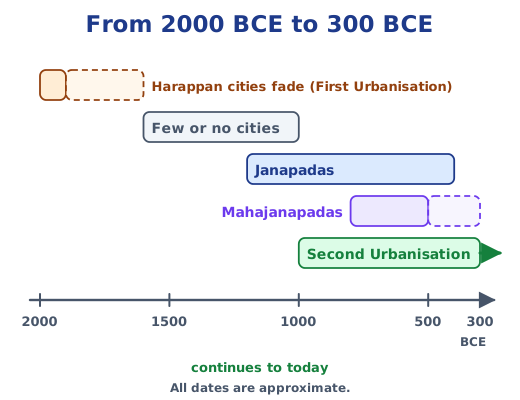
In the early 2nd millennium BCE the Harappan civilisation, which we call India’s First Urbanisation, broke up. People left some of its cities altogether; in others they stayed on but lived as villagers. Everything that makes a city had gone: grand buildings, busy streets and markets, specialised craftspeople, writing, drains, an administration and a state with rulers. For about a thousand years there were hardly any cities in India, though a few towns may have existed in the north, and regional cultures carried on.
The Second Urbanisation
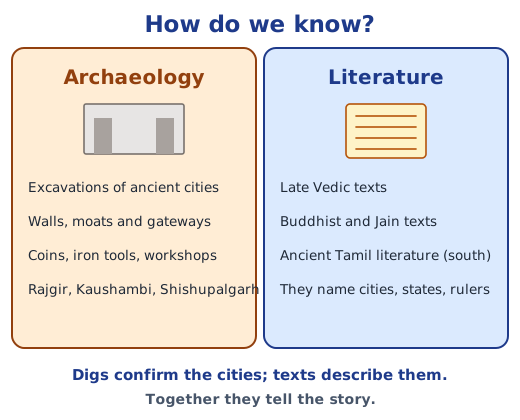
In the 1st millennium BCE, city life returned. It began in the Ganga plains, in some areas of the Indus (Sindhu) basin and nearby regions, and slowly spread across the Subcontinent. We know this from two kinds of evidence: excavations that have found the remains of these cities, and late Vedic, Buddhist and Jain texts that mention them again and again. This new phase is called India’s Second Urbanisation, and it has never ended: our towns and cities today belong to it. Read the Second Urbanisation.
Janapadas and mahajanapadas
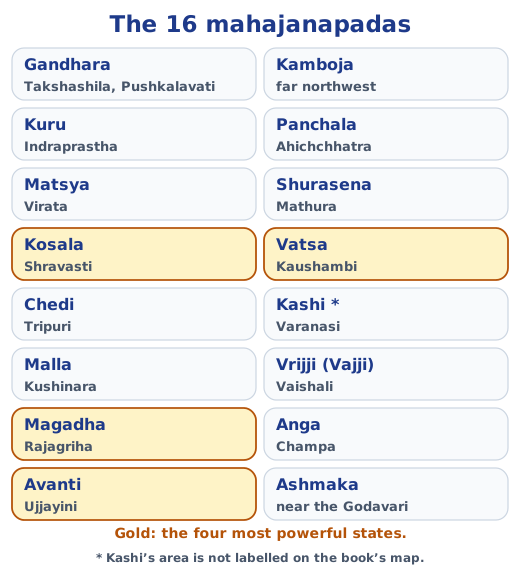
Late in the 2nd millennium BCE, people in north India formed clans that probably shared a language and customs. Each clan came to be linked with its own territory, a janapada, led by a raja. As trade networks grew and connected them, some janapadas merged, and by the 8th or 7th century BCE these bigger states were called mahajanapadas. Ancient texts give different lists, but the most common one names 16, from Gandhara in the far northwest across to Anga in the east, and down to Ashmaka near the Godavari. Many lie in the fertile Ganga plains, close to iron ore in the hills and along new trade routes.
The strongest were Magadha, Kosala, Vatsa and Avanti. Most capitals were large, well-fortified cities with a moat outside the walls, and their gateways were kept narrow so that guards could control who and what came in or went out. Most of these capitals are still living cities, often about 2,500 years old. Read the mahajanapadas.
Early democratic traditions
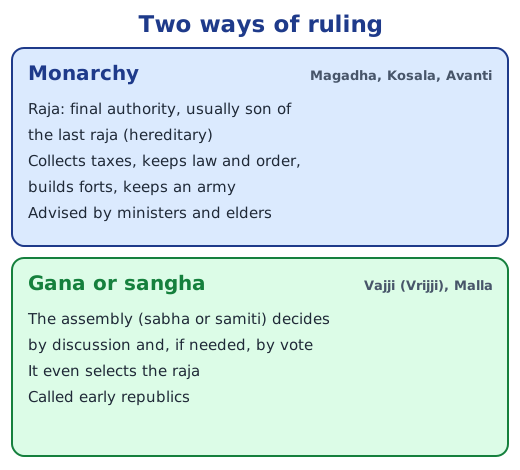
Every janapada had its own assembly, the sabha or samiti, probably made up mostly of elders, where the clan’s affairs were discussed. A good raja was expected to take its advice, as well as that of the ministers, and some texts even say an assembly could remove an incompetent ruler, though our evidence from so long ago is incomplete. Many mahajanapadas, such as Magadha, Kosala and Avanti, were in effect monarchies: the raja was the final authority, usually the son of the previous raja, and collected taxes, kept order, built fortifications and kept an army. But at least two, Vajji (or Vrijji) and its neighbour Malla, worked differently. Their assembly decided matters by discussion and, if needed, by vote, and even chose the raja. These ganas or sanghas are called early republics, among the earliest anywhere.
New ideas and new technologies
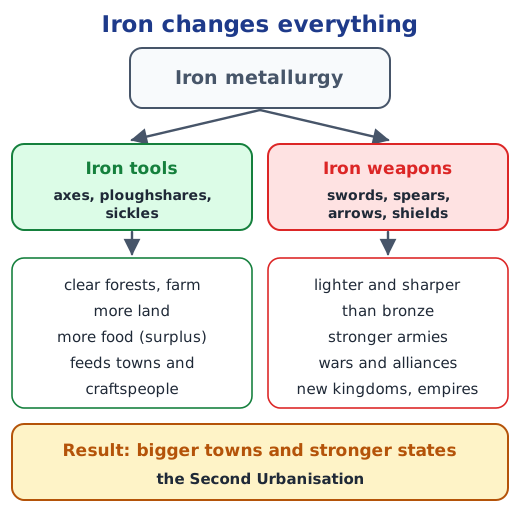
This was an age of deep change. Late Vedic, Buddhist and Jain schools of thought spread through travelling scholars, monks, nuns and pilgrims, and art began a renewal. The Harappans had worked copper and bronze; the new age ran on iron. Iron-working had been perfected in parts of India from the early 2nd millennium BCE, and by its end iron tools were common, helping people farm on a bigger scale. Iron weapons were lighter and sharper than bronze ones, and there is some evidence of wars, and alliances, between neighbouring mahajanapadas. Growing trade also brought the first Indian coins, punch-marked pieces of silver; later came coins of copper, gold and other metals.
The varna–jati system
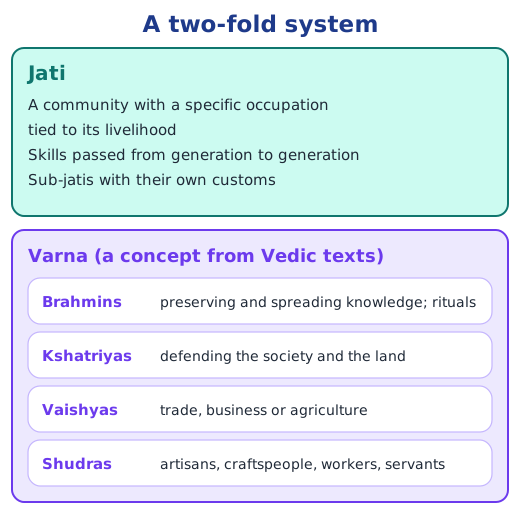
As societies grow complex, people form groups by occupation, class or other criteria. Ideally such groups help one another, but they often lead to inequality. Indian society was organised in two ways: by jati, communities tied to an occupation whose skills passed down the generations, and by varna, four groups described in the Vedic texts. In early times people could change occupations when circumstances demanded, but the system later became rigid and led to discrimination. Read the varna–jati system.
Developments elsewhere in India
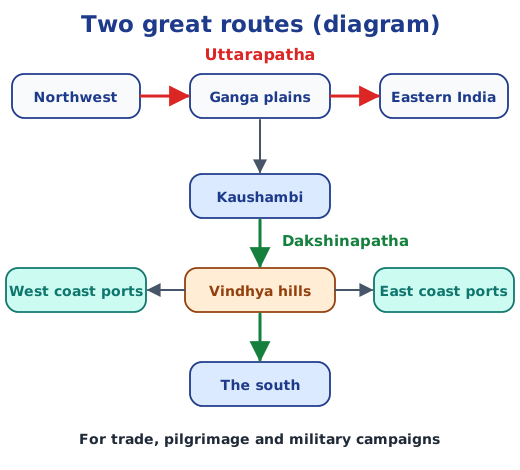
Routes opened up for trade, pilgrimage and military campaigns. The Uttarapatha joined the northwest to the Ganga plains and eastern India, and the Dakshinapatha ran from Kaushambi, near Prayagraj, across the Vindhya hills to the south. Side roads led to busy ports on both coasts. In the east, Shishupalgarh, capital of Kalinga and now part of Bhubaneswar, had a square plan, massive walls and broad streets. In the south, cities appeared from about 400 BCE, and three kingdoms arose: the Cholas, Cheras and Pandyas, mentioned in the earliest Tamil literature. Rich in gems, gold and spices, the south traded within India and overseas.
Before we move on
By 300 or 200 BCE almost the whole Subcontinent, the Northeast included, had become one connected land, where goods and culture passed between regions and often went on to Central and Southeast Asia. Around the same time the mahajanapadas ceased to exist, making way for empires. Answers to the Big Questions, every Let’s Explore and all four questions are in the NCERT solutions for Chapter 4.
Key terms
| Term | Meaning |
|---|---|
| First Urbanisation | India’s first age of cities, the Harappan (Indus or Sindhu-Sarasvati) civilisation, which broke up in the early 2nd millennium BCE. |
| Second Urbanisation | The new phase of city life that began in the 1st millennium BCE in the Ganga plains, in some areas of the Indus basin and nearby regions. It has continued to today. |
| Janapada | The territory of a clan, led by a raja. In Sanskrit it means the place where people (jana) set their foot (pada), in other words, where they settled. |
| Mahajanapada | A bigger state formed when some janapadas merged, by the 8th or 7th century BCE. The most common list in ancient texts names 16. |
| Sabha and samiti | The assembly or council of a janapada, probably made up mostly of clan elders, where its matters were discussed. Both words first appear in the Vedas. |
| Gana or sangha | A mahajanapada such as Vajji or Malla in which the assembly took the main decisions and even chose the raja. Scholars call these early republics. |
| Moat | A deep, wide ditch filled with water that surrounds a fort or a fortified city, as an extra line of defence. |
| Iron metallurgy | The skill of extracting iron from its ore and shaping it into tools and weapons. It drove the Second Urbanisation, as copper and bronze had served the Harappans. |
| Punch-marked coins | The first Indian coins: pieces of silver, a metal soft enough for symbols to be stamped into it with punches. |
| Jati | A community whose members follow a particular occupation tied to their livelihood, with its skills usually passed on from one generation to the next. |
| Varna | A concept from the Vedic texts that sorts society into four groups by duty: Brahmins, Kshatriyas, Vaishyas and Shudras. |
| Uttarapatha and Dakshinapatha | Two great routes. The Uttarapatha ran from the northwest across the Ganga plains to eastern India; the Dakshinapatha ran from Kaushambi over the Vindhyas to the south. |
Topics in this chapter
Practice
-
What does the word ‘janapada’ mean?
Show answer
Answer: (b) The place where the people have set foot, or settled
-
Which of these was NOT one of the four most powerful mahajanapadas?
Show answer
Answer: (c) Malla
-
What were the first Indian coins made of?
Show answer
Answer: (c) Silver
-
In which two mahajanapadas did the assembly choose the raja?
Show answer
Answer: (b) Vajji and Malla
-
Which route started from Kaushambi and crossed the Vindhyas to the south?
Show answer
Answer: (b) Dakshinapatha
-
From about when did cities begin to emerge in the southern regions?
Show answer
Answer: (c) 400 BCE
Questions students ask
What are the main topics of Class 7 SST Chapter 4?
The end of the First Urbanisation and the rise of the Second; janapadas and the 16 mahajanapadas with their fortified capitals; early democratic traditions, from assemblies to the gana or sangha states; new technologies such as iron metallurgy and punch-marked coins; the varna–jati system; and developments elsewhere: the Uttarapatha and Dakshinapatha, Shishupalgarh, and the Chola, Chera and Pandya kingdoms.
Is New Beginnings: Cities and States in the new NCERT Class 7 book?
Yes. It is Chapter 4 of Exploring Society: India and Beyond, the Class 7 Social Science textbook Part 1 (Reprint 2026-27), on pages 67 to 81. It opens the theme Tapestry of the Past, after three chapters on India’s land and climate, and it is followed by The Rise of Empires.
What is the Second Urbanisation of India?
It is the second great age of city life in India. The first, the Harappan civilisation, faded in the early 2nd millennium BCE. In the 1st millennium BCE new cities rose in the Ganga plains, in some areas of the Indus basin and nearby regions, and the trend spread across the Subcontinent. Cities have never disappeared since, so this phase continues today.
Why are the mahajanapadas important?
They were the first organised states of their time, the 1st millennium BCE. Their capitals became fortified cities, many of which are still living cities. They developed ways of ruling with assemblies, including early republics, used iron and coins, and were linked by trade routes. Their age shaped Indian society, ideas and art for centuries.
Stuck on a question?
Take a photo and Lagnever AI explains it step by step. Try it for 7 days for ₹2.
Get it on Google Play Open in browser
For parents: after the trial, the plan renews monthly by UPI or card autopay. You can cancel anytime in the app.