
Class 7 Social Science Chapter 5: The Rise of Empires Notes
This chapter in five lines
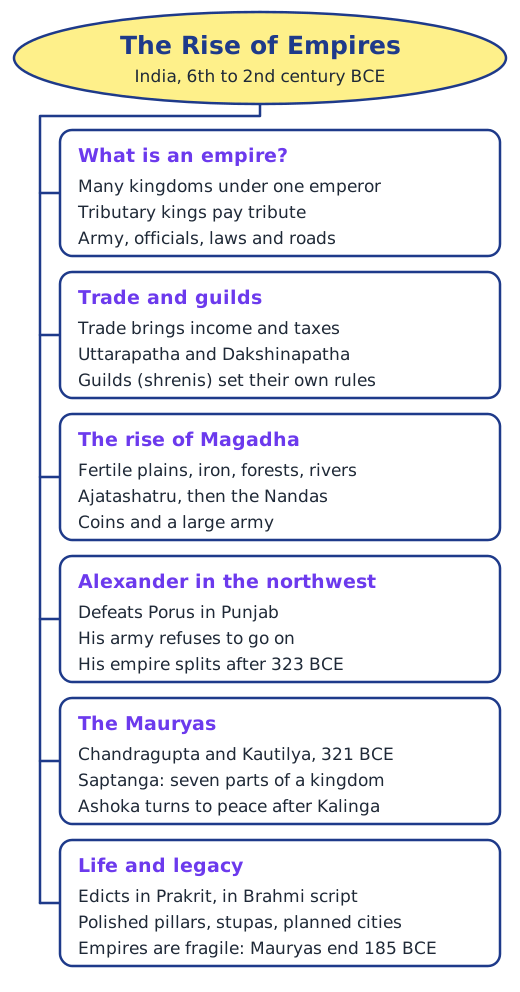
The Rise of Empires explains how, between the 6th and 2nd centuries BCE, kingdoms in India grew into empires. Magadha, rich in fertile land, iron and rivers, rose under Ajatashatru and the Nandas. Chandragupta Maurya, guided by Kautilya, built the Maurya empire, and Ashoka, after the Kalinga war, ruled through dharma and welfare.
What is this chapter about?
The chapter begins with a thought from Kautilya’s Arthashastra: a kingdom needs a land, and a land needs its people. It then asks four Big Questions: what an empire is, how empires rose and shaped Indian civilisation, what helped kingdoms turn into empires, and how people lived between the 6th and 2nd centuries BCE.
A story sets the scene. Bhavisha and Dhruv switch on ‘Itihasa’, their new time machine, and land outside Pataliputra, close to today’s Patna. Ira, an ironsmith’s daughter, shows them soldiers leaving over a drawbridge that can be raised above a moat, and the hills and forests that supply timber, herbs and elephants for the army. Inside, they pass wooden ramparts with watchtowers, palaces, a market selling Chinese silk and southern spices and gems, and street acrobats. Ira’s king rules so much land that a rider needs almost two months to reach its borders. That, she says proudly, is an empire.
What is an empire?
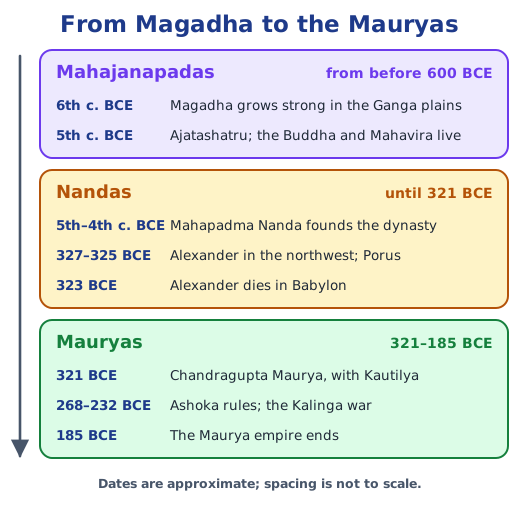
Empire comes from the Latin imperium, ‘supreme power’. An empire is a group of smaller kingdoms or territories under one powerful ruler or group of rulers, often won by war. The smaller states usually kept their own rulers but became tributaries, or vassals: they paid the emperor tribute, such as money, gold, grain, livestock or elephants, as a sign of loyalty. The emperor ruled from a capital, usually a big centre of trade and government. Sanskrit texts call such a ruler samraj, ‘lord of all’, adhiraja, ‘overlord’, or rajadhiraja, ‘king of kings’.
An empire keeps an army, runs an administration with officials and taxes, makes laws and issues coins, weights and measures, controls resources such as mines and forests, supports art and learning, and maintains roads and waterways. Indian history saw many empires rise and fall; the last one to rule the Subcontinent ended less than a century ago. Read what is an empire.
Trade, trade routes and guilds
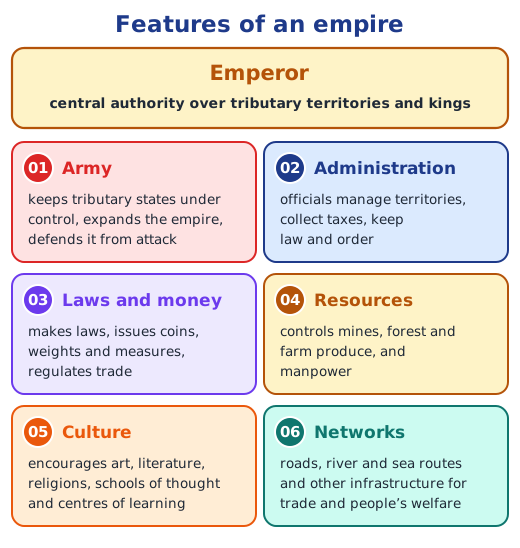
Wars in distant lands cost a great deal: soldiers must be fed, armed and paid, elephants and horses looked after, and roads or ships built. So an empire needs a strong economy, and trade is one of its keys. Controlling trade routes inside and beyond the empire meant more goods, more income for producers and more taxes for the ruler. Literature and excavations show that Indians traded textiles, spices, farm produce, gems, handicrafts and animals, by land and by sea, even to distant countries.
Traders often joined hands in guilds (shrenis), and so did craftspeople, moneylenders and farmers. A guild had a head, usually elected, and officers expected to be honest. Members worked together instead of competing, sharing resources and news about markets, and a guild made its own rules without the king’s interference. Guilds spread across India and lasted for centuries, a fine example of how Indian society could organise itself.
The rise of Magadha
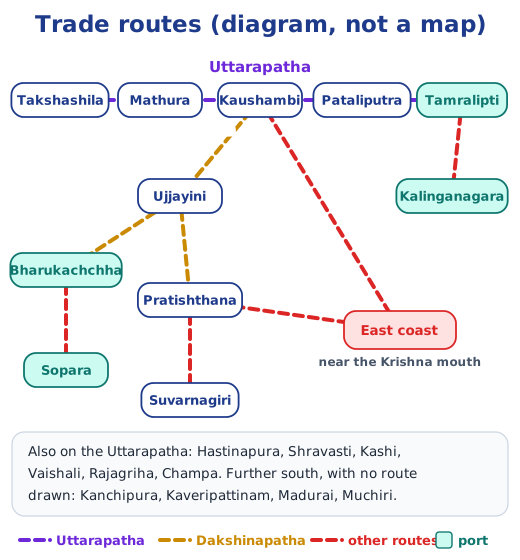
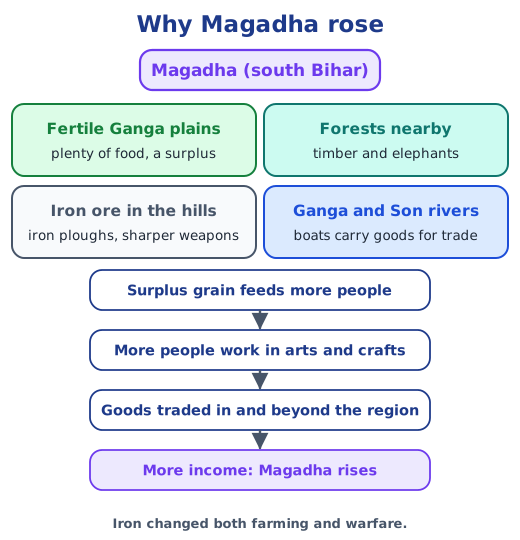
Between the 6th and 4th centuries BCE, north India changed deeply. Of the sixteen mahajanapadas, Magadha, in south Bihar and some nearby areas, grew strongest, helped by kings such as Ajatashatru, in whose time the Buddha and Mahavira lived. It lay in the fertile Ganga plains, with forests for timber and elephants, and with iron ore in the hills close by: iron ploughs raised harvests and iron weapons made the army stronger. Surplus grain freed people for crafts, and the Ganga and Son rivers carried goods for trade. Read the rise of Magadha.
Around the 5th century BCE, Mahapadma Nanda founded the Nanda dynasty, built an empire that covered parts of northern and eastern India, issued coins and kept a large army. The great grammarian Panini, who set out the rules of Sanskrit in 3,996 sutras, lived in the Nanda period. The last Nanda emperor, Dhana Nanda, was very rich but oppressed his people and became unpopular.
The arrival of the Greeks
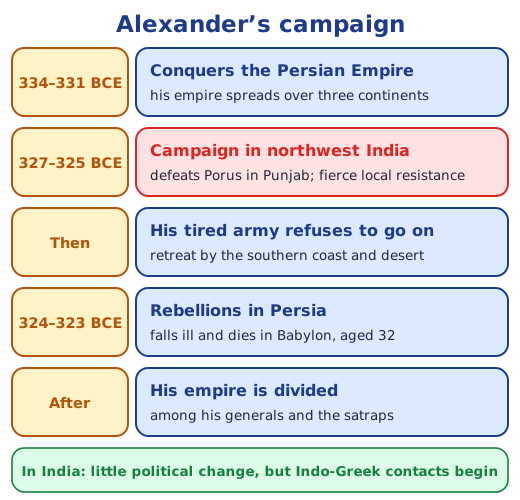
Meanwhile, small kingdoms in the northwest lay along an old route to the Mediterranean. Alexander, a young Greek king from Macedonia, conquered the Persian Empire in 334–331 BCE and then marched into India in 327–325 BCE. He defeated Porus, king of the Pauravas, in Punjab and met fierce resistance from local peoples; in some battles, Greek records say, women fought beside the men. His tired soldiers refused to march on towards the Ganga, so he turned back and lost many men in the deserts on the way. He died in Babylon aged 32, and his generals and satraps divided his empire. The campaign changed little politically in India, but it opened the door to Indo-Greek cultural contacts. One famous tale has Alexander testing Indian sages, the ‘Gymnosophists’, with riddles; impressed by their calm, wise replies, he spared them all.
The mighty Mauryas
Around 321 BCE, a few years after Alexander left, Chandragupta Maurya founded the Maurya empire. Stories about his early life differ, but all agree that he overthrew the Nandas and ruled from Pataliputra. His mentor was Kautilya, also called Chanakya or Vishnugupta, a teacher at Takshashila whom Dhana Nanda had insulted. Using Magadha’s strengths and Kautilya’s advice, Chandragupta expanded step by step, defeated the Greek satraps in the northwest and ruled from the northern plains to the Deccan. He kept friendly ties with the Greeks, and the Greek historian and diplomat Megasthenes wrote about India in his Indika, now known only from quotations.
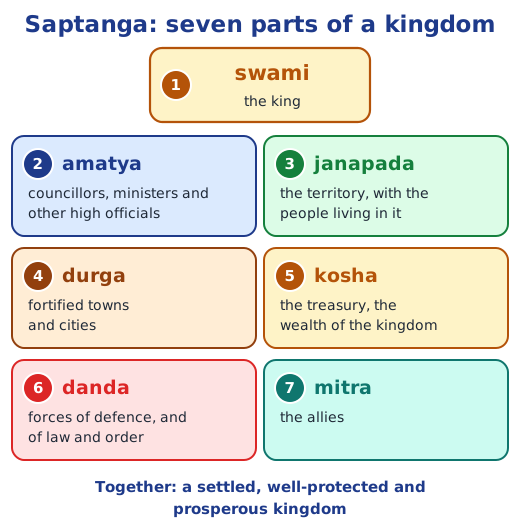
In the Arthashastra, Kautilya set out the saptanga, the seven parts of a kingdom, and insisted that a king must put his people’s welfare first. Read the Mauryan empire and Ashoka.
The king who chose peace
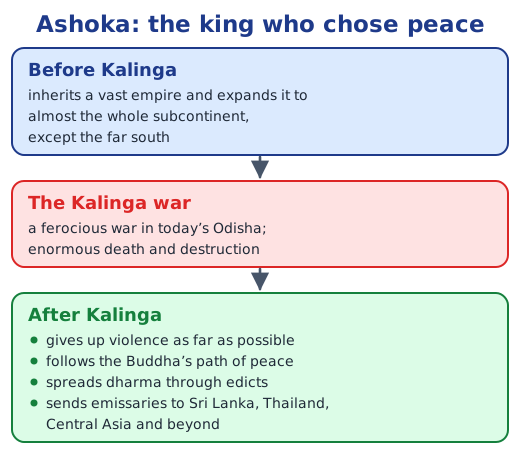
Chandragupta’s grandson Ashoka (268–232 BCE) extended the empire over almost the whole Subcontinent except the far south. Then he invaded Kalinga, today’s Odisha. The bloodshed of that war moved him to give up violence as far as possible and follow the Buddha’s path of peace. He sent emissaries as far as Sri Lanka, Thailand and Central Asia, and had edicts carved on rocks and pillars, mostly in Prakrit and in the Brahmi script, urging people to follow dharma. Calling himself Devanampiya Piyadasi, he claimed to give medical care to people and animals, to ban cruelty to animals, to dig wells, build rest houses and plant trees along roads, and to ask all sects to respect one another.
Life in the Mauryan period
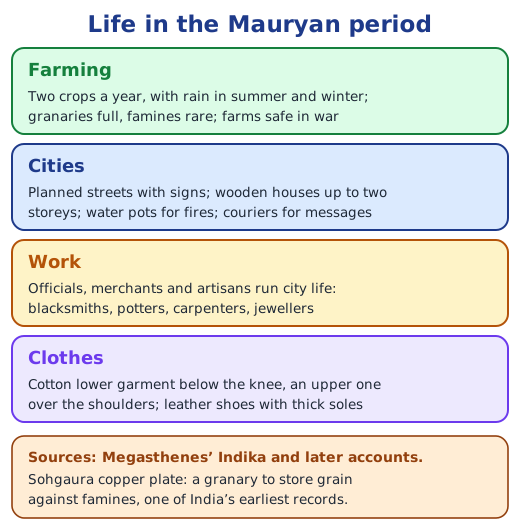
Cities such as Pataliputra had palaces, public buildings and planned streets, and taxes and trade kept the treasury full. According to Megasthenes, most people farmed; two crops a year and stocked granaries made famines rare, and farmers were left undisturbed even in war. Artisans lived in the cities, houses were of wood and up to two storeys high, streets had signs and pots of water against fire, and couriers carried messages. The Sohgaura copper plate records a granary set up against famine. Mauryan art is famous for its highly polished stone pillars; the lion capital of the Sarnath pillar is now India’s national emblem, with the motto satyameva jayate.
Why empires are fragile
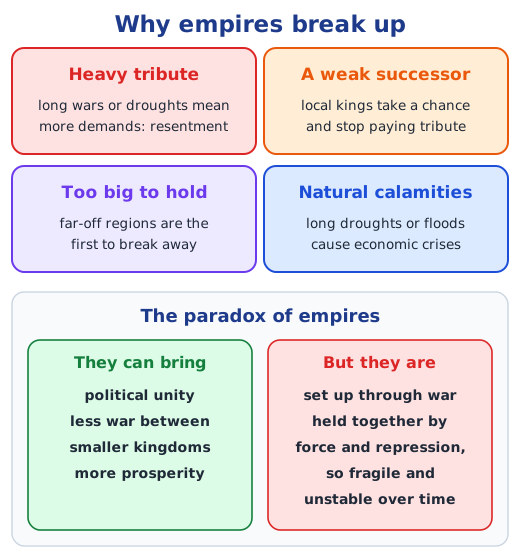
After Ashoka the Maurya empire lasted about fifty years, but weaker successors lost their grip, smaller kingdoms broke away, and around 185 BCE a new phase of history began. Empires fall for several reasons: rising demands for tribute cause resentment, a weak ruler tempts local kings to stop paying, far-off regions split away, and droughts or floods shake the economy. Empires can bring unity, less war and more prosperity, but because they are usually built by war and held by force, they remain fragile.
Before we move on
The first Indian empires grew in regions rich in natural resources, rivers and trade. The Mauryas left a long legacy: stronger trade routes, the wide use of coins, planned towns, an elaborate administration and great art, and Ashoka presented himself as a caring ruler who urged dharma. Answers to the Big Questions, every Let’s Explore and Think About It, and all nine questions are in the NCERT solutions for Chapter 5.
Key terms
| Term | Meaning |
|---|---|
| Empire | A big territory that joins many smaller kingdoms or regions under one powerful ruler, the emperor, often brought together by war. The word comes from the Latin imperium, ‘supreme power’. |
| Tributary or vassal | A ruler or state that accepts an emperor as overlord and pays him tribute, such as money, gold, grain, livestock or elephants, as a sign of loyalty, while usually keeping its own ruler. |
| Samraj, adhiraja, rajadhiraja | Sanskrit titles for an emperor, meaning ‘lord of all’ or ‘supreme ruler’, ‘overlord’ and ‘king of kings’. |
| Guild (shreni) | A powerful association of traders, craftspeople, moneylenders or farmers, with a head who was usually elected and the right to make its own rules. |
| Satrap | A governor left by a Persian or Greek overlord to run a far-off province. Satraps often enjoyed great power and freedom. |
| Arthashastra | Kautilya’s famous work, ‘the science of governance and economics’, with directions on defence, the economy, administration, justice, town planning, farming and people’s welfare. |
| Saptanga | Kautilya’s idea of the seven parts of a kingdom: the king, ministers, the territory and its people, fortified towns, the treasury, the forces of defence and order, and allies. |
| Edict | An official declaration issued by an authority, here a king. Ashoka had his edicts carved on rocks and pillars across his empire. |
| Emissary | Someone sent on a special mission, often a diplomatic one, like those Ashoka sent to Sri Lanka, Thailand and Central Asia to spread the Buddha’s message. |
| Dharma (dhamma) | Duty, law, truth, order and ethics together: a person’s moral duties towards family, community and country, and a life in harmony with the order of the universe (ritam). |
| Brahmi | The script in which most of Ashoka’s Prakrit edicts were written. It is the mother of all the regional scripts of India. |
| Capital (of a pillar) | The top portion, or ‘head’, of a pillar, such as the lion capital of Ashoka’s pillar at Sarnath, now India’s national emblem. |
Topics in this chapter
Practice
-
‘Empire’ comes from a Latin word, imperium. What does imperium mean?
Show answer
Answer: (b) Supreme power
-
In this chapter, what is a ‘tributary’?
Show answer
Answer: (b) A ruler or state that pays tribute to an emperor
-
Which two rivers helped Magadha’s trade by carrying goods?
Show answer
Answer: (a) Ganga and Son
-
Who guided Chandragupta Maurya in overthrowing the Nandas?
Show answer
Answer: (b) Kautilya
-
Which war led Ashoka to give up violence?
Show answer
Answer: (b) The Kalinga war
-
Most of Ashoka’s edicts were written in which language and script?
Show answer
Answer: (b) Prakrit, in the Brahmi script
Questions students ask
What are the main topics of Class 7 SST Chapter 5?
What an empire is and how it differs from a kingdom; trade, trade routes and guilds; the rise of Magadha under Ajatashatru and the Nandas; Alexander’s campaign in the northwest; the Mauryas, with Chandragupta, Kautilya and the saptanga; Ashoka, the Kalinga war and his edicts; life in the Mauryan period; and why empires are fragile.
Is The Rise of Empires in the new NCERT Class 7 book?
Yes. It is Chapter 5 of Exploring Society: India and Beyond, the Class 7 Social Science textbook Part 1 (Reprint 2026-27), on pages 83 to 116. It belongs to the theme Tapestry of the Past, follows New Beginnings: Cities and States, and is followed by The Age of Reorganisation.
What is the difference between a kingdom and an empire?
A kingdom is one territory ruled by a king. An empire is much larger: it brings many kingdoms and territories under one emperor, often after war. The smaller kings usually kept their thrones but became tributaries, paying tribute to the emperor, who ruled from a capital with a big army and administration.
Why is Ashoka important?
Ashoka ruled almost the whole Subcontinent, yet after the Kalinga war he chose peace. He spread dharma through edicts on rocks and pillars, cared for the welfare of people and animals, and asked all sects to respect one another. His lion capital at Sarnath is India’s national emblem, and the dharmachakra is on our flag.
Stuck on a question?
Take a photo and Lagnever AI explains it step by step. Try it for 7 days for ₹2.
Get it on Google Play Open in browser
For parents: after the trial, the plan renews monthly by UPI or card autopay. You can cancel anytime in the app.