
NCERT Solutions Class 7 Social Science Chapter 5: The Rise of Empires
Answers to every question in Chapter 5, The Rise of Empires, of Exploring Society: India and Beyond Grade 7 Part 1 (Reprint 2026-27): the Big Questions, every Let’s Explore and Think About It, the questions in the side boxes, and all nine questions and activities. Page numbers follow the book (pages 83–116). Answers that ask for your own views are given as samples to adapt. Short notes: Chapter 5 notes.
The Big Questions (page 83)
1. What is an empire? An empire is a vast territory that joins many smaller kingdoms or regions under one powerful ruler, the emperor, or a group of rulers, usually brought together by war. The smaller states kept their own rulers but became tributaries: they paid tribute and accepted the emperor’s overlordship, while the emperor ruled the whole from a capital. The word comes from the Latin imperium, ‘supreme power’, and Sanskrit texts call the emperor samraj, adhiraja or rajadhiraja, ‘king of kings’.
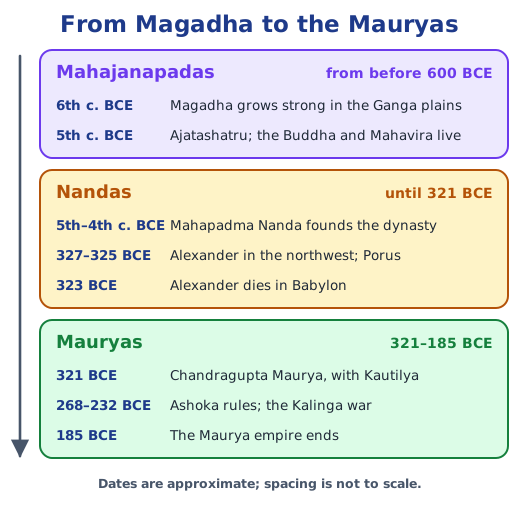
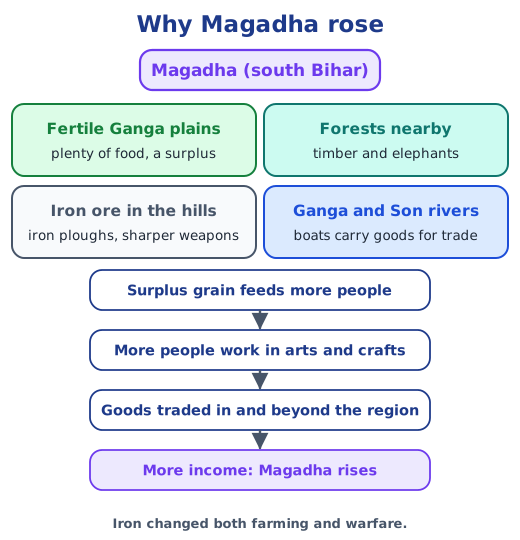
2. How did empires rise and shape Indian civilisation? Empires grew where a kingdom had rich resources and strong rulers. Magadha, in the fertile Ganga plains with forests, iron ore and rivers, grew wealthy and powerful, and under the Nandas and then the Mauryas it absorbed its neighbours. Empires shaped Indian civilisation at every level. Politically, the Mauryas united almost the whole Subcontinent. Economically, they strengthened trade routes, used coins widely, collected taxes and kept granaries. Socially and culturally, they built planned cities, supported religions, learning and art, from polished pillars to stupas, and Ashoka spread a message of dharma and welfare in Brahmi, the parent of India’s regional scripts.
3. What factors facilitated the transition from kingdoms to empires? Natural resources, such as fertile land, forests with timber and elephants, and iron ore; iron technology, which gave surplus grain and sharper weapons; rivers and roads for transport and trade; trade and taxes that paid for large armies; coins and an established economic system; able rulers and advisers, such as Kautilya, with a strong administration; and the weakness of rivals, such as the unpopular Nandas or the Greek satraps left behind by Alexander.
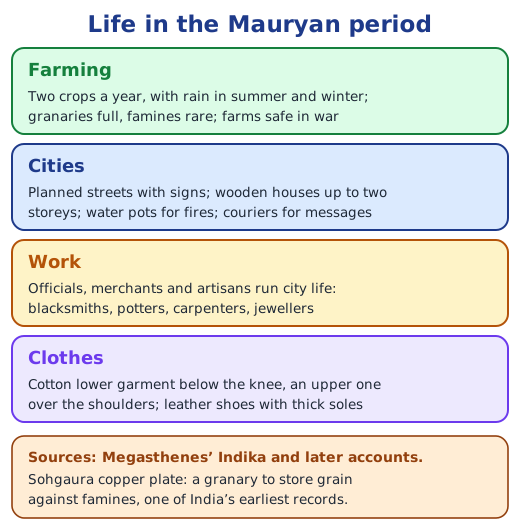
4. What was life like from the 6th to the 2nd century BCE? Most people farmed, and under the Mauryas two crops a year and well-stocked granaries made famines rare. Cities such as Pataliputra had walls, moats, palaces and planned streets with signs, wooden houses up to two storeys high, markets with goods from distant lands, artisans such as blacksmiths, potters, carpenters and jewellers, and entertainers such as street acrobats. Traders formed guilds, routes linked distant regions, and coins were in use. People wore cotton clothes, new teachings spread with the Buddha and Mahavira, and under Ashoka the ruler spoke of dharma and welfare. There were also wars, from Alexander’s campaign to the Kalinga war.
Let’s Explore (page 89)
How did emperors make sure that diverse peoples lived in harmony? Ideas for your group discussion: they let tributary kings and local chiefs go on ruling their areas and keep their customs; they respected and supported all religions and schools of thought, as Ashoka asked every sect to respect the others; they spoke to people in a widely understood language, such as Prakrit; they built roads, rest houses and markets that brought people together; they gave fair justice through officials told to be impartial; they helped people in famine or illness; and they kept an army to stop local conflicts.
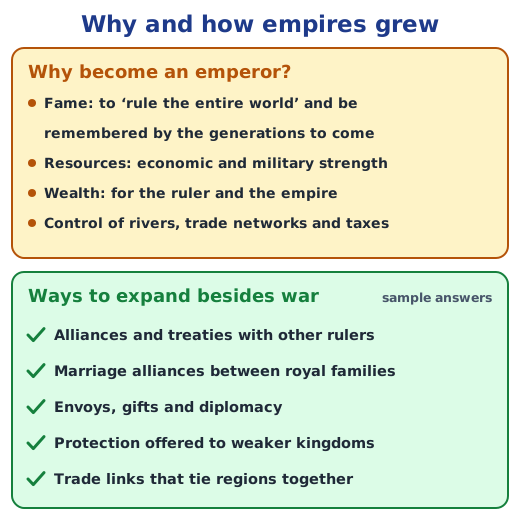
Why should a king want an empire? More reasons. Besides fame, resources and wealth, which the book gives, a king might want to make his borders safe by controlling his neighbours; to control rivers, trade routes and ports for their taxes; to gain more farmland and more people to tax; to protect trading caravans; to end constant wars between small kingdoms; to spread his religion or ideas; to take revenge for an attack, as Alexander wanted to avenge the Persian invasions of Greece; or simply to prove himself stronger than his rivals.
Let’s Explore (page 91)
Warfare apart, what other methods might rulers have used? Sample ideas: alliances and treaties with other rulers; marriages between royal families; envoys, gifts and diplomacy; protection offered to weaker kingdoms in return for loyalty and tribute; promises that local kings could keep their thrones as tributaries; trade agreements that tied regions to the empire; and good government and welfare that made people welcome the ruler.
Let’s Explore (page 93)
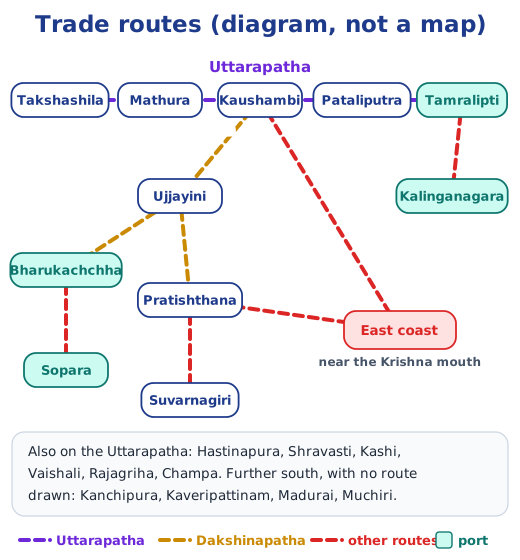
Geographical features that helped traders. On the map of trade routes: the flat, fertile Ganga plains, across which the Uttarapatha runs; rivers such as the Ganga and Yamuna, whose valleys guide the roads and whose waters carry boats; routes through gaps in the hills, as the Dakshinapatha crosses the Vindhya region from Kaushambi to Ujjayini; passes in the northwestern mountains, leading on from Takshashila; long coastlines with ports such as Bharukachchha, Sopara and Tamralipti; and the Deccan plateau, crossed by routes to Pratishthana and Suvarnagiri.
What modes of transport were available? On land: walking, with porters carrying loads; bullock carts; pack animals such as oxen, donkeys and mules; horses; elephants; and camels in the dry northwest. On water: boats on rivers like the Ganga and the Son, ferries across rivers, and ships along the coasts and across the sea.
Let’s Explore (page 94)
How many types of weapons, and what uses of iron? The panel shows at least four kinds of weapons: bows and arrows used by archers, swords, spears or lances, and shields; elephant riders also hold goads to control their animals. Iron would have been used for arrowheads, sword blades and spearheads, for the goads, for fittings on chariots and horse gear, and even for the chisels with which the sculptors carved the panel. Soldiers fight on foot, on horseback and on elephants around a walled city with gateways and balconies.
Why was a parasol kept over the casket? In ancient India a parasol, or chhattra, was a sign of honour, kingship and holiness; important people walked beneath one. Holding it over the casket shows the deep respect people felt for the Buddha’s relics, treating them as if the Buddha himself were present, and it also shaded and protected them. Parasols are carved on top of stupas for the same reason.
Don’t Miss Out (page 97)
How could satraps exercise so much power? They governed provinces far from the overlord, and in those days news and orders took weeks or months to travel, so they had to decide most matters themselves. They commanded local troops, collected taxes and knew the land and its people far better than the distant ruler, who depended on them to keep the province in order. When the overlord died, as Alexander did, there was no strong central power to check them, and several satraps made themselves kings.
Think About It (page 97)
Why did Alexander want to rule over the entire world, and what would he have gained? Sample answer: Alexander was young, ambitious and hungry for glory. He wanted to be remembered as the greatest king, to reach what he thought was the end of the world, and to avenge the earlier Persian invasions of Greece. He would have gained enormous wealth and tribute, control of the trade routes linking Europe, Asia and Africa, more soldiers and resources, the spread of Greek culture, and lasting fame. Yet his empire fell apart soon after his death, which shows how hard it is to hold such vast lands.
Let’s Explore (page 97)
Enacting the battle between Porus and Alexander. Details to look up with your teacher: the battle took place around 326 BCE by the Hydaspes, the river now called the Jhelum, in Punjab. Greek writers say that Alexander crossed the swollen river secretly at night in a storm, that Porus fought with war elephants and kept fighting even when wounded, and that Alexander was struck by his courage. A sample plan for the play:
- Scene 1: Porus’s camp by the river, his elephants and soldiers ready; Alexander’s army on the far bank.
- Scene 2: a stormy night, as Alexander’s soldiers cross secretly upstream.
- Scene 3: the battle, with elephants charging, horses panicking and a wounded Porus refusing to give up.
- Scene 4: Porus before Alexander. Asked how he wishes to be treated, he replies, “Like a king.” Alexander leaves him at the head of his kingdom as a satrap.
Add a narrator, and show the courage of both sides rather than only the victory.
Think About It (page 103)
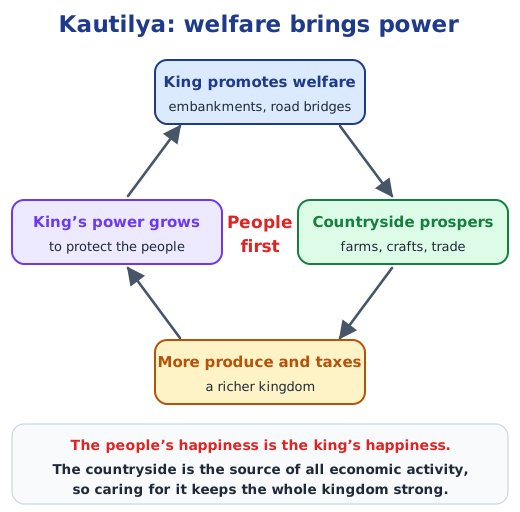
Why was it important to take special care of the countryside? The countryside is where all economic activity begins: farmers grow the grain that feeds the cities and the army, and forests and mines give timber, elephants and iron. Most people lived there, and most taxes came from farming. As the chapter showed at the start, an empire needs food, resources and money for its army, officials and roads. When villages prosper, the treasury fills and the king grows strong; when they suffer, the whole empire weakens. So encouraging people to build embankments and road bridges, beautify villages and protect them made good sense.
Let’s Explore (page 103)
Kautilya’s empire and a modern nation, compared. Points for your group discussion, part by part:
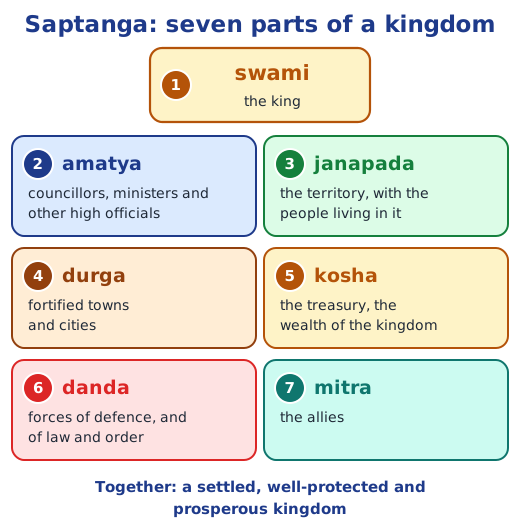
- The king (swami): India today has a President as head of state and an elected government led by the Prime Minister, chosen through elections, not by birth.
- Ministers (amatya): the council of ministers and the civil services.
- Territory and people (janapada): the country’s territory and its citizens, within borders that other countries recognise.
- Fortified towns (durga): defence posts on the borders and well-planned cities.
- Treasury (kosha): taxes, the government’s budget and the Reserve Bank.
- Defence and order (danda): the army, navy and air force, the police and the courts.
- Allies (mitra): friendly countries, treaties and international bodies such as the United Nations.
What is similar: both aim at a settled, secure and prosperous land, and both say that people’s welfare must come first. What is different: in a modern democracy power comes from the people, a written Constitution limits the rulers, every citizen has equal rights and a vote, and no region pays tribute to another.
Think About It (page 104)
Why do you think Ashoka admitted to the destructive Kalinga war? Sample answer: Admitting the war made his change of heart believable, because people could see that he truly regretted the suffering and meant his message of peace. It taught his subjects and future rulers the real cost of war. Being truthful also fitted the dharma that he preached. And it may have helped him win the trust of the people of Kalinga and of others he had conquered.
Language and script (page 105)
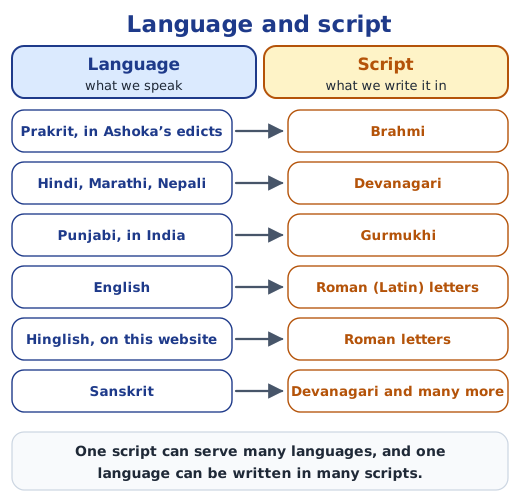
Examples from everyday life. Hindi, Marathi, Nepali and Sanskrit are written in the Devanagari script, English in the Roman alphabet, and Punjabi in Gurmukhi in India. The same language can use different scripts: when we type Hindi words in Roman letters on a phone, the language is Hindi but the script is Roman, just as on the Hinglish pages of this website. Our banknotes show the same amount in many languages and scripts.
Let’s Explore (page 107)
Would Ashoka’s instructions to his officials have worked? Sample answer: Probably yes, to a good extent. The instructions were clear: officials had to win people’s affection, treat everyone as the king’s own children, be impartial and even-tempered, and never imprison or torture anyone without good reason. Carving them in public meant that people knew what to expect and officials knew they were watched, and an inspector on tour every five years added accountability. Fair treatment would make people trust the government, pay taxes willingly and live peacefully, which helps hold a huge empire together. There were limits, though: five years is a long gap, the empire was vast, news travelled slowly, and much depended on the honesty of the inspectors themselves.
Let’s Explore (page 109)
Wearing a historian’s hat: what do the artefacts tell us? The terracotta dancing girl’s headdress, hairstyle and jewellery show that people cared about fashion and enjoyed music and dance. The female deities, the yakshi with a fly whisk and the seven mother goddesses show what people worshipped, a tradition that continues. The terracotta horse’s decorated bridle shows that horses were valued and well cared for. The polished stone pillars, the Great Stupa at Sanchi and the life-size elephant carved from the rock at Dhauli show skilled artists, rulers who supported Buddhism and art, and iron tools that could shape hard stone. Together they suggest a prosperous, settled society with skilled craftspeople and varied beliefs.
Let’s Explore (page 112)
What might the symbols on the coins mean? Sample guesses: the round symbol with rays or petals may be the sun, standing for light, life or the ruler’s power; the six-armed symbol may stand for royal authority or a wheel; the mark that looks like two loops, one above the other, may be the sign of a mint or of whoever issued the coin. Other punch-marked coins show animals such as a bull or an elephant, perhaps for strength and wealth, and hills, trees or rivers, perhaps for places. Small extra marks may have been punched by traders or officials who tested the coins. Historians still debate many of these meanings.
Questions and activities (pages 114–115)
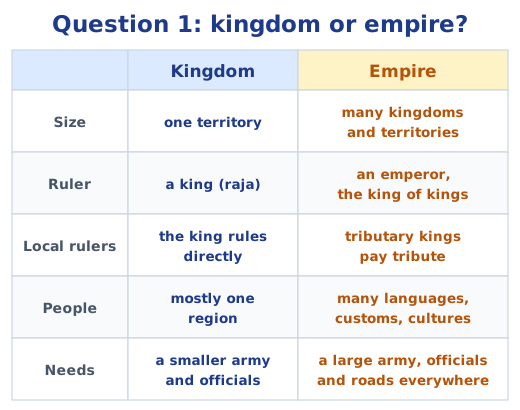
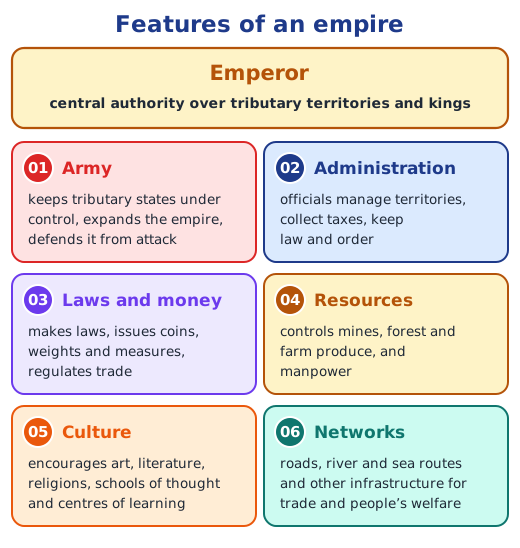
1. What are the features of an empire, and how is it different from a kingdom? An empire has a supreme ruler, the emperor, with authority over many tributary territories and kings. It keeps an army to control the tributaries, expand and defend itself; runs an administration with officials who manage territories, collect taxes and keep order; makes laws and issues coins, weights and measures and regulates trade; controls resources such as mines, forests, farm produce and manpower; encourages art, literature, religions and learning; and maintains roads, river and sea routes and other infrastructure. A kingdom is a single territory ruled directly by its king, usually over people of one region. An empire joins many kingdoms and territories, often won by war, with peoples of many languages and customs; its local kings keep ruling but pay tribute to the emperor.
2. What are some important factors for the transition from kingdoms to empires?
- Natural resources: fertile land for surplus grain, forests for timber and elephants, iron ore and other minerals.
- Iron technology: ploughs for bigger harvests and lighter, sharper weapons.
- Surplus food, which let more people become craftspeople, traders and soldiers.
- Rivers and roads, such as the Ganga and Son and the Uttarapatha and Dakshinapatha, for transport and trade.
- Trade and taxes, which paid for large armies, and coins that made trade easier.
- Strong armies with elephants, horses and foot soldiers.
- Able rulers and advisers, such as Mahapadma Nanda, Chandragupta and Kautilya, and a strong administration.
- Weak or unpopular rivals, such as Dhana Nanda and the Greek satraps after Alexander.
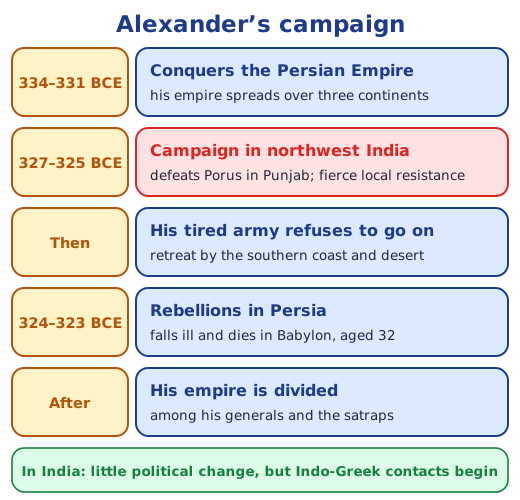
3. Why is Alexander considered an important king in world history? In about ten years he built one of the largest empires the world had seen, over three continents, from Greece and Egypt through Persia to the Indus. He spread Greek culture over a vast area and linked the Mediterranean world with Persia and India. In India his campaign had little political effect, but it opened the door to Indo-Greek cultural contacts, and stories such as his dialogue with the Gymnosophists mark a meeting of Greek and Indian philosophies. His story also shows the limits of conquest: his tired army refused to go on, and his empire broke up soon after his death.
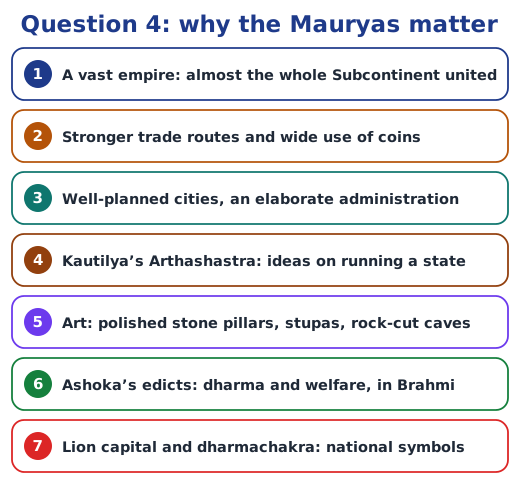
4. In early Indian history, the Mauryas are considered important. State your reasons. They built one of the largest empires India has known and united almost the whole Subcontinent for the first time. They strengthened trade routes and the economy, and coins came into wide use. They ran an elaborate administration, guided by Kautilya’s ideas in the Arthashastra, and built well-planned cities. Their art, with highly polished pillars, stupas and rock-cut caves such as those in the Barabar hills, set new standards. Ashoka’s edicts are among the earliest messages from a ruler to his people, written in Brahmi across the land, and his ideas of dharma, welfare and respect for all sects still inspire. Our national emblem, the Sarnath lion capital, and the dharmachakra on our flag come from them.
5. What were some of Kautilya’s key ideas, and which can we observe today?
- The saptanga: a kingdom needs a ruler, ministers, territory and people, fortified towns, a treasury, forces of defence and order, and allies. Today every country has a government, ministers and officials, a territory and citizens, a budget, armed forces and police, and friendly nations.
- Welfare first: the ruler’s happiness lies in the people’s happiness. Today governments run welfare schemes for health, food and education.
- Care for the countryside, the source of all economic activity: today we see rural roads, irrigation, embankments and support for farmers.
- A strong administration with laws against corruption and punishments for harming the people: today we have anti-corruption laws, courts and the police.
- Peace through alliances as well as war: today countries sign treaties and form partnerships.
6. What were the unusual things about Ashoka and his empire, and what has continued to influence India? A sample opinion of about 250 words:
Ashoka was unusual from the start, because his empire covered almost the whole Subcontinent, from Afghanistan to Bangladesh. But what makes him truly remarkable is what he did after winning. Most conquerors celebrate their victories; Ashoka looked at the death and destruction of the Kalinga war, felt sorrow, and gave up violence as far as a ruler could. Even more unusual, he admitted the suffering he had caused, carving the story in his own edicts for everyone to read. He spoke directly to his people through edicts on rocks and pillars across the land, in Prakrit, which ordinary people understood, written in the Brahmi script. He called himself one who regards others with kindness and tried to live up to it: medical care for people and animals, wells, rest houses and shady trees along roads, a ban on cruelty to animals, and officials told to be fair. He asked followers of all sects to respect and learn from one another, and sent emissaries abroad to spread a message of peace.
Much of this still shapes India. The lion capital of his pillar at Sarnath is our national emblem, and his dharmachakra sits at the centre of our flag, reminding us of truth and righteousness. His respect for all faiths lives on in India’s ideal of harmony among religions, and his idea that rulers must work for people’s welfare is the aim of our governments today. Brahmi grew into most of our scripts. Above all, his choice of peace over power still inspires leaders who believe in non-violence, which is why I think he deserves to be remembered.
7. Was Ashoka tolerant towards other religious beliefs and schools of thought? Yes. Although Ashoka followed the Buddha’s teachings, this edict shows that he appointed officers of Dhamma to look after the affairs of every group: the Buddhist Order, brahmans, the Ajivikas, the Jains and various other sects, among both ascetics and householders. He did not ban or neglect any of them. Another of his edicts asked all sects to respect and study the good teachings of one another. So he was tolerant: he wanted every school of thought to be treated fairly and all of them to live in harmony.
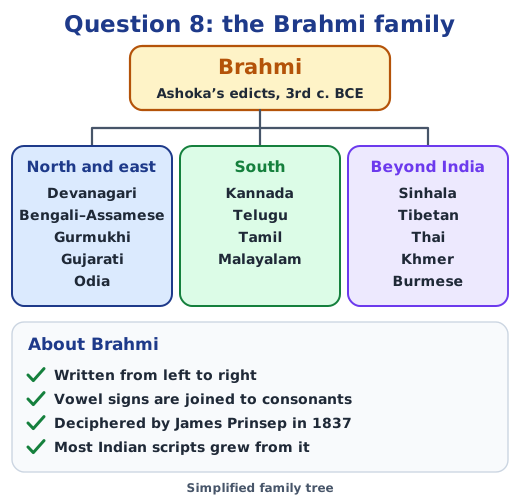
8. A small project on the Brahmi script. What to include:
- Brahmi is one of the oldest scripts of India; most of Ashoka’s edicts, from the 3rd century BCE, are in Prakrit written in Brahmi.
- It is written from left to right, and vowel signs are attached to consonants, as in Devanagari today.
- After centuries of disuse, nobody could read it until James Prinsep deciphered it in 1837, which unlocked Ashoka’s edicts.
- Most scripts of India grew out of it: in the north and east, Devanagari, Bengali–Assamese, Gurmukhi, Gujarati and Odia; in the south, Kannada, Telugu, Tamil and Malayalam; and beyond India, Sinhala, Tibetan, Thai, Khmer and Burmese.
Project ideas: draw a family tree of scripts; with your teacher’s help, find a chart of Brahmi letters and write your name in it; collect pictures of the edicts at Girnar, Dhauli or Sarnath; and, if you can, visit a museum to see an inscription.
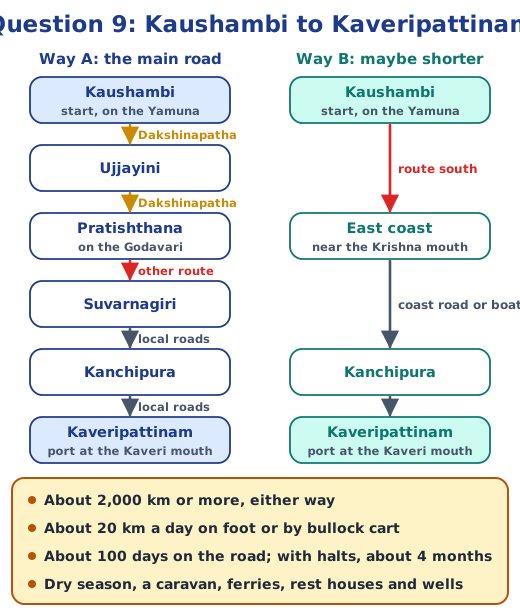
9. How would you travel from Kaushambi to Kaveripattinam in the 3rd century BCE, and how long would it take? Sample plan, using the map of trade routes:
- Way A, the main road: take the Dakshinapatha from Kaushambi south-west to Ujjayini and on south to Pratishthana on the Godavari; then follow another route south to Suvarnagiri; from there, local roads lead south-east to Kanchipura and down to Kaveripattinam, a port at the mouth of the Kaveri. This way passes big cities where you can rest and buy supplies.
- Way B, possibly shorter: take the route that runs south from Kaushambi to the east coast near the mouth of the Krishna, then travel down the coast, by road or by boat, to Kanchipura and Kaveripattinam.
- How: travel in a merchants’ caravan for safety, on foot or by bullock cart, with pack animals; go in the dry season, after the monsoon, when rivers are low and roads firm; cross big rivers such as the Narmada, Godavari and Krishna by ferry; and rest at towns, wells and rest houses, which Ashoka said he set up along the main roads.
- How long: either way is roughly 2,000 kilometres or more. At about 20 kilometres a day, that is around 100 days of travel; with halts for rest, bad weather and river crossings, expect about four months. On horseback it could take about half that time.
For revision, see the Chapter 5 notes, or read the topics in detail: the rise of Magadha, the Mauryan empire and Ashoka and what is an empire.
Practice
-
Which city was the capital of the Maurya empire?
Show answer
Answer: (b) Pataliputra
-
Around which year did Chandragupta Maurya found the Maurya empire?
Show answer
Answer: (b) 321 BCE
-
India’s national emblem carries the motto satyameva jayate. Which text does it come from?
Show answer
Answer: (b) The Mundaka Upanishad
-
What were the main goods traded in ancient India, according to the chapter?
Show answer
Answer: Textiles, spices, farm produce, luxury goods such as gems and handicrafts, and various animals, traded within India and to distant countries by land and by sea.
-
Name two places with Ashoka’s edicts in Karnataka and one in Odisha.
Show answer
Answer: Maski and Brahmagiri in Karnataka, both minor rock edicts, and Dhauli in Odisha, near Bhubaneswar, a major rock edict.
Stuck on a question?
Take a photo and Lagnever AI explains it step by step. Try it for 7 days for ₹2.
Get it on Google Play Open in browser
For parents: after the trial, the plan renews monthly by UPI or card autopay. You can cancel anytime in the app.