
The Mauryan empire and Ashoka
Answer in short
The Maurya empire was founded around 321 BCE by Chandragupta Maurya, guided by Kautilya, author of the Arthashastra. It reached from the northern plains down to the Deccan. His grandson Ashoka ruled almost the whole Subcontinent, but after the bloody Kalinga war he chose peace, spreading dharma and welfare through edicts in Prakrit, written in Brahmi.
Stuck on a question? Take a photo and Lagnever AI explains it step by step. Try it for 7 days for ₹2. Get it on Google Play
Chandragupta and Kautilya
Around 321 BCE, a few years after Alexander’s army left India, a new dynasty took power in Magadha. Chandragupta Maurya overthrew the Nandas and made Pataliputra his capital. Stories of his origins differ, but most give credit to his mentor Kautilya, also known as Chanakya or Vishnugupta, the teacher from Takshashila whom Dhana Nanda had insulted. With Magadha’s geography, its economy and its trade behind him, and Kautilya’s strategy to guide him, Chandragupta expanded step by step. He defeated the Greek satraps whom Alexander had left in the northwest and built an empire that ran from the plains of the north to the Deccan plateau. He then kept up friendly relations with the Greeks: the Greek historian and diplomat Megasthenes lived at his court and described India in his book Indika, which survives only in quotations by later writers.
Kautilya’s idea of a kingdom
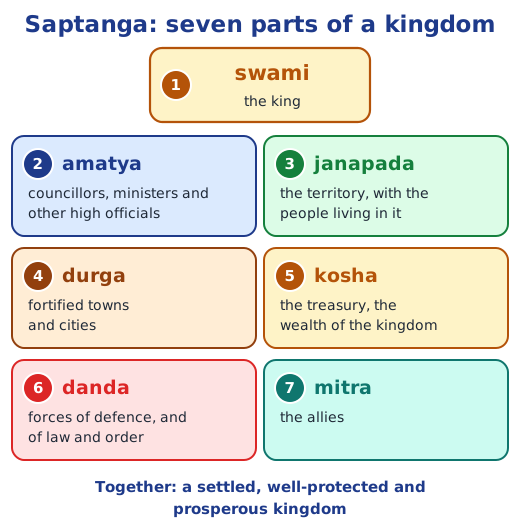
Kautilya’s Arthashastra, ‘the science of governance and economics’, gives directions on defence, the economy, administration, justice, town planning, farming and welfare. Its most famous idea is the saptanga, the seven parts of a kingdom: the king (swami), the councillors and ministers (amatya), the territory and its people (janapada), the fortified towns (durga), the treasury (kosha), the forces of defence and of law and order (danda) and the allies (mitra). Together they should make a kingdom settled, safe and prosperous, kept up by war or by alliances for peace, as the situation needed. Kautilya wanted strong administration, laws against corruption and punishments for anything that harmed the people.
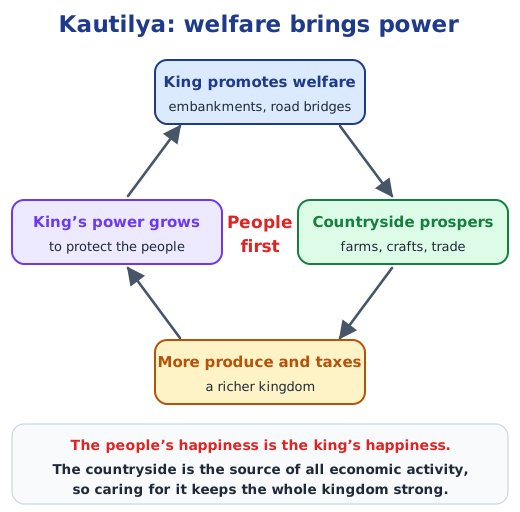
At the heart of his thinking is welfare. A king grows strong by making his people prosperous, because power comes from the countryside, where all economic activity begins; he should favour those who build embankments and road bridges or protect villages. The king’s happiness lies in his subjects’ happiness, so their interests must come first, however powerful he is.
Ashoka and the Kalinga war
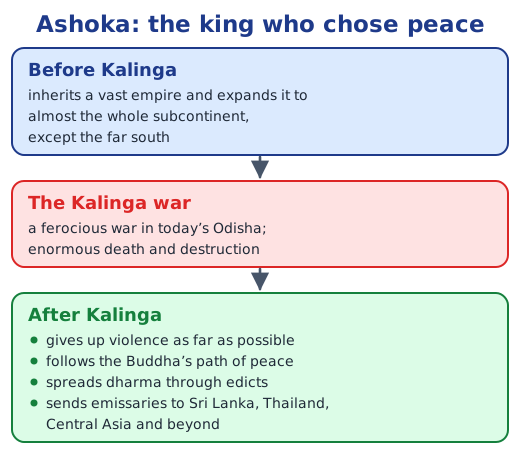
Chandragupta’s grandson Ashoka ruled from 268 to 232 BCE. At first he was ambitious: he enlarged the vast empire he had inherited until it covered almost the whole Subcontinent, except the far south, including today’s Bangladesh and Pakistan and parts of Afghanistan. Then, as one of his own edicts tells, he marched on Kalinga, today’s Odisha, and fought a ferocious war. The death and destruction he saw changed him. He gave up violence as far as he could and followed the Buddha’s teaching of peace and non-violence. Embracing Buddhism, he sent emissaries as far as Sri Lanka, Thailand and Central Asia to carry the Buddha’s message.
Edicts across the empire
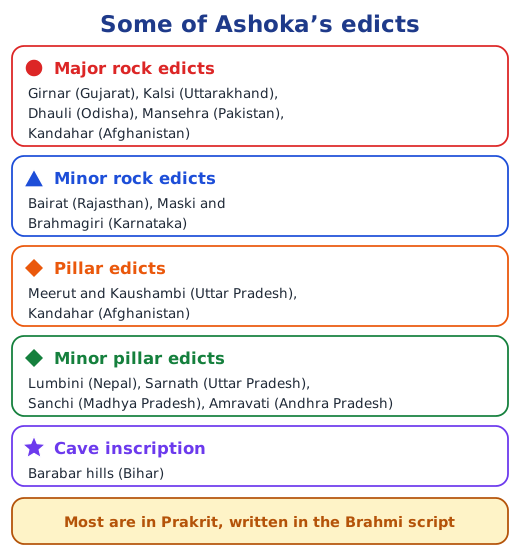
Historians call Ashoka a great communicator. He had edicts, his messages to the people, carved on rocks and pillars all over his empire, encouraging everyone to follow dharma: duty, truth, right conduct and ethics. Most were in Prakrit, the popular language of many regions, written in the Brahmi script, the parent of all of India’s regional scripts. In them he called himself Devanampiya Piyadasi, ‘Beloved of the Gods’ who ‘regards others with kindness’.
A ruler who cared
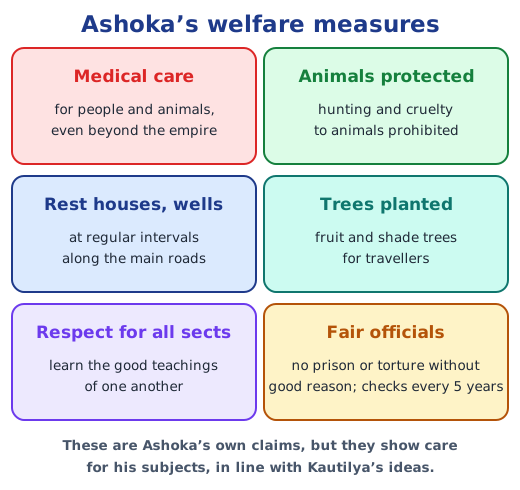
The edicts list Ashoka’s welfare work. He said he provided medical treatment for people and animals, even in southern kingdoms outside his empire; he banned hunting and cruelty to animals, an early step towards protecting wildlife; he had wells dug and rest houses built at intervals along the main roads, with fruit and shade trees; and he urged all sects to learn the good teachings of one another. He told his officials to be fair and patient, and promised an inspector every five years to check that no one was jailed or tortured without good reason. We need not believe every claim, but like Kautilya he clearly cared about his subjects’ welfare.
After Ashoka
The empire lasted about half a century after Ashoka’s death, but his successors could not hold it together, many smaller kingdoms broke away, and around 185 BCE a new phase of Indian history began. The Mauryan legacy endured: the lion capital of Ashoka’s pillar at Sarnath is India’s national emblem today.
Why it matters
The Mauryas united almost the whole Subcontinent for the first time. How Magadha grew strong enough to make this possible is in the rise of Magadha, and how empires work, and why they break up, in what is an empire. Every question is answered in the NCERT solutions for Chapter 5; see all of the Chapter 5 notes.
Practice
-
Which Greek historian and diplomat lived at Chandragupta Maurya’s court?
Show answer
Answer: (b) Megasthenes
-
In Kautilya’s saptanga, what is ‘kosha’?
Show answer
Answer: (b) The treasury
-
What did Ashoka call himself in his edicts?
Show answer
Answer: (b) Devanampiya Piyadasi
-
Name the seven parts of a kingdom in Kautilya’s saptanga.
Show answer
Answer: Swami, the king; amatya, the councillors, ministers and high officials; janapada, the territory and its people; durga, the fortified towns and cities; kosha, the treasury; danda, the forces of defence and of law and order; and mitra, the allies.
-
Give three welfare measures that Ashoka claimed in his edicts.
Show answer
Answer: Medical treatment for people and for animals, even outside his empire; wells and rest houses along the main roads, with fruit and shade trees planted; and a ban on hunting and cruelty to animals. He also asked all sects to respect one another.
Questions students ask
Who founded the Maurya empire?
Chandragupta Maurya founded it around 321 BCE, a few years after Alexander left India. Guided by his mentor Kautilya, he overthrew the unpopular Nanda dynasty of Magadha, made Pataliputra his capital, defeated the Greek satraps in the northwest and built an empire reaching from the northern plains down to the Deccan.
What is Kautilya’s saptanga?
It is Kautilya’s idea, in the Arthashastra, that a kingdom has seven parts: the king, the ministers and officials, the territory with its people, fortified towns, the treasury, the forces of defence and order, and allies. Together they should make the kingdom settled, well protected and prosperous.
Why did Ashoka give up war?
According to one of his own edicts, Ashoka attacked Kalinga, in today’s Odisha, and saw enormous death and destruction in the war. Moved by it, he chose to give up violence as far as possible and follow the Buddha’s path of peace and non-violence, ruling through dharma instead.
Where are Ashoka’s edicts found?
Across the Subcontinent, on rocks, on pillars and in caves: for example at Girnar in Gujarat, Kalsi in Uttarakhand, Dhauli in Odisha, Sanchi in Madhya Pradesh, Sarnath in Uttar Pradesh, Maski in Karnataka, Lumbini in Nepal, Mansehra in Pakistan and Kandahar in Afghanistan.
Stuck on a question?
Take a photo and Lagnever AI explains it step by step. Try it for 7 days for ₹2.
Get it on Google Play Open in browser
For parents: after the trial, the plan renews monthly by UPI or card autopay. You can cancel anytime in the app.