
What is an empire?
Answer in short
An empire is a vast territory that joins many smaller kingdoms or regions under one powerful ruler, the emperor, often after war. The smaller kingdoms usually kept their own rulers but became tributaries, paying tribute as a sign of loyalty. The emperor ruled from a capital, with an army, officials, laws and roads.
Stuck on a question? Take a photo and Lagnever AI explains it step by step. Try it for 7 days for ₹2. Get it on Google Play
Supreme power
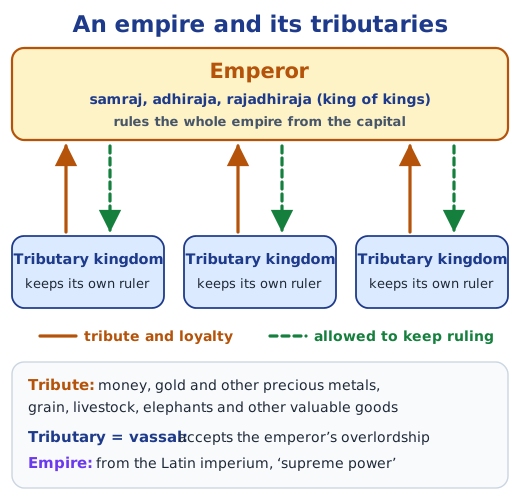
The English word empire has its roots in the Latin imperium, meaning ‘supreme power’. Put simply, an empire is a group of smaller kingdoms or territories under the control of one powerful ruler, or a group of rulers, usually after defeating them in war. Ancient Sanskrit texts show the same idea in their titles for an emperor: samraj, ‘the lord of all’ or ‘supreme ruler’; adhiraja, ‘overlord’; and rajadhiraja, ‘king of kings’. Indian history is full of empires that rose, spread, lasted a while and then disappeared; the last one to rule the Subcontinent ended less than a century ago.
The emperor and the tributaries
In an empire the smaller territories usually kept their own rulers, but each became a tributary of the emperor. A tributary paid tribute, a payment in money, precious metals such as gold, grain, cattle, elephants or other goods produced in its land, to show submission, loyalty or respect. Another word for a tributary is a vassal: it accepted the emperor’s overlordship. In return, emperors generally let the regional kings or chiefs go on governing their own areas. The emperor governed all these lands from a capital, normally a big centre of trade and administration.
Six features of an empire
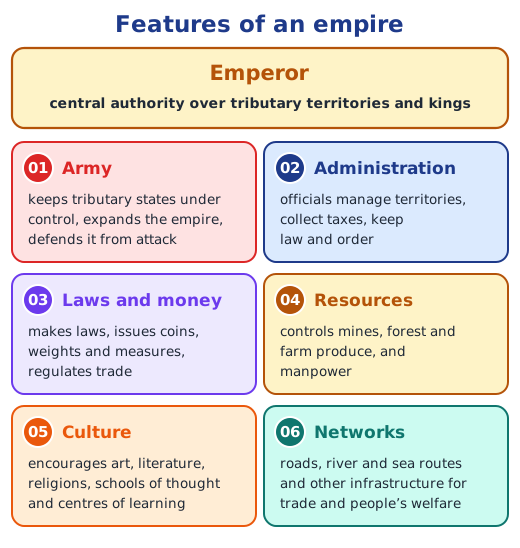
At the centre of an empire is the emperor’s authority over all the tributary lands and kings. Around it, the book lists six features. An empire:
- keeps an army, to control the tributary states, to expand, and to defend itself from attack;
- runs an administration, with officials who manage territories, collect taxes and keep law and order;
- makes laws, issues coins, weights and measures, and regulates trade;
- controls resources such as mines, forest and farm produce, and manpower;
- encourages art, literature, religions, schools of thought and centres of learning;
- maintains roads, river and sea routes and other infrastructure for government, trade and welfare.
Why become an emperor?
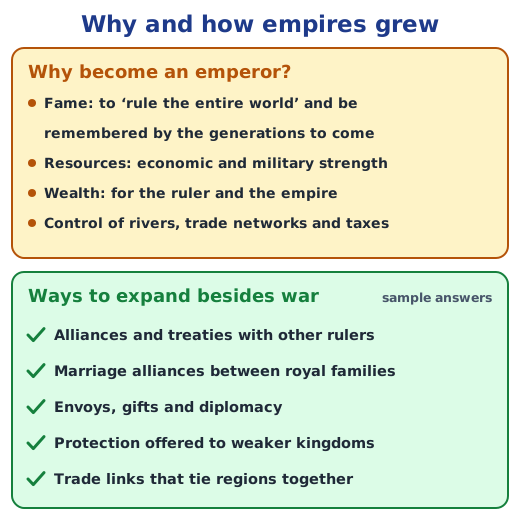
Ruling an empire is hard: its peoples speak different languages and follow different customs, and its borders are long. Why, then, did kings want one? Some dreamed of ‘ruling the entire world’, a way of saying that they wanted vast lands and lasting fame. Others wanted the resources of new lands, to build up economic and military strength, or simply great wealth. Rulers also tried to control rivers and trade networks, for the goods and taxes they brought. A kingdom often began by attacking its neighbours, built forts at strategic places such as its borders, and among many warring kingdoms the one with the strongest army and the most surplus resources became the overlord.
Trade pays for power
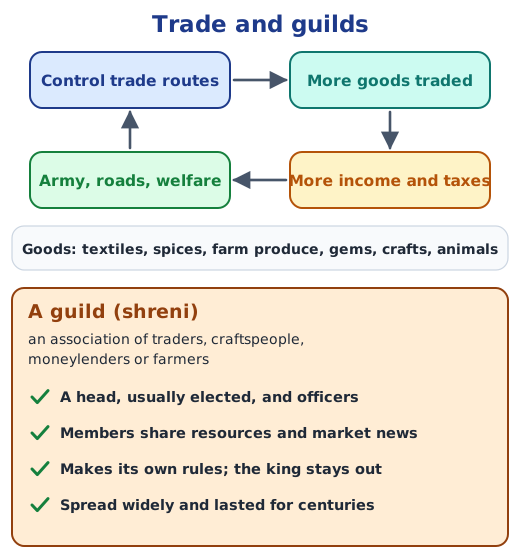
Military campaigns, especially far from home, are expensive. Soldiers need food, clothes, weapons and pay; elephants and horses need care; and roads or ships have to be built. That takes economic power, workers and resources. Production and trade are therefore keys to holding an empire, and to the welfare of its people, which a good ruler cares about. Controlling trade routes inside and beyond the empire meant more goods, more income for producers and more taxes. Ancient India traded textiles, spices, farm produce, gems, handicrafts and animals, within the land and far beyond it.
Traders and others organised themselves into guilds (shrenis), with an elected head and officers expected to be honest. Members cooperated, sharing resources and information on markets and workers, and set their own rules; the king was not to interfere. Like village councils, guilds show how well Indian society could organise itself.
Why empires are fragile
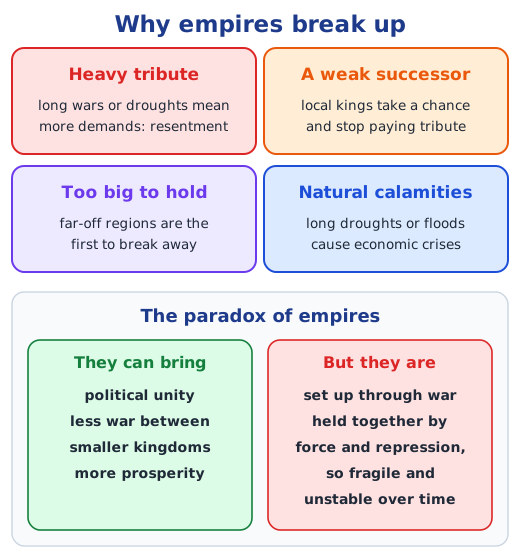
Mighty empires, from the Roman and Persian to the Ottoman and British, have all disappeared. Historians point to several causes. If an emperor needs more resources for long wars or in a drought, heavier demands for tribute breed resentment. If a strong emperor is followed by a weak one, local kings may stop paying. The larger an empire, the harder it is to hold, and distant regions break away first. Natural calamities such as long droughts or floods can also shake it. This is the paradox of empires: they can bring political unity, fewer wars between small kingdoms and more prosperity, but they are usually set up through war and kept going by force, which makes them fragile.
Why it matters
These ideas explain the story of India’s first empires: how Magadha rose and how the Mauryas built and held an empire, in the Mauryan empire and Ashoka. Answers to every question are in the NCERT solutions for Chapter 5; see all of the Chapter 5 notes.
Practice
-
Which Sanskrit title means ‘king of kings’?
Show answer
Answer: (c) Rajadhiraja
-
What did a tributary kingdom give the emperor?
Show answer
Answer: (b) Tribute, such as money, grain or elephants
-
Which of these is NOT a cause of an empire’s decline given in the chapter?
Show answer
Answer: (d) Too many guilds
-
List the six features of an empire.
Show answer
Answer: It keeps an army; it runs an administration with officials who manage territories, collect taxes and keep order; it makes laws and issues coins, weights and measures; it controls resources such as mines, forests and farm produce; it encourages art, literature, religions and learning; and it maintains roads, river and sea routes and other infrastructure.
-
Why was trade so important to an empire?
Show answer
Answer: Armies were costly: soldiers, animals, weapons, roads and ships all had to be paid for. Trade brought income to producers and taxes to the ruler, so controlling trade routes gave an empire the wealth it needed to survive and to look after its people.
Questions students ask
What is the meaning of empire in Class 7 SST?
An empire joins many smaller kingdoms or territories under the power of one strong ruler or a group of rulers, often after war. The word comes from the Latin imperium, ‘supreme power’. The smaller states keep their rulers but become tributaries of the emperor, who rules from a capital.
What is a tributary state?
A tributary is a ruler or state that has accepted an emperor as overlord and pays him tribute, such as money, gold and other precious metals, grain, cattle, elephants or other goods of value, to show that it submits to him and is loyal. It is also called a vassal, and it accepts the emperor’s overlordship.
Why are empires fragile?
Empires break up when heavy demands for tribute cause resentment, when a weak ruler follows a strong one and local kings stop paying, when far-off regions split away, or when droughts and floods cause economic crises. Because they are built by war and held by force, they are unstable over time.
Stuck on a question?
Take a photo and Lagnever AI explains it step by step. Try it for 7 days for ₹2.
Get it on Google Play Open in browser
For parents: after the trial, the plan renews monthly by UPI or card autopay. You can cancel anytime in the app.