
The rise of Magadha
Answer in short
Magadha, in today’s south Bihar, became the strongest mahajanapada between the 6th and 4th centuries BCE. Fertile Ganga plains, forests with timber and elephants, iron ore from nearby hills and the Ganga and Son rivers gave it food, weapons and trade. Ajatashatru made it powerful, and the Nandas turned it into an empire.
Stuck on a question? Take a photo and Lagnever AI explains it step by step. Try it for 7 days for ₹2. Get it on Google Play
A mahajanapada pulls ahead
The 6th to the 4th century BCE was a time of deep change in north India. In the previous chapter we met the sixteen mahajanapadas, the big states of north and central India, each with its assembly. One of them, Magadha, covering today’s south Bihar and some nearby areas, grew steadily more important and prepared the ground for the joining of many kingdoms into India’s first empire. Strong early kings, such as Ajatashatru, made it the leading centre of power. Two of the world’s most famous religious teachers lived in his time: Siddhartha Gautama, who became the Buddha, and Vardhamana, better known as Mahavira.
Gifts of geography
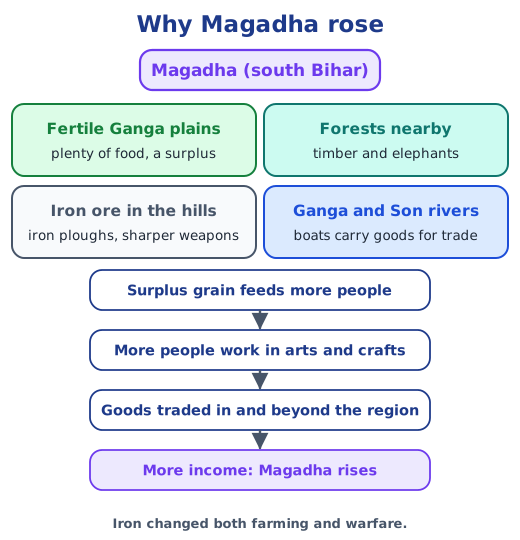
Magadha had natural advantages that few rivals could match. It lay in the Ganga plains, where fertile soil gave rich harvests. Its forests supplied timber for buildings and boats, and elephants, which could be caught and trained for the army. In the hills close by lay iron ore and other minerals. And two rivers, the Ganga and the Son, served as highways for carrying goods.
Iron changes farming and war
Iron transformed other technologies, from farming to warfare. Iron ploughs could break more ground, so farmers produced more grain. Iron weapons were lighter and sharper, which made Magadha’s army more capable. A carved panel from the Sanchi stupa, made centuries later, gives an idea of armies of the age: soldiers on elephants, on horses and on foot lay siege to Kusinara, today’s Kushinagar, to recover relics of the Buddha, carried away on an elephant under a parasol.
From surplus to trade
Surplus grain meant that not everyone had to farm. More people could work as artisans and craftspeople, and their goods were in demand both inside and outside the kingdom’s borders. The Ganga and Son rivers made it easy to move these goods by boat. Flourishing trade raised Magadha’s income, and a richer state could pay for a bigger army. Step by step, geography, iron, surplus and trade turned Magadha into the strongest power of its time.
The Nanda dynasty
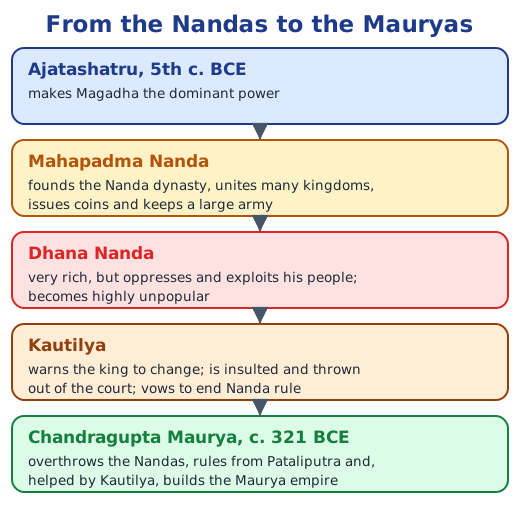
Around the 5th century BCE, Mahapadma Nanda became powerful in Magadha, where he founded the Nanda dynasty. He brought many smaller kingdoms under his rule, building an empire that covered parts of northern and eastern India. With a thriving economy he issued coins, punch-marked pieces of silver, a sign of his economic strength, and Greek accounts tell us the Nandas kept a large army. The famous grammarian Panini, whose Ashtadhyayi sets out the rules of Sanskrit in 3,996 short sutras, is placed in the Nanda period, around the 5th century BCE.
The last Nanda emperor, Dhana Nanda, was very rich, but he oppressed and exploited his people and became highly unpopular. When Kautilya, a teacher from Takshashila, warned him to change his ways, Dhana Nanda insulted him and threw him out of his court. Kautilya vowed to end Nanda rule, and with his help Chandragupta Maurya conquered the Nanda empire around 321 BCE.
Meanwhile, in the northwest
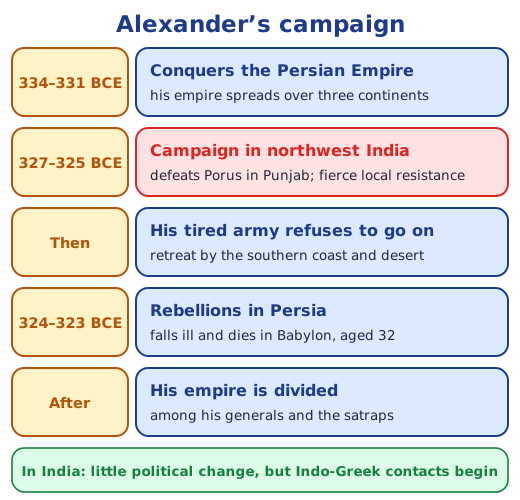
While Magadha grew in the east, the northwest held smaller kingdoms along an ancient route to the Mediterranean, among them the Pauravas under King Porus. Alexander of Macedonia, having conquered the Persian Empire in 334–331 BCE, pushed into India in 327–325 BCE. He defeated Porus in Punjab, but local tribes and rulers resisted fiercely, he massacred the people of several cities, and he was himself badly wounded. His homesick soldiers refused to march deeper towards the Ganga, so he retreated, losing many men to thirst, hunger and disease. When Porus was asked how he wished to be treated, he answered “like a king”, and Alexander left him to rule as a satrap.
Why it matters
Magadha shows how geography, technology and trade can lift a kingdom into an empire. Its next rulers, the Mauryas, are in the Mauryan empire and Ashoka, and the idea of an empire itself is in what is an empire. Answers to every question are in the NCERT solutions for Chapter 5; see all of the Chapter 5 notes.
Practice
-
Which two rivers helped Magadha’s trade?
Show answer
Answer: (a) Ganga and Son
-
Who founded the Nanda dynasty?
Show answer
Answer: (c) Mahapadma Nanda
-
Which king did Alexander defeat in Punjab?
Show answer
Answer: (b) Porus
-
How did iron help Magadha grow?
Show answer
Answer: Iron ore came from the hills nearby. Iron ploughs let farmers till more land and grow more grain, and lighter, sharper iron weapons made the army stronger, so Magadha could feed more people and defeat its rivals.
-
Why did the Nanda empire fall?
Show answer
Answer: Its last emperor, Dhana Nanda, was very rich but oppressed and exploited his people and became highly unpopular. This opened the way for Chandragupta Maurya, guided by Kautilya, to overthrow him around 321 BCE.
Questions students ask
Where was Magadha?
Magadha lay in the Ganga plains, in what is now south Bihar and some nearby areas. Its old capital was Rajagriha, today’s Rajgir, and Pataliputra, near modern Patna, became the capital of the Maurya empire that grew out of it.
Why did Magadha become so powerful?
It had fertile land that gave surplus grain, forests with timber and elephants, iron ore for ploughs and weapons, and the Ganga and Son rivers for transport. Surplus food supported craftspeople, trade brought income, and strong kings such as Ajatashatru and the Nandas used these advantages to defeat their rivals.
Who was Mahapadma Nanda?
He founded the Nanda dynasty of Magadha around the 5th century BCE. He united many smaller kingdoms into an empire covering parts of northern and eastern India and issued coins that showed his economic power, and Greek accounts say the Nandas kept a large army.
Stuck on a question?
Take a photo and Lagnever AI explains it step by step. Try it for 7 days for ₹2.
Get it on Google Play Open in browser
For parents: after the trial, the plan renews monthly by UPI or card autopay. You can cancel anytime in the app.