
Class 7 Social Science Chapter 8: How the Land Becomes Sacred Notes
This chapter in five lines
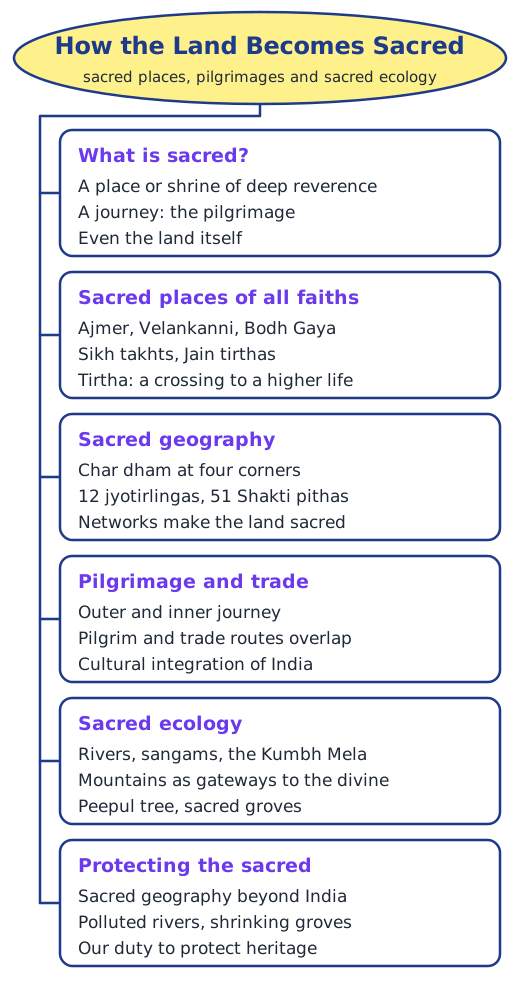
How the Land Becomes Sacred shows how places, journeys and even the whole land can be sacred in India. Every faith has its shrines; networks of tirthas such as the char dham, 12 jyotirlingas and 51 Shakti pithas cover the subcontinent; pilgrims and traders shared routes; and sacred rivers, mountains and groves helped protect nature and draw Indian culture together.
What is this chapter about?
The chapter opens with a line from the Bhagavata Purana that counts the elements, rivers, seas, trees and all creatures as parts of the supreme Lord’s body. It asks four questions: what sacredness is, how a land becomes sacred, how sacred sites and pilgrimage routes connect with people’s lives, and how this sacred geography helped bring the cultures of the subcontinent together.
What is sacred?
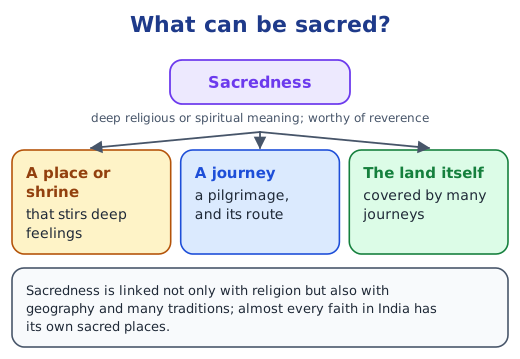
Here, something is sacred if it carries deep religious or spiritual meaning and is worthy of reverence. That can be a shrine that stirs strong feelings, a special journey called a pilgrimage, the route it follows, or even the land it crosses. So sacredness is tied not only to religion but also to geography and to many traditions.
Sacred places of every faith
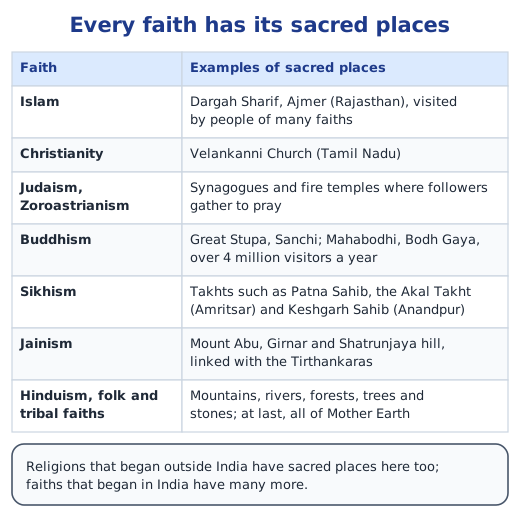
Almost every faith in India has sacred places. Religions that began outside India have shrines here that people of other faiths also visit, such as the Dargah Sharif at Ajmer and the Velankanni Church in Tamil Nadu. Buddhists revere places linked with the Buddha, like the Great Stupa at Sanchi and the Mahabodhi at Bodh Gaya, which draws over four million visitors a year. Sikhs hope to visit the takhts, seats of spiritual authority such as the Akal Takht at Amritsar, at least once. Jain tirthas such as Mount Abu, Girnar and Shatrunjaya are linked with the Tirthankaras, and hilltop shrines like Sabarimala in Kerala were once reached only by a hard trek. Read sacred geography of India.
Pilgrimage and sacred geography
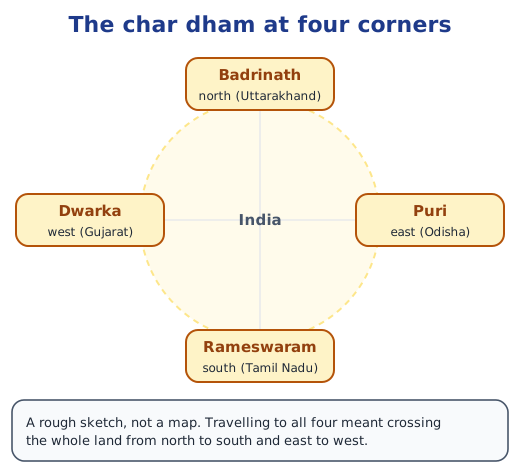
A tirtha is literally a place to cross a river, and symbolically a place to cross into a higher, spiritual life. For at least 3,000 years, long before trains and buses, Indians have walked across the subcontinent to such places. The char dham were placed at the four corners of the land, Badrinath, Rameswaram, Puri and Dwarka, and the 12 jyotirlingas and 51 Shakti pithas are spread over the whole map, some in today’s Bangladesh and Pakistan. In the story of the Shakti pithas, the places where parts of Sati’s body fell became shrines, so the entire land is seen as the divine mother’s body. Crisscrossed by such networks, the land itself becomes sacred.
Travellers and traders
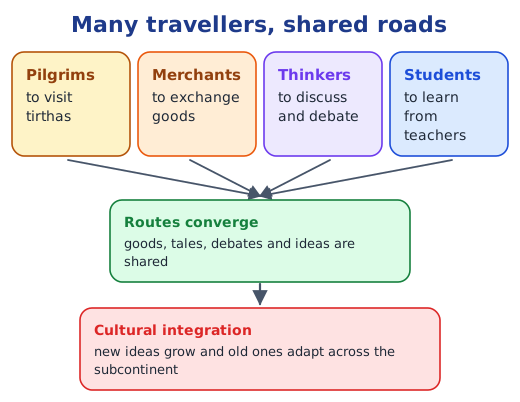
People travelled for many reasons: pilgrims to visit tirthas, merchants to trade, thinkers to debate and spread their ideas, and students to learn from famous teachers. Their routes often met, and the sharing of goods, stories and debates gave rise to new ideas and changed old ones, which became a major force in the cultural integration of the subcontinent. Pilgrims needed supplies that traders could provide, so pilgrimage routes and trade routes such as the Uttarapatha and Dakshinapatha overlapped. Read pilgrimage and trade.
Sacred ecology
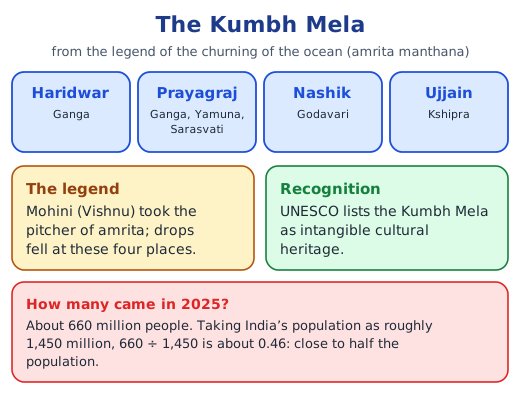
Most tirthas lie beside rivers or lakes, inside forests or up on mountains, so the landscape itself is seen as a sacred space, a punyakshetra, and this has helped protect nature. Rivers have been worshipped since Vedic times, and the Kumbh Mela draws millions to Haridwar, Prayagraj, Nashik and Ujjain. Mountains are seen as gateways to the divine. The peepul tree is sacred to four faiths, and communities have protected sacred groves, which shelter wildlife and conserve water. The Niyam Dongar hill in Odisha, Sikkim’s sacred lakes and caves and the Toda peaks of the Nilgiris show how widely nature is revered. Read sacred groves and sacred ecology.
Protecting the sacred
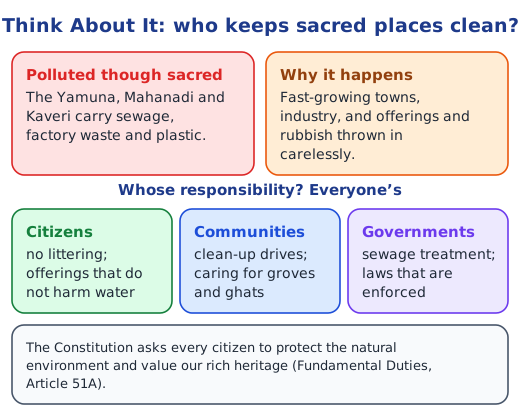
Sacred geography is found beyond India too, from ancient Greece to the Maori of New Zealand, whose ancestor mountain has been given the rights of a person by law. Yet in India many sacred rivers, such as the Yamuna, Mahanadi and Kaveri, are polluted, and sacred groves are shrinking. A worldview that treats nature as sacred can help in an age worried about sustainability, and the Constitution reminds us of our duty to protect our heritage.
Before we move on
All faiths in India have sacred places spread across the land; Hindu pilgrimage networks cover the whole subcontinent and serve both personal growth and trade and cultural unity; many traditions see the land itself as sacred; and protecting these places is our shared duty. Answers to every question are in the NCERT solutions for Chapter 8.
Key terms
| Term | Meaning |
|---|---|
| Sacredness | Deep religious or spiritual meaning that makes a place, a journey or the land worthy of reverence. |
| Pilgrimage (tirthayatra) | A journey to a sacred place that matters within a religion or belief system; in India it is also an inner journey with its own code of conduct. |
| Shrine | A place held holy because it is tied to a god, a holy relic or a revered spiritual figure. |
| Relic | A part of a saint’s or spiritual figure’s body, or something they owned, kept as an object of reverence, as in a relic stupa. |
| Tirtha | Literally a place to cross a river; symbolically a place to cross from ordinary life to a higher, spiritual life. |
| Tirthankara | In Jainism, ‘one who makes a tirtha’: the supreme teachers of dharma who guide the crossing to a higher life. |
| Takht | A seat of spiritual authority in Sikhism, such as the Akal Takht at Amritsar or Takht Sri Patna Sahib. |
| Char dham | Four pilgrimage sites at the corners of India: Badrinath (north), Rameswaram (south), Puri (east) and Dwarka (west). |
| Jyotirlingas and Shakti pithas | Networks of 12 shrines of Shiva and 51 shrines of the divine mother spread across the subcontinent. |
| Sacred geography | The way networks of pilgrimage sites crisscross a land so that the land itself comes to be seen as sacred. |
| Sangam | The meeting point of rivers, such as Prayag, where the Ganga, Yamuna and the unseen Sarasvati meet. |
| Sacred grove | A natural forest protected by a community as the home of a deity, which shelters plants, animals and water. |
Topics in this chapter
Practice
-
Which of these is one of the char dham?
Show answer
Answer: (b) Puri
-
How many Shakti pithas are there in the tradition?
Show answer
Answer: (c) 51
-
Where, according to Buddhist tradition, did the Buddha attain enlightenment?
Show answer
Answer: (b) Bodh Gaya
-
In which state is the Niyam Dongar hill, sacred to the Dongria Khond?
Show answer
Answer: (b) Odisha
-
What is a sacred grove called in Marathi?
Show answer
Answer: (b) devarai
-
Which tree do Hindus, Buddhists, Sikhs and Jains all hold sacred?
Show answer
Answer: (c) Peepul
Questions students ask
What are the main topics of Class 7 SST Chapter 8?
What sacredness means; sacred places of many faiths; tirthas and pilgrimages; networks such as the char dham, jyotirlingas and Shakti pithas that make up a sacred geography; why people travelled and how pilgrimage met trade; sacred rivers, the Kumbh Mela, mountains, the peepul tree and sacred groves; sacred geography beyond India; and protecting sacred places.
Is How the Land Becomes Sacred in the new NCERT Class 7 Social Science book?
Yes. It is Chapter 8 of Exploring Society: India and Beyond, the Class 7 Social Science textbook Part 1 (Reprint 2026-27), on pages 167 to 184, in the theme Our Cultural Heritage and Knowledge Traditions. It follows The Gupta Era.
How does the land become sacred?
Sacred sites are spread all over India and joined into networks, such as the char dham at the four corners, the 12 jyotirlingas and the 51 Shakti pithas. Pilgrims travelling between them crisscross the land, so the whole geography comes to be seen as sacred. Many traditions also see rivers, mountains, forests and the Earth herself as divine.
What role did pilgrimage play in uniting India?
Pilgrims crossing the subcontinent met different languages, customs, clothes and foods, but also noticed what they shared. Their routes overlapped with those of traders, scholars and students, so goods, stories and ideas moved across the land. Over centuries this helped the cultural integration of the subcontinent.
Stuck on a question?
Take a photo and Lagnever AI explains it step by step. Try it for 7 days for ₹2.
Get it on Google Play Open in browser
For parents: after the trial, the plan renews monthly by UPI or card autopay. You can cancel anytime in the app.