
Sacred groves and sacred ecology
Answer in short
Sacred ecology is the idea that nature itself is holy: rivers, sangams, mountains, trees and forests are revered, which helps protect them. Sacred groves are forests kept as the homes of deities, where hunting and felling are forbidden; they shelter wildlife, conserve water and protect animals such as fruit bats, though many are now shrinking.
Stuck on a question? Take a photo and Lagnever AI explains it step by step. Try it for 7 days for ₹2. Get it on Google Play
Nature as sacred space
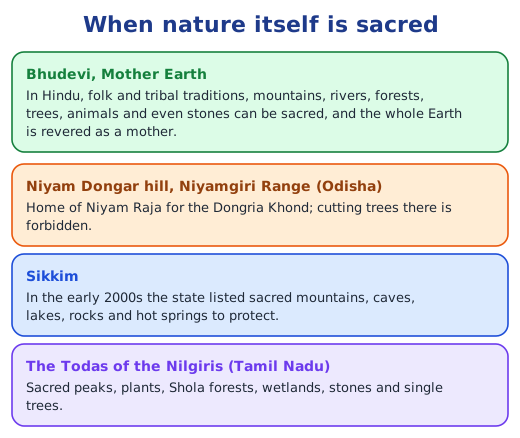
Hindu traditions and many folk and tribal belief systems see the divine in all of nature. Particular mountains, rivers and forests are worshipped, many rivers are regarded as goddesses, and some trees, plants and animals are especially holy; in the end the whole Earth is Bhudevi, Mother Earth. For the Dongria Khond, the Niyam Dongar hill in Odisha’s Niyamgiri Range is the home of Niyam Raja, who provides all they need, and cutting its trees is forbidden. In the early 2000s Sikkim listed the caves, lakes, hot springs, rocks and peaks it held sacred, for protection, and the Todas of the Nilgiris hold peaks, plants, Shola forests, wetlands and even single stones sacred. Since tirthas usually lie by rivers and lakes, in forests or on mountains, the landscape is a sacred space, a punyakshetra, and this outlook has helped protect nature.
Rivers and sangams
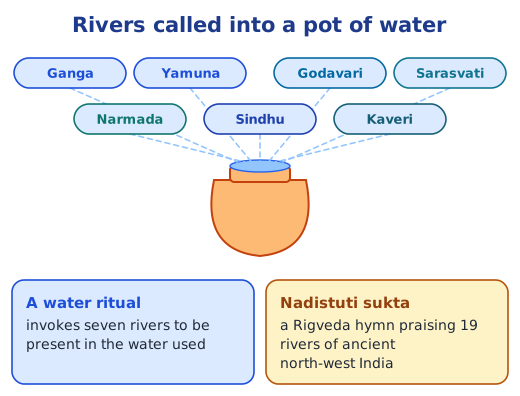
People in India have worshipped rivers ever since the Vedic age. The nadistuti sukta of the Rigveda praises 19 major rivers of ancient north-west India, and even today many water rituals call on the Ganga, Yamuna, Godavari, Sarasvati, Narmada, Sindhu and Kaveri to be present in the water. These rivers have been lifelines of Indian civilisation, so the places where they rise, the streams that join them and the towns on their banks draw pilgrims too, and people speak of them with respect as ‘Ganga ji’ or ‘Yamuna ji’. Confluences, or sangams, are especially sacred: Prayag stands where the Ganga, Yamuna and unseen Sarasvati meet.
The Kumbh Mela
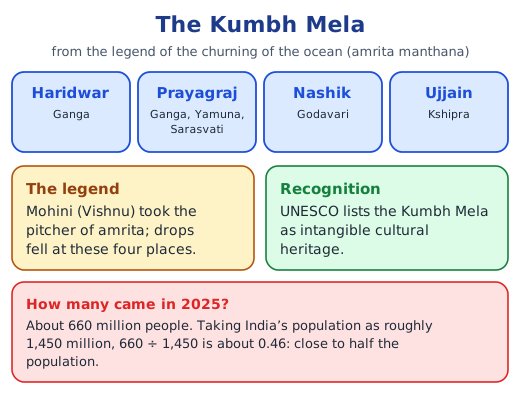
In the legend of the churning of the ocean, the devas and asuras worked together for once to obtain amrita, the nectar of immortality. Vishnu, as Mohini, snatched away the pitcher, or kumbha, and a few drops fell at Haridwar, Prayagraj, Nashik and Ujjain. The Kumbh Mela is held at these places, where a dip at the right time is considered most auspicious. UNESCO lists it as intangible cultural heritage, and about 660 million people took part in 2025.
Mountains and the peepul tree
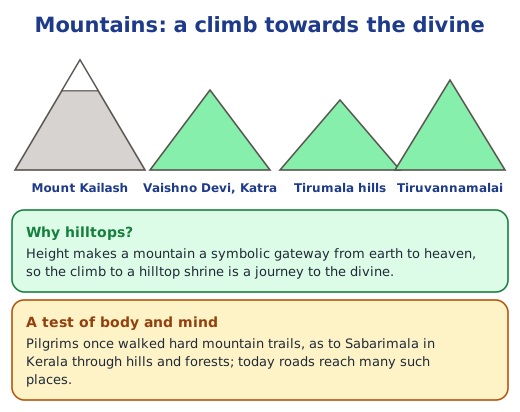
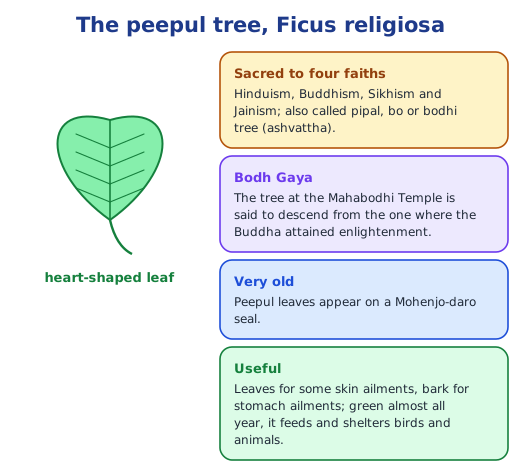
Across the world, mountains carry legends of gods and heroes, and their height makes them seem like gateways to heaven. That is why so many Indian tirthas, from Mount Kailash to Vaishno Devi, the Tirumala hills and Tiruvannamalai, sit on heights reached by hard trails. Trees are revered too, often decorated with turmeric and kumkum. The peepul, or Ficus religiosa, is holy for Hindus, Buddhists, Sikhs and Jains alike; the tree at Bodh Gaya is said to descend from the one under which the Buddha attained enlightenment, and peepul leaves appear on a seal from Mohenjo-daro.
Sacred groves
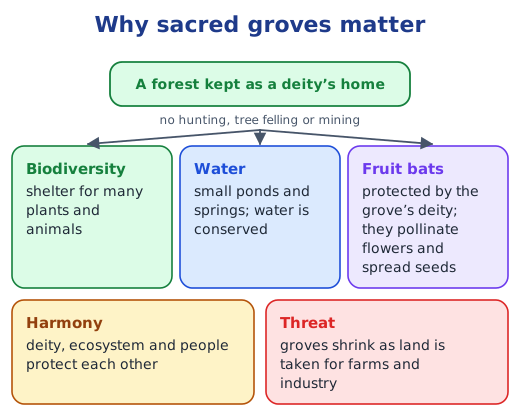
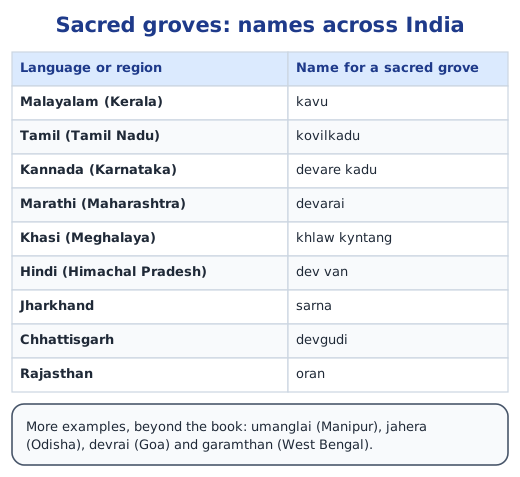
Over time, many rural and tribal communities chose to protect certain natural forests from hunting, tree felling and mining, seeing them as the homes of deities, such as Ryngkew or Basa in Meghalaya. These sacred groves shelter rich plant and animal life, and many hold small ponds that help conserve water. They have many names: kavu in Malayalam, kovilkadu in Tamil, devare kadu in Kannada, devarai in Marathi, khlaw kyntang in Khasi, dev van in Himachal Pradesh, sarna in Jharkhand, devgudi in Chhattisgarh and oran in Rajasthan. In Thanjavur district, a local chronicle says the grove deities protect fruit bats, whose sighting is lucky, and the bats in turn pollinate flowers and spread seeds. India once had many thousands of groves, but encroachment for farming and industry is shrinking them.
Beyond India, and today
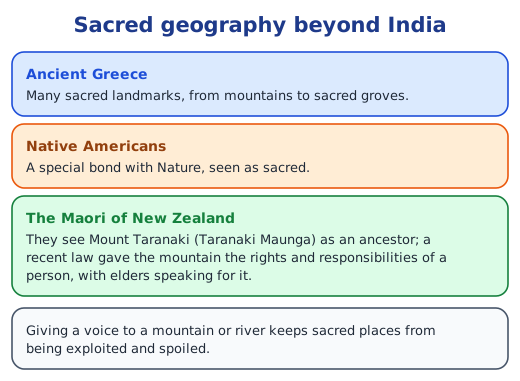
Ancient Greece had sacred mountains and groves, Native Americans saw nature as sacred, and the Maori of New Zealand regard Mount Taranaki as an ancestor; a recent law gave it the rights and responsibilities of a person. In India, though, many sacred rivers are polluted and sacred places degraded. When a river is drained almost dry or a sacred mountain is threatened, people have spoken up for their environment and values, and a worldview that sees nature as sacred has much to offer a world worried about sustainability.
Why it matters
Seeing rivers, mountains and forests as sacred has helped Indians protect them for centuries, and it can still guide conservation today. The pilgrimage networks that cross this landscape are in sacred geography of India, and the journeys themselves in pilgrimage and trade. Answers to every question are in the NCERT solutions for Chapter 8; see also the full Chapter 8 notes.
Practice
-
Where is the Kumbh Mela held?
Show answer
Answer: (a) Haridwar, Prayagraj, Nashik and Ujjain
-
What is the botanical name of the peepul tree?
Show answer
Answer: (b) Ficus religiosa
-
What is a sacred grove called in Malayalam?
Show answer
Answer: (a) kavu
-
How do fruit bats in sacred groves help the forest?
Show answer
Answer: They pollinate flowers and spread seeds; in Thanjavur district, a local chronicle says the grove deities protect them, and seeing one is thought to bring good luck.
-
Why are many tirthas on hilltops?
Show answer
Answer: Because their height makes mountains a symbolic gateway from earth to heaven, so the hard climb to a hilltop shrine stands for the journey to the divine and tests the pilgrim’s body and mind.
Questions students ask
What is a sacred grove?
A sacred grove is a natural forest that a rural or tribal community protects because it is seen as the home of a deity. Hunting, tree felling and mining are not allowed, so it shelters many plants and animals and often small water bodies. Examples include Mawphlong near Shillong and groves of the Bhils.
Why are rivers sacred in India?
Rivers have been worshipped since Vedic times; the Rigveda’s nadistuti sukta praises 19 rivers, and a common verse invokes the Ganga, Yamuna, Godavari, Sarasvati, Narmada, Sindhu and Kaveri into ritual water. They are lifelines of Indian civilisation, so their sources, tributaries and banks are sacred too.
What is the Kumbh Mela?
It is a great gathering for a holy dip at Haridwar, Prayagraj, Nashik and Ujjain, where, in the legend of the churning of the ocean, drops of amrita fell from the pitcher that Mohini carried. UNESCO lists it as intangible cultural heritage, and about 660 million people took part in 2025.
Stuck on a question?
Take a photo and Lagnever AI explains it step by step. Try it for 7 days for ₹2.
Get it on Google Play Open in browser
For parents: after the trial, the plan renews monthly by UPI or card autopay. You can cancel anytime in the app.