
Pilgrimage and trade
Answer in short
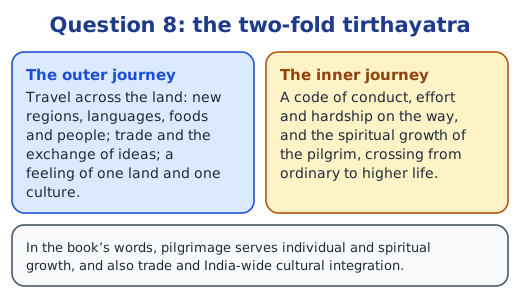
A pilgrimage, or tirthayatra, is both an outer journey across the land and an inner journey of discipline and spiritual growth. Pilgrims shared the roads with traders, scholars and students, and since pilgrims needed goods that traders supplied, pilgrimage and trade routes overlapped. This movement of people, goods and ideas helped unite the cultures of the subcontinent.
Stuck on a question? Take a photo and Lagnever AI explains it step by step. Try it for 7 days for ₹2. Get it on Google Play
A journey outside and inside
Many Indians make a tirthayatra, a pilgrimage to sacred places, at least once in their lives. It is a physical journey, but also an inner one, with a code of conduct to follow. For at least 3,000 years, without any modern transport, Indians have walked across the subcontinent in this way. Hilltop shrines such as Sabarimala in Kerala, which now draws over ten million devotees a year, were once reached by a hard trek through hills and forests; the difficulty itself stood for the challenges of the inner path. In Maharashtra, the 800-year-old Pandharpur wari sees pilgrims walk together for 21 days to the Vithoba temple every year.
Pilgrims on a train
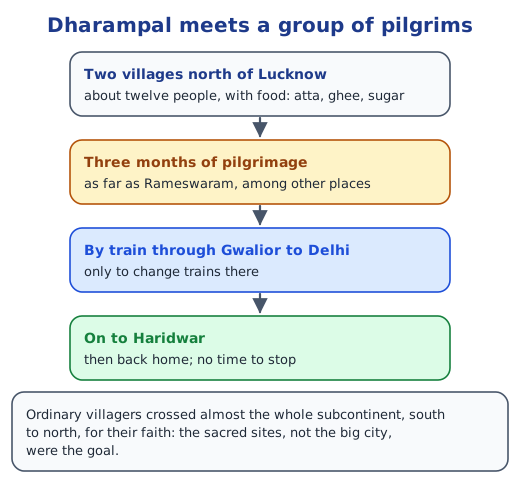
The historian and thinker Dharampal once met about a dozen villagers, a few women and several men, on a train from Gwalior to Delhi. They came from two villages north of Lucknow and had already spent three months on a pilgrimage reaching as far as Rameswaram, carrying their own atta, ghee and sugar. They would only change trains at Delhi, because they were heading straight on to Haridwar and then home. Their journey shows how ordinary people still crossed almost the whole length of India for their faith.
Why people travelled
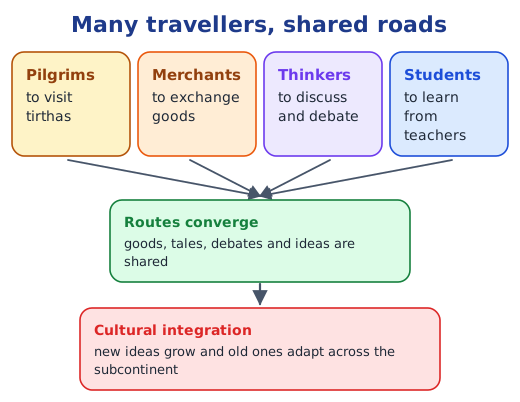
Faith was not the only reason to travel. Merchants and traders went to exchange goods; thinkers travelled to discuss, debate and spread their ideas; students went to learn from famous teachers in other parts of the country. Though their reasons differed, their routes often came together. Everyone gained from the debates and from swapping goods, experiences and stories: fresh ideas appeared, old ones were reshaped, and over time this did much to knit the cultures of the subcontinent together.
Pilgrimage and trade routes
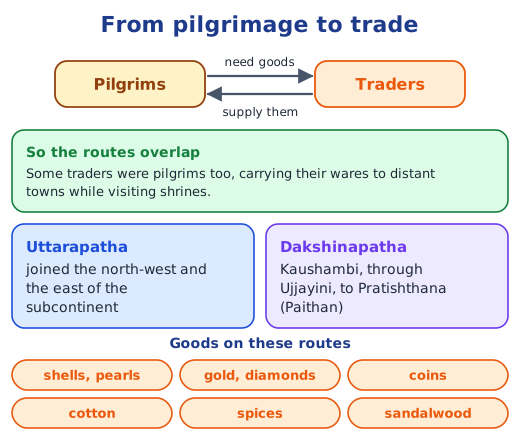
Pilgrims met traders all along their way, and both gained: pilgrims needed many items, and traders could supply them. So pilgrimage routes and trade routes often overlapped, and some traders were pilgrims too, taking their goods to distant towns while visiting shrines. In ancient India, the Uttarapatha joined the north-west and east of the subcontinent, while the Dakshinapatha ran from Kaushambi through Ujjayini to Pratishthana (Paithan). Along them moved shells and pearls, coins, gold and diamonds, cotton, spices and sandalwood.
Sacred places and livelihoods
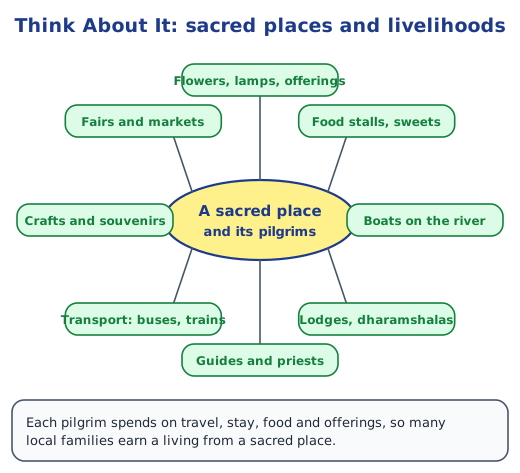
A sacred site still supports many livelihoods. Pilgrims spend on travel, rooms and food, and buy flowers, lamps, offerings, sweets, crafts and souvenirs; boatmen, guides, priests and transport workers earn from them, and fairs bring traders from far away. The chapter’s photographs of a busy riverside town and of women selling goods at a pilgrimage site hint at these links.
Why it matters
Pilgrimage joined faith, trade and learning, and so helped build a shared culture across a land of many languages and customs. The networks of sacred sites themselves are in sacred geography of India, and the rivers, mountains and groves along the way in sacred groves and sacred ecology. Answers to every question are in the NCERT solutions for Chapter 8; see also the full Chapter 8 notes.
Practice
-
For how long, at least, have Indians been crisscrossing the subcontinent on pilgrimage?
Show answer
Answer: (c) 3,000 years
-
Which route ran from Kaushambi through Ujjayini to Pratishthana?
Show answer
Answer: (b) Dakshinapatha
-
How long is the Pandharpur wari walk to the Vithoba temple?
Show answer
Answer: (c) 21 days
-
Why did Dharampal’s pilgrims not stop in Delhi?
Show answer
Answer: Delhi was not their goal: they only had to change trains there on the way to Haridwar, a sacred place, and then had to return home, so they had no time to spare.
-
Give two ways a sacred site can support the local economy.
Show answer
Answer: Pilgrims spend on food, lodging and transport, and they buy flowers, offerings, crafts and souvenirs, which gives work to many local families; fairs at sacred sites also bring trade.
Questions students ask
What is the two-fold significance of a pilgrimage?
Outwardly, it is a journey across the land that brings people into contact with other regions, languages and foods, and supports trade and cultural integration. Inwardly, it is a spiritual journey with a code of conduct, where effort and hardship on the way stand for crossing from ordinary life to a higher one.
How did pilgrimage routes help trade?
Pilgrims needed food, supplies and other goods, which traders along the way could provide, so pilgrimage and trade routes often ran together. Some traders combined business with pilgrimage, carrying their goods to distant towns while visiting shrines, along routes such as the Uttarapatha and Dakshinapatha.
How did travel help unite Indian culture?
Pilgrims, merchants, thinkers and students travelled for different reasons, but their routes converged. As they swapped goods, stories and arguments, fresh ideas arose, old ones changed, and travellers noticed what regions had in common. Over the centuries this helped knit the subcontinent’s cultures together.
Stuck on a question?
Take a photo and Lagnever AI explains it step by step. Try it for 7 days for ₹2.
Get it on Google Play Open in browser
For parents: after the trial, the plan renews monthly by UPI or card autopay. You can cancel anytime in the app.