
Sacred geography of India
Answer in short
Sacred geography is the idea that a whole land becomes sacred when pilgrimage sites are spread across it and joined by networks. In India, every faith has its shrines, and networks such as the char dham at the four corners, the 12 jyotirlingas and the 51 Shakti pithas cover the subcontinent, making the land itself sacred.
Stuck on a question? Take a photo and Lagnever AI explains it step by step. Try it for 7 days for ₹2. Get it on Google Play
What makes something sacred
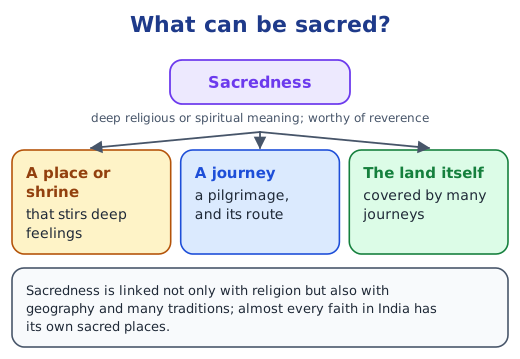
In this chapter, sacredness means finding something of deep religious or spiritual importance, worthy of respect and reverence. It may be a special place or shrine that brings up deep feelings and high thoughts. It may also be a special kind of journey, the pilgrimage, the route it takes, or the very land it covers. So sacredness reaches beyond religion into geography and many traditions.
Sacred places of many faiths
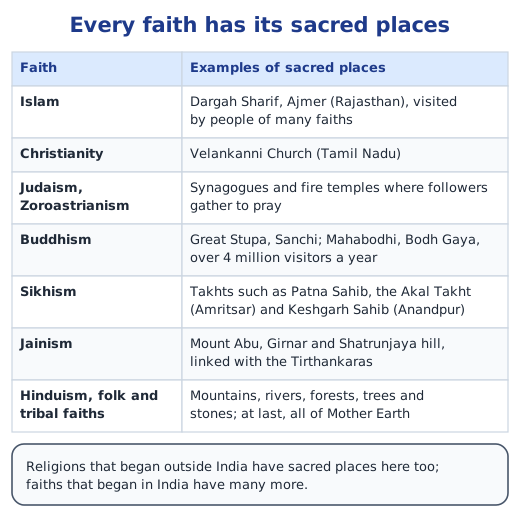
Places held holy by Muslims, Christians, Jews and Zoroastrians, whose religions began outside India, are found here too, and people of other faiths visit them as well, as at the Dargah Sharif in Ajmer or the Velankanni Church in Tamil Nadu. Faiths that began in India have many more. Buddhist sites are often places the Buddha visited or where his relics are kept, such as the relic stupa at Sanchi and the Mahabodhi at Bodh Gaya. Sikhs hope to visit the takhts, such as Patna Sahib, the Akal Takht in Amritsar and Keshgarh Sahib in Anandpur, and Sikh tradition records Guru Nanak’s journeys to Haridwar, Prayag, Mathura, Varanasi, Ayodhya, Puri and some Muslim shrines. Jain tirthas mark where the Tirthankaras attained liberation; Mount Abu, Girnar and Shatrunjaya are examples.
Tirthas and pilgrimage
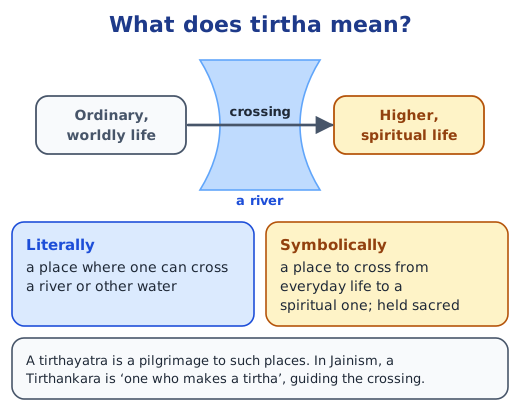
A pilgrimage is a journey to a place that matters within a religion or belief system. Many Indians make tirthayatras to tirthas during their lives. The word tirtha first meant a crossing place on a river; it came to mean a place where one crosses from everyday life into a spiritual one. Such a journey is physical, but also inner, with its own code of conduct. In 1961 Jawaharlal Nehru wrote that what drew people from south to north and back on these pilgrimages was ‘the feeling of one country and one culture’.
Networks across the land
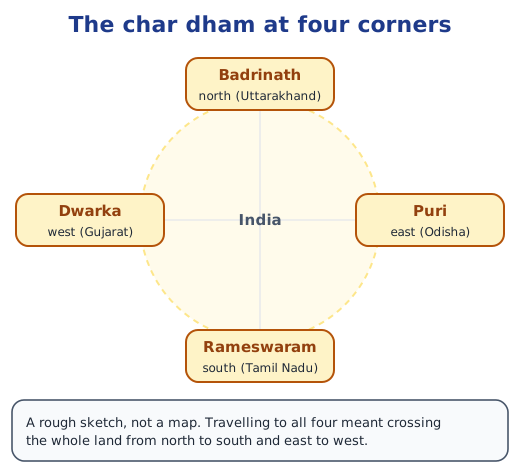
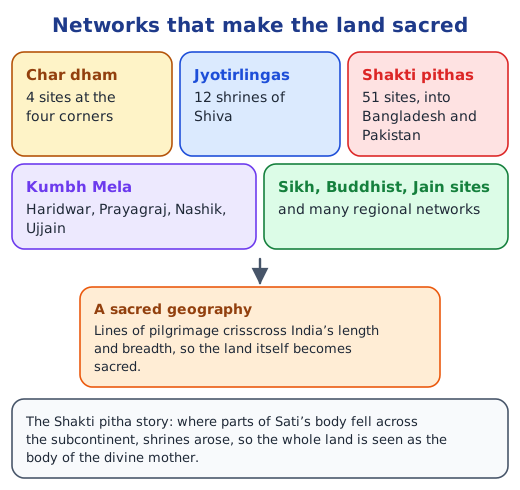
Sacred places in India are spread out but linked. The char dham seem to have been deliberately placed at the four corners: Badrinath in the north, Rameswaram in the south, Puri in the east and Dwarka in the west. Many also hope to visit the 12 jyotirlingas, shrines of Shiva, each with its own story, while the 51 Shakti pithas cover the whole map, reaching into today’s Bangladesh and Pakistan. In their story, Sati’s father insulted her and Shiva; Sati gave up her life, and Vishnu’s chakra cut her body into pieces that fell across the land. Each place became a shrine, so the land itself is the body of the divine mother.
One land, many journeys
Pilgrims visiting the sites of their faith naturally covered the geography of India. On the way they met many languages, customs, clothes and foods, but also noticed what they had in common. Regional networks added to the national ones, so the whole land was crossed again and again in every direction. That is how, in the words of the chapter, the land itself becomes sacred.
Why it matters
Sacred geography explains why journeys across India have shaped a shared culture for thousands of years. How pilgrims and traders shared the same roads is in pilgrimage and trade, and how rivers, mountains and forests became sacred is in sacred groves and sacred ecology. Answers to every question are in the NCERT solutions for Chapter 8; see also the full Chapter 8 notes.
Practice
-
What does ‘tirtha’ literally mean?
Show answer
Answer: (b) A place to cross a river
-
Which char dham site lies in the west?
Show answer
Answer: (c) Dwarka
-
Which of these is a Sikh takht?
Show answer
Answer: (b) Keshgarh Sahib
-
What does the story of the 51 Shakti pithas symbolise?
Show answer
Answer: The places where parts of Sati’s body fell became shrines across the subcontinent, so the whole land is seen as the body of the divine mother.
-
Why are Jain tirthas sacred?
Show answer
Answer: They are places where the Tirthankaras attained liberation or where important events of their lives took place; trees, ponds, hills and mountains they visited, such as Mount Abu, Girnar and Shatrunjaya, are also sacred.
Questions students ask
What is sacred geography?
It is the way a land comes to be seen as sacred because sacred sites are spread all over it and linked into networks. In India, pilgrims travelling between the char dham, jyotirlingas, Shakti pithas and many regional sites crisscross the land, so its whole geography becomes sacred.
What are the char dham?
The char dham are four pilgrimage sites that some Hindus hope to visit: Badrinath in the north, Rameswaram in the south, Puri in the east and Dwarka in the west. They seem to have been placed deliberately at the four corners of India, so the journey covers the whole land.
What is the meaning of tirtha?
Literally, a tirtha is a crossing point on a river or other water. Symbolically, it is where one passes from everyday life into a spiritual one, which is why such places are held sacred. A pilgrimage to them is a tirthayatra.
Stuck on a question?
Take a photo and Lagnever AI explains it step by step. Try it for 7 days for ₹2.
Get it on Google Play Open in browser
For parents: after the trial, the plan renews monthly by UPI or card autopay. You can cancel anytime in the app.