
The mean as a balancing point
Answer in short
The mean is the one point where the total distance to the values below it equals the total distance to the values above it. Including a value above the mean raises it and one below lowers it; adding the same number to every value raises the mean by that number, and doubling every value doubles it.
Stuck on a question? Take a photo and Lagnever AI explains it step by step. Try it for 7 days for ₹2. Get it on Google Play
From two numbers to many
Take any two numbers and find their mean: for 3 and 7 it is (3 + 7) ÷ 2 = 5, and for 8 and 9 it is 8.5. On a dot plot the mean always lands exactly halfway between the two. With three numbers it is still the ‘centre’, but not always the midpoint of the extremes. The book’s dot plots show 6, 7, 8 with mean 7; 3, 6, 9 with mean 6; 2, 4, 9 with mean 5; and 4, 11, 15 with mean 10. With four values, 11, 13, 17, 19 have mean 15 and 5, 6, 15, 16 have mean 10.5.
Balancing the distances
What makes the mean the centre? Measure how far each value is from the mean. For 2, 4 and 9, with mean 5, the values below are 3 and 1 away, a total of 4, and the value above is 4 away. For 10, 10, 11 and 17, with mean 12, the distances below are 2 + 2 + 1 = 5 and above, 5. The total distance on the left (LHS) always equals the total on the right (RHS): the mean is the balancing point.
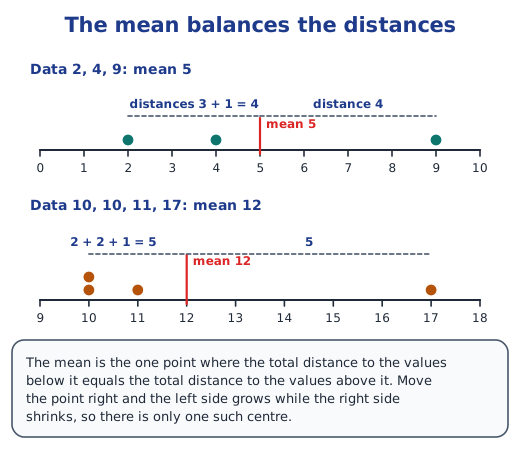
Could another point balance too? Try 13 for the data 10, 10, 11, 17: every distance on the left grows and the distance on the right shrinks, so the totals no longer match. Any point below 12 fails the other way. So the balancing point is unique.
Including and removing values
If a new value above the mean is included, the right side gains distance, so the balancing point has to move up: the mean increases. A value below the mean pulls it down, and a value equal to the mean adds no distance, so nothing changes. Removing values works in reverse: removing a value above the mean lowers it. In the fair-share picture, a newcomer who brings more than the fair share raises everyone’s share.
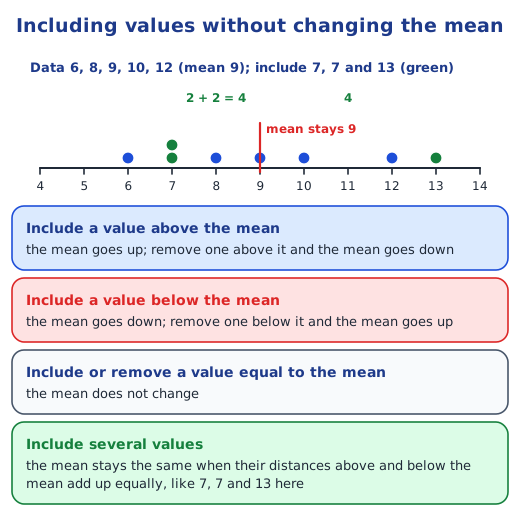
The mean can stay fixed when several values are included, as long as their distances balance. With mean 9, including 7 and 11 (2 below and 2 above) keeps it at 9, and so does including 7, 7 and 13 (2 + 2 below, 4 above). Two values above and one below also work, such as 10 and 11 with 6: 1 + 2 above balance 3 below.
Changing every value
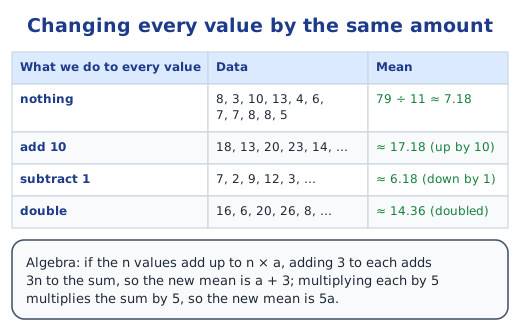
What if every value goes up by the same amount? The mean of 8, 3, 10, 13, 4, 6, 7, 7, 8, 8, 5 is 79 ÷ 11 ≈ 7.18. Add 10 to every value and the whole dot plot slides 10 to the right, so the new mean is about 17.18; subtract 1 and it is about 6.18. Algebra shows why: if n values add up to n × a, adding 3 to each adds 3n to the sum, and dividing by n gives a + 3. If every value is doubled, the mean doubles too: multiplying each value by 5 multiplies the sum, and so the mean, by 5.
Using the mean to find unknowns
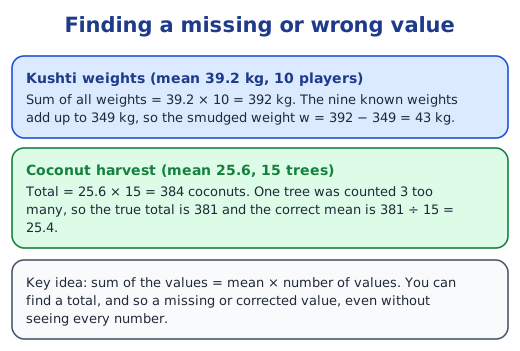
Because sum = mean × number of values, the mean can reveal a hidden number. Coach Balwan’s ten wrestlers average 39.2 kg, so they weigh 392 kg together; the nine readable weights add up to 349 kg, so the smudged one is 43 kg. Venkayya’s 15 coconut trees average 25.6, a total of 384; one count was 3 too high, so the true total is 381 and the correct mean is 25.4.
Read on: line graphs, mean and median from a frequency table, the chapter notes and the NCERT solutions.
Practice
-
The mean of 3, 6 and 9 is:
Show answer
Answer: (b) 6
-
Data with mean 9 gets a new value, 13. The new mean will be:
Show answer
Answer: (c) more than 9
-
The mean of 8, 3, 10, 13, 4, 6, 7, 7, 8, 8, 5 is about 7.18. If every value is doubled, the mean is about:
Show answer
Answer: (c) 14.36
-
Can two different points both balance the distances? Explain.
Show answer
Answer: No. Move the point up and every distance below it grows while every distance above it shrinks, so the two totals can no longer be equal; moving it down does the opposite.
-
Give three values you could include in 6, 8, 9, 10, 12 without changing the mean.
Show answer
Answer: For example 7, 7 and 13. The mean is 9; 7 and 7 are 2 + 2 = 4 below it and 13 is 4 above it, so the balance is kept.
Questions students ask
Why is the mean called the centre of the data?
Because it balances the data: the total distance from the mean to the smaller values equals the total distance to the larger values, like a see-saw resting on one point.
What happens to the mean when a value is removed?
Removing a value above the mean lowers it, removing a value below the mean raises it, and removing a value equal to the mean leaves it unchanged.
What does multiplying every value by the same number do to the mean?
The mean is multiplied by that number too. If the values add up to n × a, multiplying each by 5 makes the sum 5 × n × a, so the new mean is 5a.
Stuck on a question?
Take a photo and Lagnever AI explains it step by step. Try it for 7 days for ₹2.
Get it on Google Play Open in browser
For parents: after the trial, the plan renews monthly by UPI or card autopay. You can cancel anytime in the app.