
How do scientists ask questions and investigate?
Answer in short
Scientists turn a wonder into a focused question, then list what they can change or control and what they can observe or measure. They change only one thing at a time, keep the rest the same and note everything they notice. The chapter shows this with a puri, testing things such as oil temperature, dough thickness and flour.
Stuck on a question? Take a photo and Lagnever AI explains it step by step. Try it for 7 days for ₹2. Get it on Google Play
From a wonder to a focused question
Every investigation starts with wondering. Ever watched a puri or a bhatura balloon up in hot oil, or a phulka swell when it is held over the flame? Why does that happen, and why does one face of a puri turn out thinner than the other? These are the questions a scientist would ask, and you can ask them too.
“Why?” questions are often too wide to answer in one go, so a scientist breaks them into smaller, focused questions. A focused question names one thing you will change or compare and one thing you will observe or measure. “Why do puris puff?” becomes “Does a puri puff up faster in hotter oil?”. Some questions cannot be tested in a kitchen. To find out whether the world is getting warmer, scientists cannot run an experiment on the whole planet; they compare temperature records kept over many years instead.
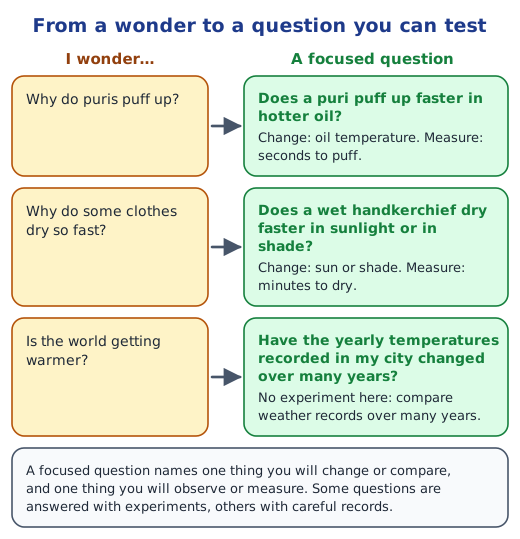
The chapter’s first page ends with a blank line for your own question. Write one there, then try to make it focused.
What can we change, and what can we measure?
Before an experiment, the chapter says, find out two things. First, what can we change or control? For a puri: how thick the rolled dough is, how big the circle is, which flour we use (atta, maida and so on), how hot the oil is, and how the dough goes into the oil: dropped flat, slid in at a slant or slid in slowly. Second, what can we observe or measure to see whether a change made any difference? Some results are a simple yes or no: did it puff? Others are numbers: how many seconds did it take to puff? We can also check whether very thick dough still gives a puri with one thin side.
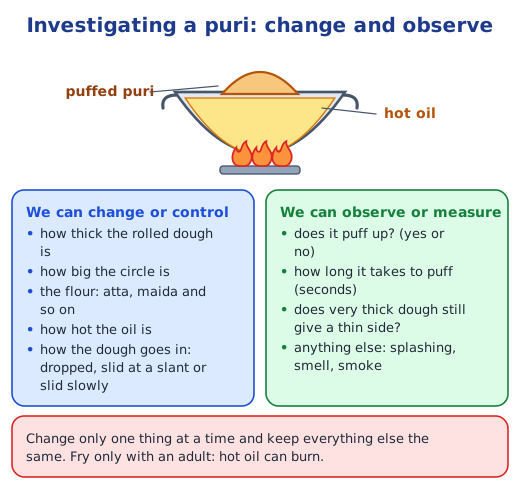
Change one thing at a time
Suppose you want to see how the heat of the oil matters. Use three heats, not very hot, hot and very hot, but give every puri the same dough, rolled to the same thickness and size, and put it into the oil the same way. Then any difference you see must come from the oil. If you also changed the thickness, you could not tell which change made the difference.
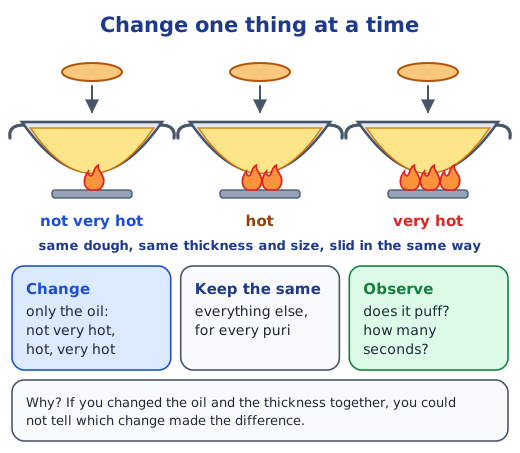
Keep a record
Write down everything you see and sense, not only what you measure. Did the oil splash? Did it smell different, or smoke? A small table in your notebook keeps your results tidy. A tip that goes beyond the chapter: repeat each trial two or three times, because one odd puri can mislead you.
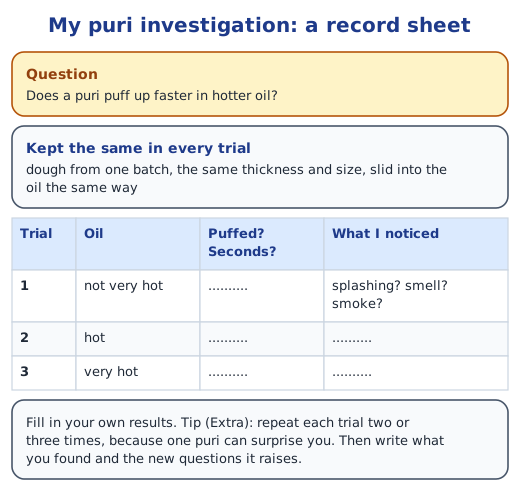
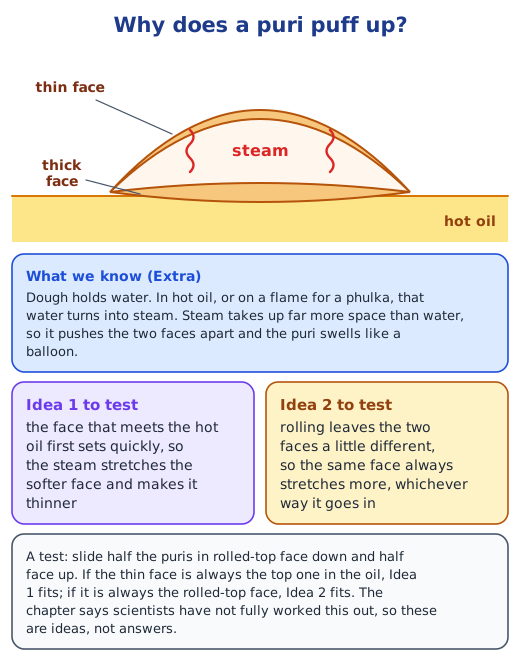
Why does a puri puff, and why is one side thin?
Here is what is well known (Extra): dough holds water, and in hot oil that water turns into steam. Steam takes up far more space than water, so it pushes the two faces of the puri apart. Why one face ends up thinner is harder. One idea is that the face touching the hot oil first sets quickly, so the steam stretches the softer face. Another is that rolling leaves the two faces a little different. A test could tell them apart: slide some puris in with the rolled top face down and some with it up, and see which face comes out thin. The chapter adds that even this everyday puzzle is not fully understood by scientists, so these are ideas to test, not settled answers.
New questions keep coming
One round of experiments usually leads to new questions. Do puris puff better from fresh dough or from dough that has been kept for a while? What happens if you prick a hole in the dough before frying? (Guess first: where might the steam go?) The same habit works far from the kitchen too. Watch the Moon for a few nights after purnima and its bright part shrinks; the phases of the Moon explain why. This planned, step-by-step way of working is what the chapter calls systematic investigation, and the most complicated experiments follow it too.
Always fry with an adult nearby: hot oil can burn. Your job can be to time, watch and record.
Read on: the scientific method, the chapter notes and the NCERT solutions.
Practice
-
Which is a focused question that you can test?
Show answer
Answer: (b) Does a puri puff up faster in hotter oil?
-
Which of these do we observe or measure, rather than change?
Show answer
Answer: (c) the seconds a puri takes to puff
-
To test the effect of oil temperature, the dough circles should be:
Show answer
Answer: (b) of the same thickness, put in the same way
-
Name two follow-up questions the chapter suggests after the first round of puri experiments.
Show answer
Answer: Do puris puff better when made from fresh dough or from dough that has been kept for a while? What happens if you prick a hole in the dough before frying it?
-
Why is “Is the world getting warmer?” investigated with records rather than one experiment?
Show answer
Answer: We cannot change the whole world’s weather to test it. Instead, scientists compare temperatures measured at the same places over many years and look for a pattern.
Questions students ask
What makes a question scientific?
It can be answered by observing, measuring or experimenting. A good one is focused: it names what you will change or compare and what you will observe or measure.
What can we change in the puri experiment?
The thickness and size of the rolled dough, the type of flour, such as atta or maida, the temperature of the oil, and the way the dough goes into the oil: dropped, slid in at a slant or slid in slowly.
Why does a puri puff up?
Water in the dough turns into steam in the hot oil, and the steam pushes the two faces apart (Extra). Why one face ends up thinner is still a puzzle; the chapter says scientists do not fully understand it yet.
Is it safe to do the puri experiment at home?
Only with an adult. Hot oil can splash and cause bad burns, so let an adult handle the kadhai while you watch, time and record.
Stuck on a question?
Take a photo and Lagnever AI explains it step by step. Try it for 7 days for ₹2.
Get it on Google Play Open in browser
For parents: after the trial, the plan renews monthly by UPI or card autopay. You can cancel anytime in the app.