
What is the scientific method?
Answer in short
The scientific method is a step-by-step way of finding answers. We observe and wonder, ask a focused question and guess an answer. Then we plan a test that changes one thing while keeping the rest the same, experiment, record what we see, explain the results and share them. The results usually lead to new questions.
Stuck on a question? Take a photo and Lagnever AI explains it step by step. Try it for 7 days for ₹2. Get it on Google Play
Learning how to find facts
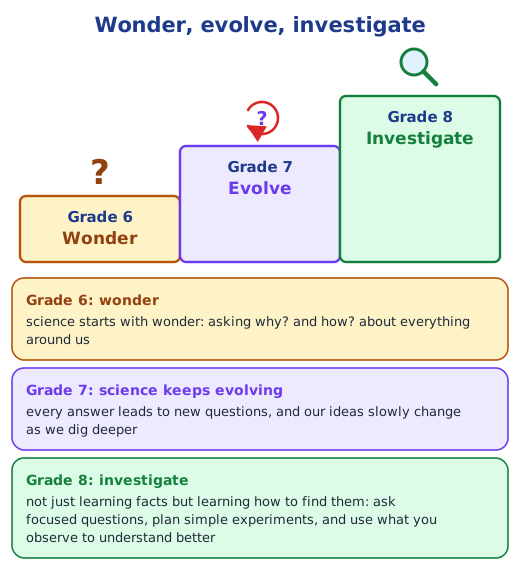
Science is not a pile of facts to memorise; it is a way of finding them out. In Grade 6, Curiosity showed that science begins with wonder. In Grade 7 it showed that science keeps changing, because each answer opens new questions. Grade 8 asks you to become an investigator: to watch closely, plan experiments with care and explain what you find in clear words. The book’s puzzles range from everyday ones, like why dough rises, to big ones about the Earth, like whether the world is getting warmer.
What are the steps of the scientific method?
The Grade 6 book called this way of working the scientific method. The Grade 8 chapter calls it systematic investigation: working step by step, in a planned order, so that others can check what you did.
- Wonder and observe. Notice something puzzling, such as a puri puffing up in hot oil.
- Ask a focused question. “Why do puris puff?” is a good start, but it is too wide to test. “Does a puri puff faster in hotter oil?” names one thing to change and one thing to measure.
- Guess an answer. For example, “hotter oil makes it puff faster”. Scientists call a guess that can be tested a hypothesis (Extra: the chapter does not use this word).
- Plan a fair test. Decide what you will change, what you will keep the same and what you will observe or measure.
- Experiment and record. Do the test carefully and write down everything you see, hear and smell, not only the result you expected.
- Explain and share. Does the result support your guess? Tell others how you did it, so they can try it too.
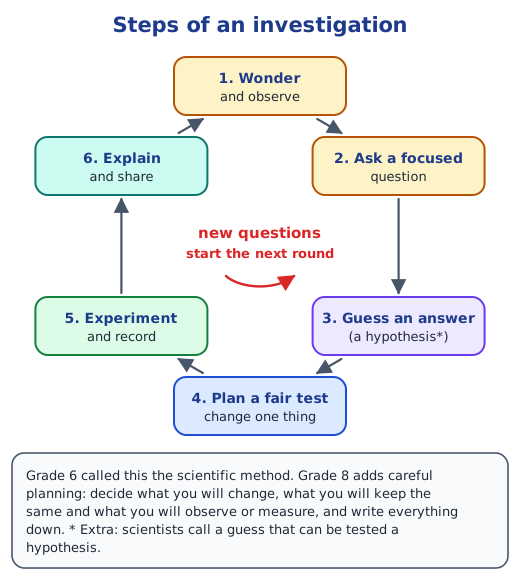
The steps form a loop rather than a line. One round of experiments almost always raises new questions, and those start the next round.
Why change only one thing at a time?
The chapter explains that, to make sense of a result, we need to know two things before we start: what we can change or control, and what we can observe or measure. Scientists call these conditions variables (Extra). The golden rule is to change only one of them at a time and keep everything else the same. If you used hotter oil and thinner dough together and the puri puffed faster, which change was responsible? You could not tell. Such a test, where only one thing differs, is often called a fair test (Extra).
A test you can try: does dough rise more in a warm place?
The chapter mentions dough rising as an everyday puzzle. Here is how to investigate one part of it.
- Question: does dough rise more in a warm place than in a cool one?
- Change: only where the dough is kept, warm or cool.
- Keep the same: dough from one batch, the same amount, the same jars and the same waiting time.
- Measure: how far the dough rises above a line marked at the start, in cm.
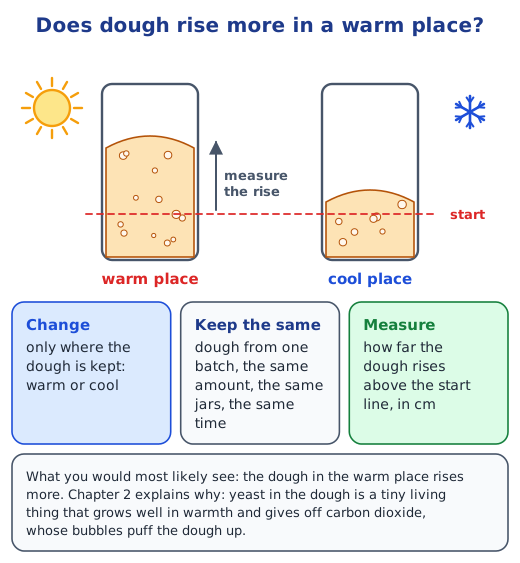
You would most likely find that the warm dough rises more. Chapter 2 of the book explains why: yeast in the dough is a tiny living thing that grows well in warmth and gives off carbon dioxide, whose bubbles make the dough soft and fluffy. Notice that the test answers one focused question and raises others. What if there were no yeast at all? What if the place were very hot?
The root and the kite
The book’s page numbers carry two symbols. A root at the bottom of the left-hand pages stands for a firm base of knowledge, and a kite at the top of the right-hand pages stands for curiosity flying towards the unknown. Good investigation balances the two: it stays tied to careful observation, like a kite held by its string, while letting creative ideas rise high.
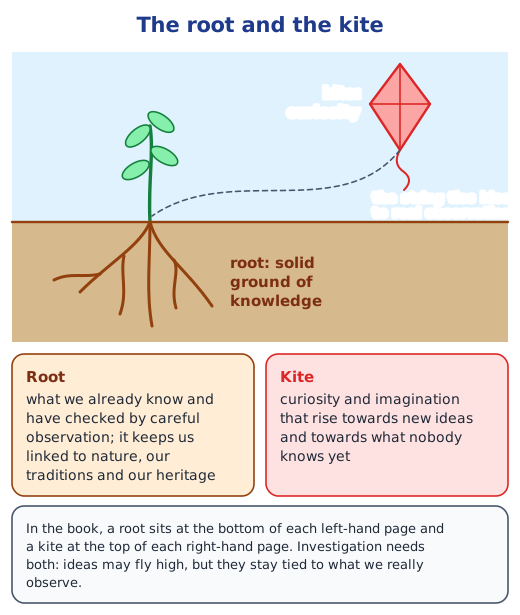
Remember too that science stays open. The chapter points out that even a puri puffing up is not yet fully understood by scientists, so careful young investigators may still find something new.
Read on: asking questions and investigating, the chapter notes and the NCERT solutions.
Practice
-
Which step comes right after asking a focused question?
Show answer
Answer: (b) guessing a possible answer
-
In a fair test of whether warmth helps dough rise, what should change?
Show answer
Answer: (b) only the place where the dough is kept
-
A guess about the answer that can be tested is called a:
Show answer
Answer: (b) hypothesis
-
Why should you write notes during an experiment?
Show answer
Answer: So you do not forget what happened, can spot patterns and surprises, and can share or repeat the test later. A small detail, such as smoke or a smell, may turn out to matter.
-
Turn “Why do plants need sunlight?” into a focused question you could test.
Show answer
Answer: For example: “Does a bean seedling kept in a dark cupboard grow differently from one on a sunny windowsill?” Change only the light; keep the soil, water and pot the same; observe the colour and height.
Questions students ask
What are the steps of the scientific method?
Observe and wonder, ask a focused question, guess an answer, plan a test that changes one thing, experiment and record, then explain and share what you found. The results usually raise new questions, so the steps go round again.
Is the scientific method the same as systematic investigation?
Very nearly. The Grade 8 chapter calls the careful, step-by-step way of finding answers systematic investigation; the Grade 6 book called it the scientific method. Grade 8 adds careful planning of what to change, what to keep the same and what to measure.
Why change only one thing at a time?
If two things change together, you cannot tell which one caused the result. Keeping everything else the same makes the test fair, so the difference you see belongs to the one thing you changed.
Do we need a laboratory to do science?
No. The chapter points out that a kitchen at home is a good place to observe and experiment. Curiosity, careful observation and the question “what happens if…?” are enough to start.
Stuck on a question?
Take a photo and Lagnever AI explains it step by step. Try it for 7 days for ₹2.
Get it on Google Play Open in browser
For parents: after the trial, the plan renews monthly by UPI or card autopay. You can cancel anytime in the app.