
NCERT Solutions Class 8 Science Chapter 1: Exploring the Investigative World of Science
Answers to every question in Chapter 1, Exploring the Investigative World of Science, of Curiosity, the Grade 8 science textbook (Reprint 2026-27). The chapter has no end-of-chapter exercise. It asks Probe and ponder questions on its first page and many more in its text, and it works through a puri investigation, all answered here. Page numbers follow the book (pages 1–7). Short notes: Chapter 1 notes.
Probe and ponder (page 1)
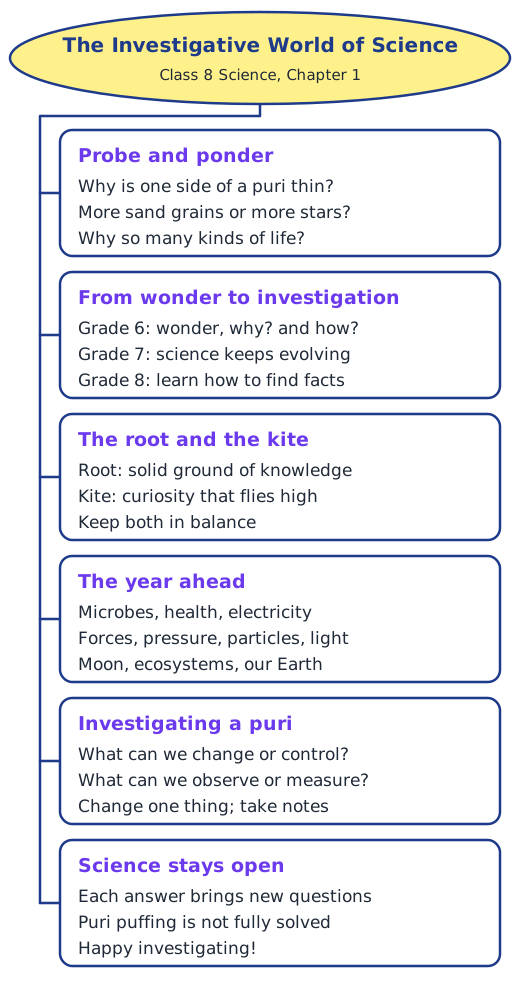
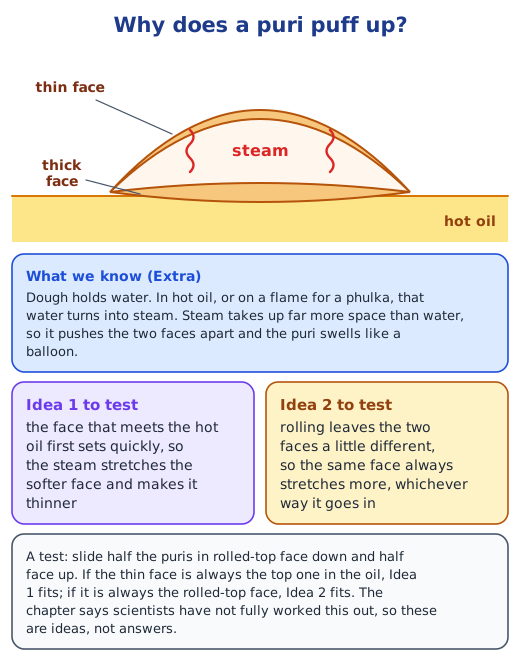
Why does one side of a puri come out thinner? Nobody knows the full answer yet: the chapter itself says that scientists do not completely understand puri puffing. What is well known (Extra) is that water in the dough turns into steam in the hot oil and pushes the two faces apart. One idea is that the face touching the oil first sets quickly, so the steam stretches the softer face thin; another is that rolling leaves the two faces different. The chapter shows how to investigate it, in the puri section below.
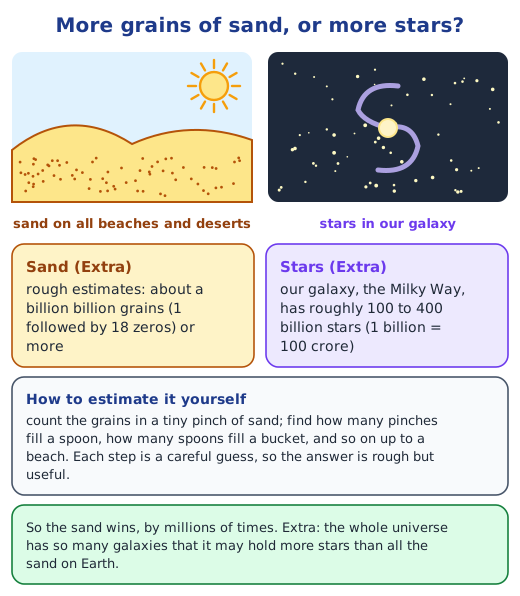
Sand grains on every beach and desert, or stars in our galaxy: which are more? More grains of sand, by far. These numbers are rough estimates and go beyond the book (Extra): our galaxy, the Milky Way, has roughly 100 to 400 billion stars, while the sand on Earth’s beaches and deserts runs to about a billion billion grains or more. You can make your own estimate: count the grains in a tiny pinch, find how many pinches fill a spoon, how many spoons fill a bucket, and keep scaling up. Each step is a careful guess, so the answer is rough but still useful.
Why are there so many kinds of plants and animals? Living things are found in very different homes: deserts, seas, forests, mountains, ponds and even our bodies. Young ones are like their parents but not exactly the same, and over very many generations the small differences that help them survive in a particular home are passed on. So, slowly, living things become suited to very different places, and the variety grows (Extra: scientists call this slow change evolution). Read about variation and reproduction and how living things share their surroundings.
Write a question that makes you curious. Any honest question is right. Some samples: Why do onions make our eyes water? Why does a steel tumbler of ice water get wet on the outside? Why do some seeds float and others sink? Then try to make yours focused, for example: “Does a tumbler of ice water collect more drops on a humid day than on a dry day?”
Questions in the text (pages 2–5)
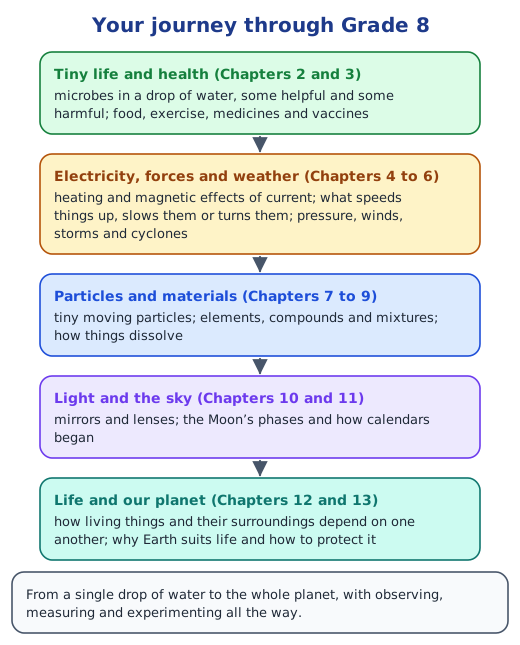
The chapter’s tour of the year raises questions that later chapters answer. Here are short answers.
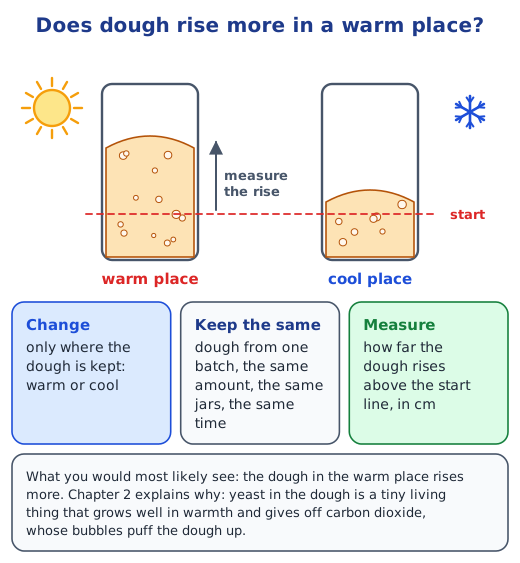
Why does dough rise? Dough made with yeast rises because yeast, a tiny living thing, breaks down food in the dough and gives off carbon dioxide; its bubbles make the dough soft and fluffy. Yeast grows well in warmth. Chapter 2 investigates this.
Is the world getting warmer? Yes. The chapter says human activities can cause small changes in the Earth’s temperature that upset climate patterns, with dangerous results. Scientists study this by comparing temperature records from many places over many years. See threats to life on Earth.
What keeps our body healthy, and how do we fight infections? Nutritious food, exercise, and medicines and vaccines when needed. Chapter 3 explains how they help. (Extra: clean water, washing hands and enough sleep help too.)
Why does a ball thrown up fall back, and why does a car stop when the brakes are applied? The Earth’s gravitational force pulls the ball back down. Brakes use friction, a force that acts against motion, to slow the car and stop it. Chapter 5 explores forces.
How can air exert pressure, and why do winds blow? Air is made of particles that move about freely and keep hitting every surface, pushing on it. Air moves from a region of high pressure to one of low pressure: a small difference gives a gentle breeze, a large one gives strong winds and sometimes cyclones. See Chapter 6, and how particles move.
Why does water boil at a certain temperature? When water is heated, its particles move faster and faster. At its boiling point they move so vigorously that they break away from one another throughout the liquid, forming bubbles of vapour. See states of matter.
How does sugar dissolve in tea to make it sweet? The sugar particles spread out between the particles of the liquid, so the sugar seems to disappear but the tea tastes sweet. See solubility.
Why does a shiny spoon show an image, and how do spectacles help? The curved surface of a spoon reflects light like a curved mirror, so the image looks stretched or upside down. Spectacles have lenses that bend light so that it focuses properly in the eye. See spherical mirrors and lenses. (The book says the bending of light explains both; strictly, the spoon’s image comes from reflection.)
Why does the Moon change shape, and how are calendars linked to the sky? The Sun always lights half of the Moon; as the Moon goes round the Earth, we see different amounts of that lit half. The cycle of phases takes about a month, and the Sun’s yearly cycle gives the year, so people built calendars by watching both. See phases of the Moon and calendars.
What makes the Earth just right for life? It lies at the right distance from the Sun for water to stay liquid, and its atmosphere gives us oxygen to breathe and shields us from harmful ultraviolet rays. See why Earth supports life.
Thinking like a scientist: the puri (pages 6–7)
What could change the way a puri puffs up? Things we can change or control: the thickness and size of the rolled dough, the type of flour (atta, maida and so on), the temperature of the oil, and the way the dough goes in: dropped, slid in at a slant or slid in slowly.
What can we observe or measure? Whether it puffs up (yes or no), how long it takes to puff (in seconds), and whether very thick dough still gives a thin side. We should also note anything else: splashing, a smell or smoke.
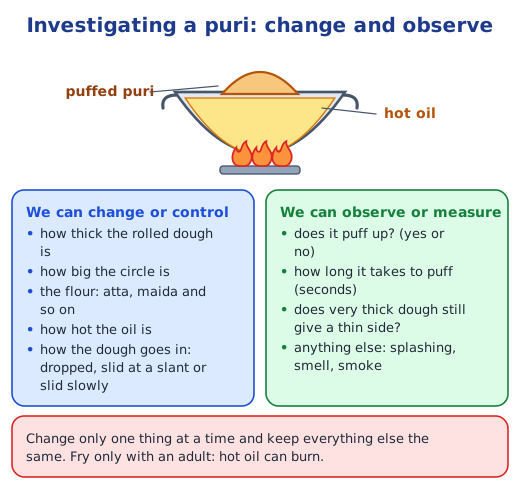
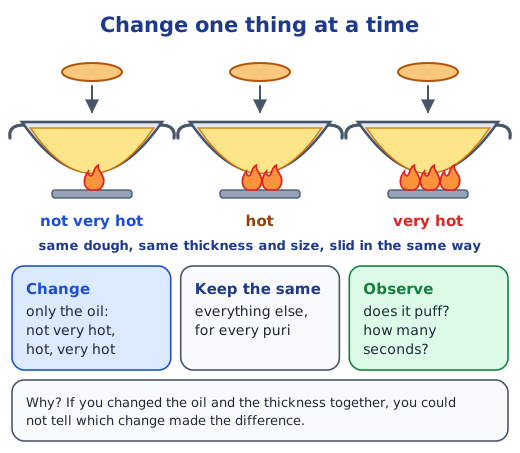
How do we test one thing, such as the heat of the oil? Use oil that is not very hot, hot and very hot, but give every puri dough from one batch, rolled to the same thickness and size, and put it in the same way. Change only the oil, so any difference must come from the oil. Record each trial, and (a tip beyond the book) repeat it two or three times. Fry only with an adult nearby: hot oil can burn.
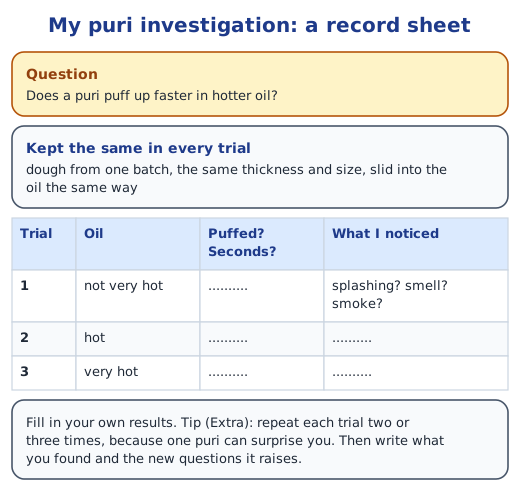
Do puris puff better from fresh dough or stored dough? Find out with a fair test: make one batch of dough, fry half of it at once and keep the other half covered for a few hours, then fry it with the same thickness, size and oil. Compare whether they puff and how fast. Your results are the answer.
What if you make a hole in the dough before frying it? Most likely it will not puff up fully, because the steam escapes through the hole instead of pushing the faces apart. (Extra: cooks prick dough with a fork when they want it to stay flat and crisp.) Try it with an adult and see.
Why is one side thinner? Still an open question. The diagram shows two ideas and a test that could tell them apart.
Why does the Moon’s lit part get smaller after purnima? After the full Moon, the bright part shrinks night by night until the new Moon (amavasya), the waning period, called Krishna Paksha in India. It happens because we see less and less of the Moon’s sunlit half. Careful watching, night after night, is an investigation too. More in the scientific method and asking questions and investigating.
Practice
-
Which tiny living thing makes dough rise?
Show answer
Answer: (b) yeast
-
A bigger difference in air pressure between two places gives:
Show answer
Answer: (b) a stronger wind
-
In which state can particles move about most freely?
Show answer
Answer: (c) gas
-
Give one helpful and one harmful effect of microbes mentioned in the chapter.
Show answer
Answer: Helpful: some help us digest our food or are used to make medicines. Harmful: some cause infections.
-
You want to test whether the flour changes how a puri puffs. What will you change, and what will you keep the same?
Show answer
Answer: Change only the flour, for example atta in one batch and maida in the other. Keep the thickness, size, oil temperature and the way the dough goes in the same, and observe whether each puffs and how many seconds it takes.
Stuck on a question?
Take a photo and Lagnever AI explains it step by step. Try it for 7 days for ₹2.
Get it on Google Play Open in browser
For parents: after the trial, the plan renews monthly by UPI or card autopay. You can cancel anytime in the app.