
Class 8 Science Chapter 1: Exploring the Investigative World of Science Notes
This chapter in five lines
Exploring the Investigative World of Science is the opening chapter of Curiosity, Grade 8. After the wonder of Grade 6 and the ever-changing science of Grade 7, it asks you to investigate: to learn how facts are found, not just the facts. It previews the year, from microbes to our planet, and uses a puffing puri to show how to plan a test that changes one thing at a time.
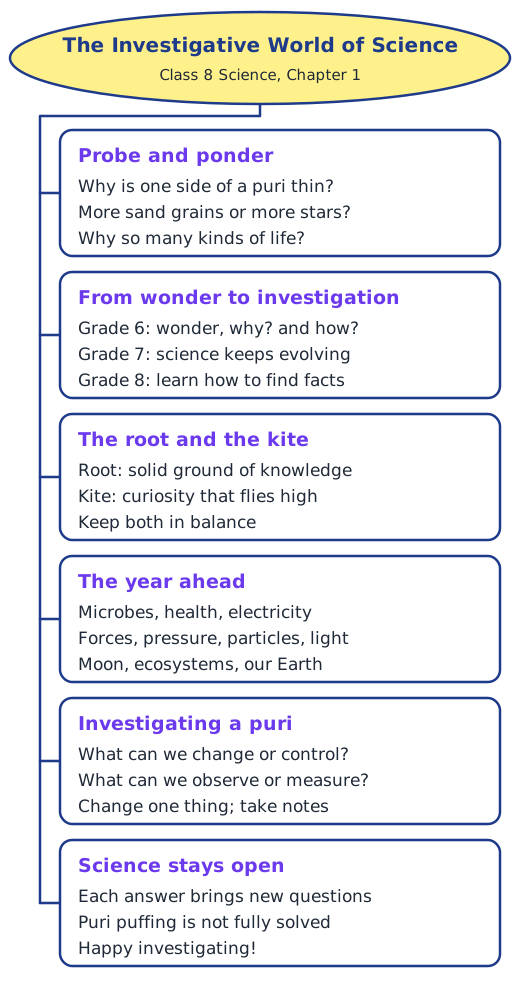
What is this chapter about?
Chapter 1 opens Curiosity, Grade 8, with a few Probe and ponder questions. Why does a puri come out with one side thinner than the other? Which is larger: the number of sand grains on all the world’s beaches and deserts, or the number of stars in our galaxy? Why do plants and animals come in so many different kinds? The book says such questions are not for any exam. They are invitations to wonder, and it asks you to write down a question of your own.
From wonder to investigation
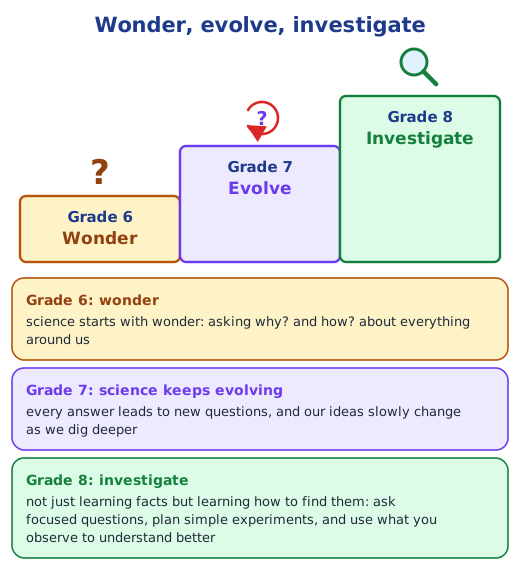
In Grade 6 you saw that science begins when we wonder and ask “why?” and “how?”. In Grade 7 you saw that science keeps evolving: every answer opens new questions, and ideas change as we dig deeper. Grade 8 takes the next step. The aim is not only to learn facts but to learn how to find them. That means asking sharper, more focused questions, planning simple experiments, and using what you observe to improve your understanding, whether the puzzle is why dough rises or whether the world is getting warmer. Read more in the scientific method.
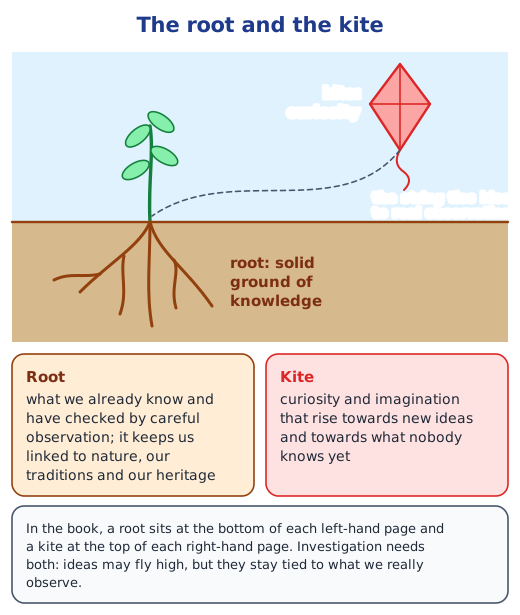
The root and the kite
Look at the page numbers in the book. At the bottom of each left-hand page there is a root; at the top corner of each right-hand page, a kite. The root stands for a firm base of knowledge that links us to the world around us, to our traditions and to the heritage, cultural and natural, that we share. The kite reminds us that curiosity has to rise into the air if we want to explore what nobody knows yet. Investigation needs both: careful observation keeps us on solid ground, and creative thinking lets new ideas take off. The wavy lines along the foot of each page also hide a few scientific ideas, so look out for them.
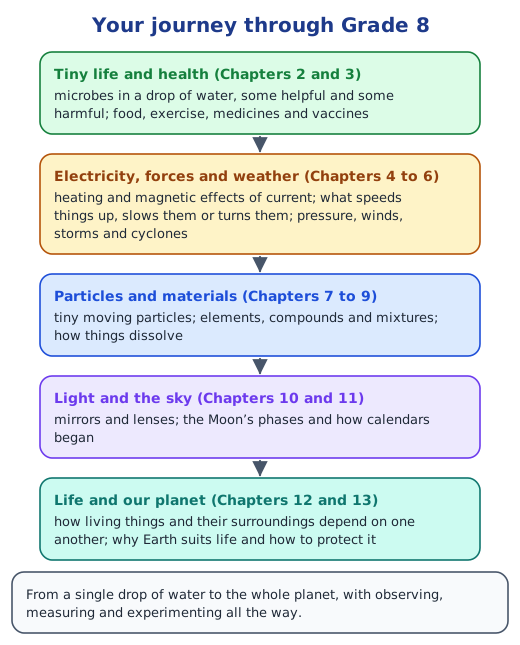
The journey of the year
The chapter then takes a quick tour of the book, from things too small to see to problems as big as the planet. A single drop of water hides tiny living things: some help us digest food or make medicines, while others cause infections, and nutritious food, exercise, medicines and vaccines keep us healthy. Electric current keeps us warm through its heating effect and runs motors through its magnetic effect. Forces make things speed up, slow down or change direction; pressure is how a force is spread over an area, and differences in air pressure cause gentle breezes, strong winds and even cyclones.
Next, everything turns out to be made of tiny particles, which hardly move in solids but move about freely in gases. Materials can be sorted into elements, compounds and mixtures, and some dissolve to make solutions, like sugar in tea. Light reflects from flat and curved mirrors, which is why a shiny spoon shows a strange image of your face, and bends as it passes through lenses, which is how spectacles help many people see clearly. The Moon reflects sunlight too, and watching its phases helped people make the first calendars. The book ends with how living things depend on one another and on their surroundings, and with our home, the Earth: why it suits life, and how human activity is now changing its climate.
You can already read the notes on tiny living things and cells, health and disease, the magnetic and heating effects of electricity, forces, particles, elements, compounds and mixtures, solutions, mirrors and lenses, the Moon and calendars, ecosystems and our home, the Earth.
Thinking like a scientist: the puri
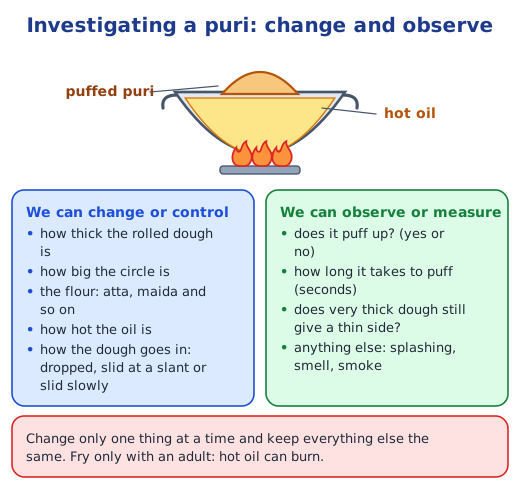
You do not need a fancy laboratory: a kitchen is full of things to observe. A puri or a bhatura puffs up in hot oil, and a phulka swells over a flame. What makes it swell like a balloon, and why does one face come out thinner? To investigate, first turn the wonder into a scientific question: what could change the way a puri puffs? Then make two lists. One is what we can change or control: the thickness and size of the dough circle, the flour (atta, maida), the heat of the oil and the way the dough goes in. The other is what we can observe or measure: does it puff (yes or no), how many seconds it takes, and whether very thick dough still gives a thin side.
Change only one thing at a time and keep everything else the same. Write down everything you notice, such as splashing, smells or smoke. After one round you will have new questions: do puris puff better from fresh dough or stored dough? What if you prick a hole first? This planned, step-by-step way of working is systematic investigation, and the biggest experiments follow it too. Surprisingly, scientists still do not fully understand why a puri puffs. Try it yourself in asking questions and investigating, and fry only with an adult nearby, because hot oil can burn.
Happy investigating!
Whether it is a puri puffing up or the bright part of the Moon shrinking night after night after purnima, let careful observation guide you. Answers to every question in the chapter are in the NCERT solutions for Chapter 1.
Key terms
| Term | Meaning |
|---|---|
| Investigation | A careful search for answers by asking focused questions, observing, measuring and experimenting. |
| Systematic investigation | An investigation done step by step in a planned order, so that others can check and repeat it. |
| Focused question | A clear question that names what you will change or compare and what you will observe or measure. |
| Observation | Noticing carefully, with our senses or with instruments, and writing down what we notice. |
| Experiment | A planned test to check an idea or to find out what happens when we change something. |
| Things we change or control | Conditions we choose, such as the thickness of the dough or the heat of the oil. (Extra: scientists call them variables.) |
| Things we observe or measure | The results we watch for: a yes or no (does it puff?) or a number (seconds to puff). |
| One change at a time | Changing only one condition and keeping the rest the same, so we know what caused a difference. (Extra: a fair test.) |
| Hypothesis (Extra) | A guess about the answer that can be checked by an experiment or by more observations. |
| Phenomenon | Something that happens and can be observed, such as a puri puffing up or the Moon changing shape. |
| The root and the kite | The book’s page symbols: the root stands for a firm base of knowledge, the kite for curiosity that explores the unknown. |
| Microbes | Living things too small to see without a microscope; some help us, and some cause infections. |
Topics in this chapter
Practice
-
What does the Grade 8 book most want you to learn?
Show answer
Answer: (b) how to find new facts
-
In the book, the kite at the top of right-hand pages stands for:
Show answer
Answer: (b) curiosity taking flight
-
When frying a puri, which of these can we change or control?
Show answer
Answer: (c) the temperature of the oil
-
To see how oil temperature affects puffing, we should:
Show answer
Answer: (b) use dough of the same thickness and put it in the same way
-
Which result is a number that we measure?
Show answer
Answer: (b) the time it took to puff, in seconds
-
Watching the Moon’s phases helped people to make the first:
Show answer
Answer: (b) calendars
Questions students ask
What is Class 8 Science Chapter 1 about?
It is the opening chapter of Curiosity, Grade 8. It explains that this year you will investigate, not just wonder, previews every chapter of the book, and shows with a puffing puri how a scientist plans an experiment.
Is Exploring the Investigative World of Science in the new NCERT book?
Yes. It is Chapter 1 of Curiosity, the Class 8 Science textbook (Reprint 2026-27), on pages 1 to 7. It follows on from the Grade 7 opening chapter, The Ever-Evolving World of Science.
Does Chapter 1 have exercise questions?
No end-of-chapter exercise is given. The chapter has Probe and ponder questions, about a puri, sand and stars and the variety of life, other questions in its text and a worked puri investigation. Our NCERT solutions page answers all of them.
Why does the chapter use a puri as its example?
Because science is everywhere, and a kitchen is a lab anyone can use. Frying a puri lets you practise listing what you can change, what you can measure, and changing one thing at a time.
Stuck on a question?
Take a photo and Lagnever AI explains it step by step. Try it for 7 days for ₹2.
Get it on Google Play Open in browser
For parents: after the trial, the plan renews monthly by UPI or card autopay. You can cancel anytime in the app.