
Class 8 Science Chapter 7: Particulate Nature of Matter Notes
This chapter in five lines
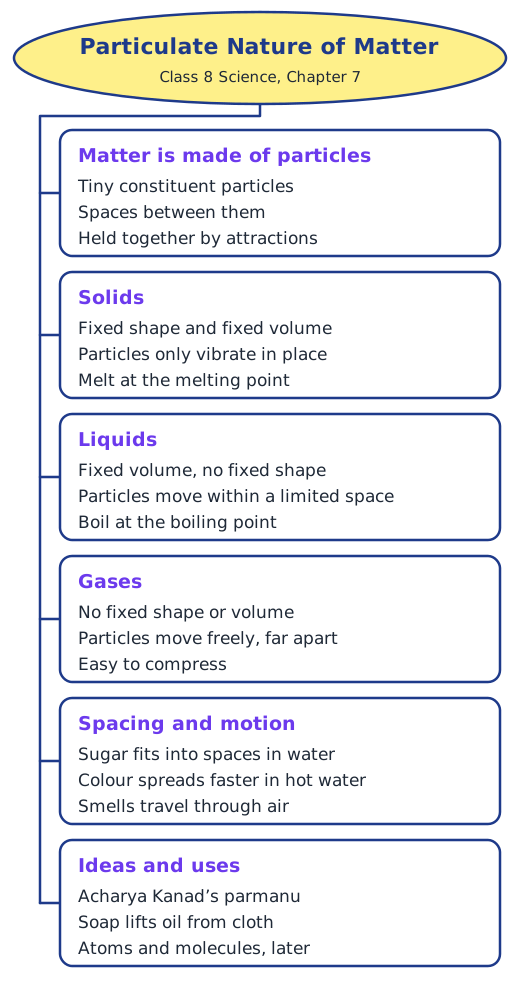
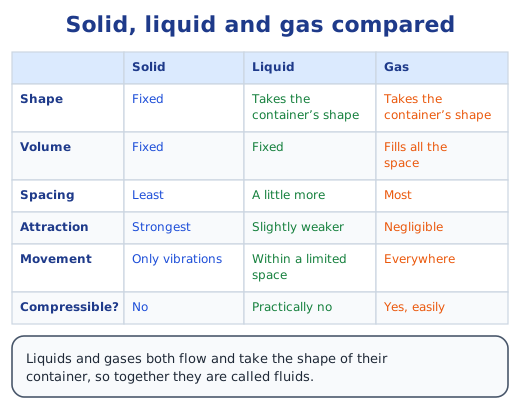
Particulate Nature of Matter shows that all matter is made of extremely small constituent particles with spaces between them, held together by attractions. In solids the attractions are strongest and particles only vibrate; in liquids they are a little weaker and particles move within a limited space; in gases they are negligible and particles move freely. Heating makes particles move faster and can change the state.
What is this chapter about?
The chapter begins with puzzles. Why can we pile up stones or sand, but not water? Why does water take the shape of cupped hands, then lose it when we let go? How does invisible air make a balloon heavier? Then it looks at a riverbank: rivers grind rocks into pebbles, sand and clay. Can a grain of sand be broken still further? The answer leads to the idea that all matter is made of particles.
Matter is made of particles
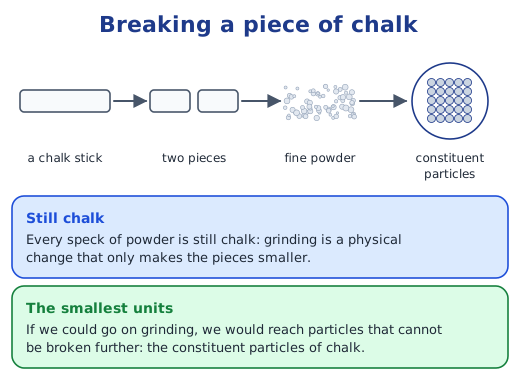
Breaking a stick of chalk and grinding it gives a fine powder, but every speck is still chalk. If we could go on grinding, we would reach units that cannot be broken any further: the constituent particles of chalk. Sugar stirred into water seems to vanish, yet the water tastes sweet, because the sugar has broken into particles that spread into the interparticle spaces between water particles. These particles are far too small to see, even with an ordinary microscope. Read what is matter made of?
What decides the state of matter?
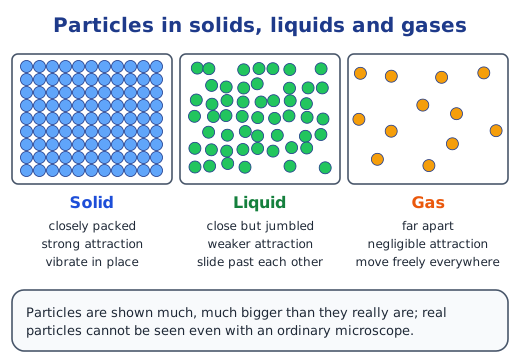
Particles are held together by interparticle attractions. Their strength depends on the substance and on the distance between particles, and it falls sharply as particles move apart. In solids the particles are closely packed and only vibrate in place; in liquids they are a little farther apart and slide past one another within a limited space; in gases they are far apart and move freely. Read states of matter.
Melting, boiling and evaporation
Heat gives particles more energy. A solid’s particles vibrate harder until, at the melting point, they leave their fixed places and the solid becomes a liquid: ice melts at 0 °C, urea at 133 °C and iron at 1538 °C. At the boiling point, a liquid’s particles escape so fast that vapour forms throughout it as bubbles. Below that, evaporation still lets particles escape slowly from the surface.
Spaces and motion
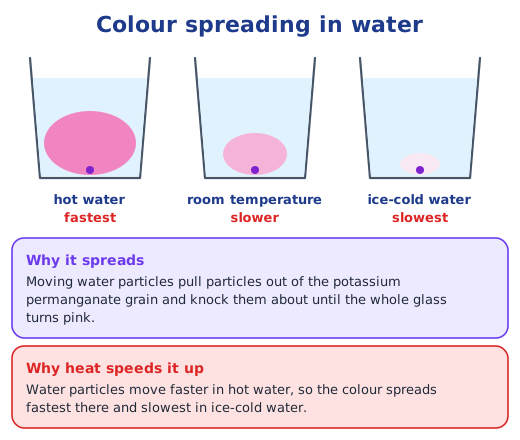
Air in a syringe can be squeezed into less space, but water practically cannot, because gas particles have large gaps between them. Sugar dissolving in water lowers the level slightly, because its particles fit into gaps between water particles. Particles are always moving: a grain of potassium permanganate turns water pink, fastest when the water is hot, and the smell of an incense stick fills a room. Read interparticle spacing and motion.
Before we move on
Matter is made of extremely small particles held together by attractions: very strong in solids, slightly less so in liquids, and next to nothing in gases. That is why solids keep their shape and volume, liquids keep only their volume, and gases keep neither. Heat decides how much the particles move, and so it decides the state. Answers to every question are in the NCERT solutions for Chapter 7.
Key terms
| Term | Meaning |
|---|---|
| Matter | Anything that has mass and takes up space; all matter is made of extremely small particles. |
| Constituent particles | The basic units that make up a substance, too small to be seen even through an ordinary microscope. |
| Interparticle spaces | The gaps between the particles of matter; they contain nothing at all, not even air. |
| Interparticle attraction | The force that holds particles together; it weakens sharply as the particles move apart and decides the state of a substance. |
| Melting point | The lowest temperature at which a solid melts into a liquid at atmospheric pressure; ice melts at 0 °C. |
| Boiling point | The temperature at which, at atmospheric pressure, a liquid boils and changes into vapour, with bubbles forming inside it. |
| Evaporation | The slow change of a liquid into vapour at any temperature below its boiling point, only from the surface. |
| Fluids | Liquids and gases, which both flow and take the shape of their container. |
| Compressible | Able to be squeezed into a smaller volume; gases are, while liquids are practically incompressible. |
| Parmanu | Acharya Kanad’s word for the tiny, indivisible, eternal particles that he said make up all matter. |
| Atoms and molecules | The tiny particles that make up matter; atoms of some elements join to form molecules, as two hydrogen atoms form a hydrogen molecule. |
Topics in this chapter
Practice
-
Which state of matter has a fixed shape and a fixed volume?
Show answer
Answer: (a) Solid
-
In which state are the interparticle attractions negligible?
Show answer
Answer: (c) Gas
-
The melting point of iron is:
Show answer
Answer: (c) 1538 °C
-
Who first spoke of the parmanu?
Show answer
Answer: (b) Acharya Kanad
-
Potassium permanganate spreads fastest in:
Show answer
Answer: (c) hot water
-
Liquids and gases together are called:
Show answer
Answer: (b) fluids
Questions students ask
What are the main topics of Class 8 Science Chapter 7?
That matter is made of tiny constituent particles with spaces between them; the forces that hold particles together; how particles are arranged and move in solids, liquids and gases; melting, boiling and evaporation; how spaces between particles explain squeezing and dissolving; how particles spread; and Acharya Kanad’s idea of the parmanu.
Is Particulate Nature of Matter in the new NCERT Class 8 Science book?
Yes. It is Chapter 7 of Curiosity, the Class 8 Science textbook (Reprint 2026-27), on pages 98 to 115.
Why do solids have a fixed shape but liquids do not?
In a solid, strong attractions hold the particles in fixed positions, so they can only vibrate and the solid keeps its shape. In a liquid, the attractions are a little weaker, so particles can move past one another within a limited space, and the liquid takes the shape of its container while keeping its volume.
What is the difference between boiling and evaporation?
Boiling happens at a fixed temperature, the boiling point, and vapour forms quickly throughout the liquid, as bubbles. Evaporation happens at any temperature below the boiling point, slowly and only from the surface; that is why spilled water dries up.
Stuck on a question?
Take a photo and Lagnever AI explains it step by step. Try it for 7 days for ₹2.
Get it on Google Play Open in browser
For parents: after the trial, the plan renews monthly by UPI or card autopay. You can cancel anytime in the app.