
What is matter made of?
Answer in short
All matter is made of an enormous number of extremely small constituent particles, the basic units of a substance, too small to see even through an ordinary microscope. There are spaces between them, and forces of attraction hold them together. Acharya Kanad called such particles parmanu; scientists today call them atoms and molecules.
Stuck on a question? Take a photo and Lagnever AI explains it step by step. Try it for 7 days for ₹2. Get it on Google Play
Can a grain be broken further?
Pebbles, stones and sand on a riverbank began as rock in the mountains. Erosion breaks the rocks, and rivers carry the pieces downstream, grinding them into pebbles, sand and finally fine clay. Is a grain of sand the smallest piece of a rock, or can it be broken further? Simple activities with chalk and sugar help answer the question.
Breaking chalk
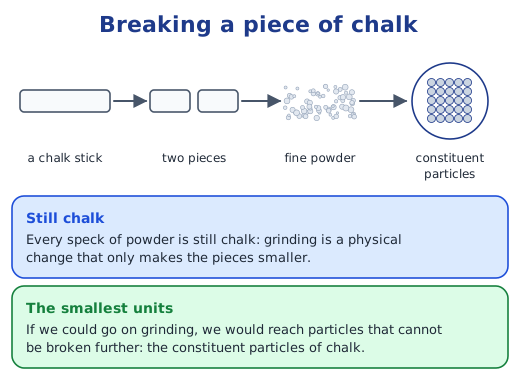
Break a stick of chalk in two, keep breaking it until your hands cannot break it any more, then grind the bits into powder with a mortar and pestle. Under a magnifying glass, each tiny grain is still a speck of chalk: grinding is a physical change, as Class 7 showed, and only the size of the pieces changes. Imagine grinding on and on. In the end we would reach units that cannot be broken any further, the basic building blocks of chalk. These are its constituent particles, and a single stick of chalk contains an enormous number of them. In the same way, a grain of sand or clay is not the tiniest piece a rock can be broken into; they too are made of countless constituent particles.
Sugar in water
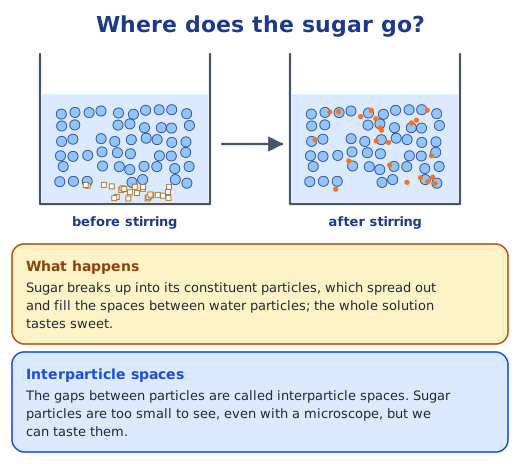
Put two teaspoons of sugar into a glass of drinking water, without stirring, and taste a spoonful from the top: it is not sweet. Stir until the sugar dissolves and taste again: now it is sweet. No sugar can be seen, but it must be there. On dissolving, sugar breaks up into its constituent particles, which spread out and occupy the gaps between water particles, the interparticle spaces. Each tiny grain of sugar holds millions and millions of such particles, all far too small to see even through an ordinary microscope.
Held together by attraction
If matter is made of separate particles, what keeps a piece of chalk in one piece? The particles attract one another. These interparticle attractions depend on the kind of substance and on how far apart the particles are; even a slight increase in the distance weakens them drastically. Their strength decides whether a substance is a solid, a liquid or a gas. Even air is made of particles: that is why air pumped into a balloon adds to its weight.
An old Indian idea
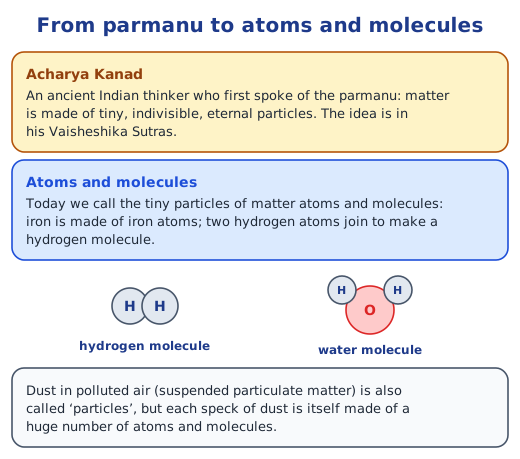
People have long wondered how far things could be broken down. The ancient Indian philosopher Acharya Kanad was the first to speak of the parmanu: he believed that matter is made of tiny, indivisible, eternal particles, and he set out this idea in his Vaisheshika Sutras. Today scientists call the tiny particles of matter atoms and molecules. Iron is made of iron atoms and gold of gold atoms. Atoms of some elements, such as hydrogen, oxygen and sulfur, cannot exist on their own, so a few of them join to form a molecule: two hydrogen atoms make a hydrogen molecule, and two hydrogen atoms with one oxygen atom make a water molecule. These come in higher classes.
Why it matters
The idea that everything is made of particles is one of the most useful in science: it explains melting and boiling, dissolving, smells spreading and much more. The three states are in states of matter, and the spaces and motion of particles in interparticle spacing and motion. Answers to every question are in the NCERT solutions for Chapter 7; see also the full Chapter 7 notes.
Practice
-
Grinding chalk into powder is a:
Show answer
Answer: (b) physical change
-
Acharya Kanad’s ideas are found in the:
Show answer
Answer: (b) Vaisheshika Sutras
-
A water molecule is made of:
Show answer
Answer: (a) two hydrogen atoms and one oxygen atom
-
If all the constituent particles of a chair were removed, what would remain?
Show answer
Answer: Nothing. A chair, like all matter, is made entirely of its constituent particles, so without them nothing of the chair would be left.
-
How do we know sugar is still present after it dissolves?
Show answer
Answer: We cannot see it, but the water tastes sweet everywhere, so the sugar particles must have spread through the water.
Questions students ask
What are constituent particles?
They are the basic units that make up a substance. A piece of chalk, a grain of sugar or a rock is made of a huge number of them. They are so small that even an ordinary microscope cannot show them.
What holds the particles of matter together?
Forces of attraction between them, called interparticle attractions. Their strength depends on the substance and on how far apart the particles are; even a small increase in distance weakens them a lot, and their strength decides whether a substance is a solid, a liquid or a gas.
What did Acharya Kanad say about matter?
The ancient Indian thinker Acharya Kanad first spoke of the parmanu. He held that matter is made of tiny, indivisible, eternal particles, an idea recorded in his Vaisheshika Sutras. Today scientists call the tiny particles of matter atoms and molecules.
Stuck on a question?
Take a photo and Lagnever AI explains it step by step. Try it for 7 days for ₹2.
Get it on Google Play Open in browser
For parents: after the trial, the plan renews monthly by UPI or card autopay. You can cancel anytime in the app.