
NCERT Solutions Class 8 Science Chapter 7: Particulate Nature of Matter
Answers to every question in Chapter 7, Particulate Nature of Matter, of Curiosity, the Class 8 Science textbook (Reprint 2026-27): the Probe and ponder questions, the questions in each activity, Think like a scientist, all ten questions of Keep the curiosity alive, and Discover, design, and debate. Page numbers follow the book (pages 98–115). Short notes: Chapter 7 notes.
Probe and ponder (page 98)
Why can we pile up stones or sand but not water? Stones and sand grains are solids: their particles are held in fixed positions, so each piece keeps its shape and pieces can rest on one another. Water is a liquid, whose particles slide past one another, so it flows away instead of forming a heap.
Why does water take the shape of folded hands and lose it when released? A liquid has no fixed shape; it takes the shape of whatever holds it. Once the hands open, nothing holds it, so it flows.
How does invisible air add weight to a balloon? Air is matter. It is made of particles that have mass, and a balloon packed with extra air particles weighs a little more than an empty one.
Is the air we breathe today the same that existed thousands of years ago? Its particles are not destroyed; they keep moving between the air, water, soil and living things, so much of the air we breathe is made of particles that have been around for a very long time, though the mix of gases changes slightly over time.
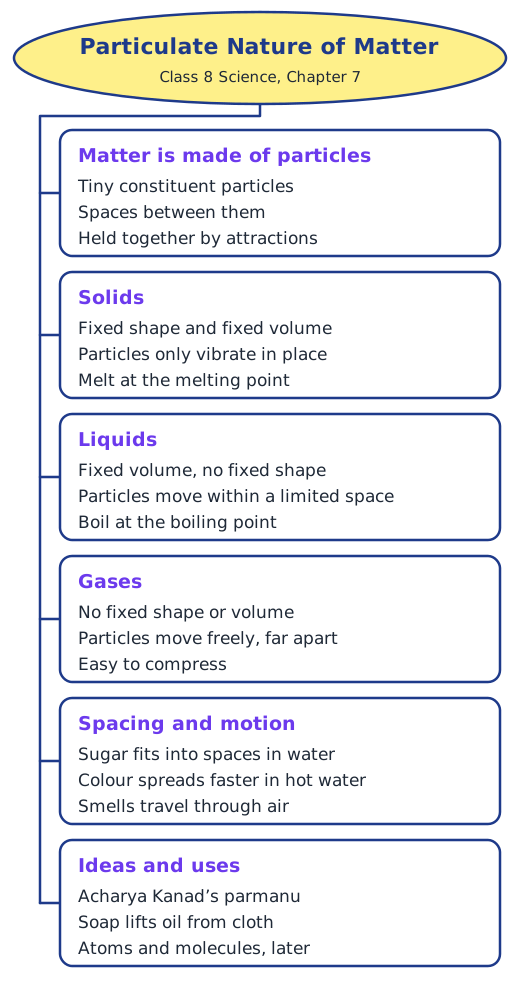
Activities 7.1 and 7.2 (pages 99–100)
Is every speck of chalk powder still chalk? Yes. Breaking and grinding is a physical change; only the size of the pieces changes. Are these specks the smallest units of chalk? No: in principle they could be ground further until we reach units that cannot be broken, the constituent particles of chalk.
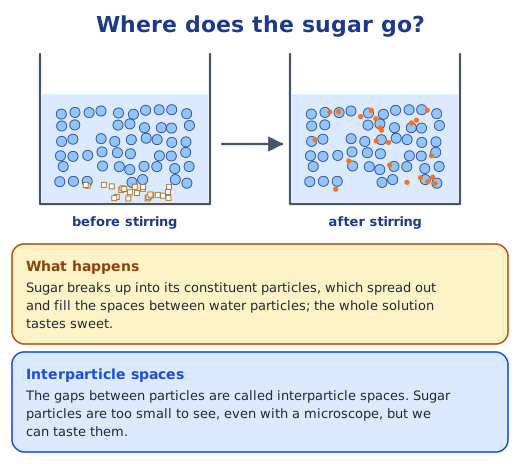
Sugar in water. Before stirring, the top layer is not sweet; after stirring, it is. No sugar particles can be seen, but the taste shows the sugar is there. Where did the sugar go? It broke into its constituent particles, which spread out into the spaces between water particles.
Activity 7.3 and the solid state (pages 101–103)
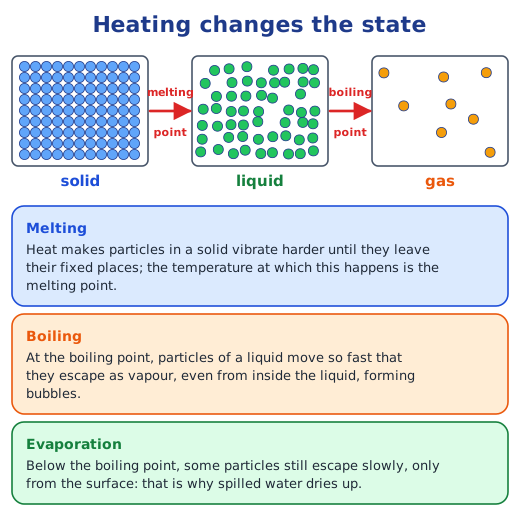
Observations. The iron nail, rock salt, stone, wood, key and aluminium each keep their shape and size: they are solids, with particles held strongly in place. When hammered, the metal objects bend or flatten but stay in one piece, the stone resists, the rock salt cracks and the wood dents. Is there any way to move solid particles apart? Yes, by heating: at the melting point they vibrate so hard that they leave their positions and the solid becomes a liquid. What about liquids and gases? Liquids have a fixed volume; gases do not.
Activity 7.4 and the liquid state (pages 103–105)
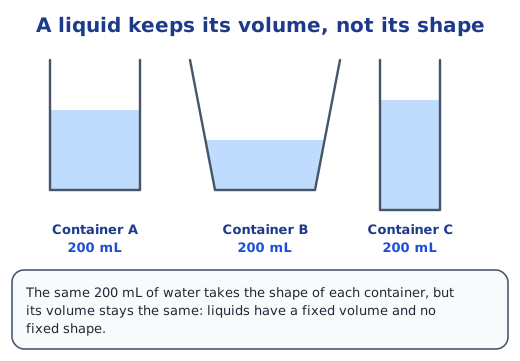
Observations. The water takes the shape of each container, but its level stays at 200 mL. Can you move your finger through water? Yes, without cutting it permanently; the water closes behind the finger, showing that attractions in liquids are weaker than in solids but still keep the particles close. Why does spilled water disappear at any temperature? Because of evaporation: some particles escape slowly from the surface even below the boiling point.
Activity 7.5 and the gaseous state (pages 105–106)
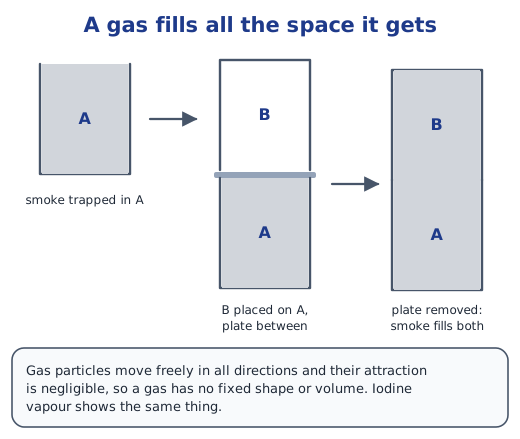
Do gases have a fixed volume? No. The smoke trapped in Gas Jar A spreads to fill Gas Jar B as soon as the glass plate is removed, taking the shape of both jars. Gas particles move freely in all directions with negligible attraction, so gases have no fixed shape or volume.
Activities 7.6 and 7.7: spaces between particles (pages 107–109)
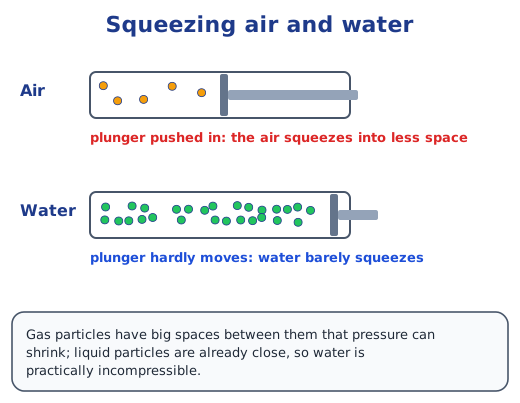
Syringe with air. The volume of air decreases as the plunger is pushed in: a gas can be compressed, because there are large gaps between its particles; when released, the plunger moves back. With water, the plunger hardly moves: water is practically incompressible.
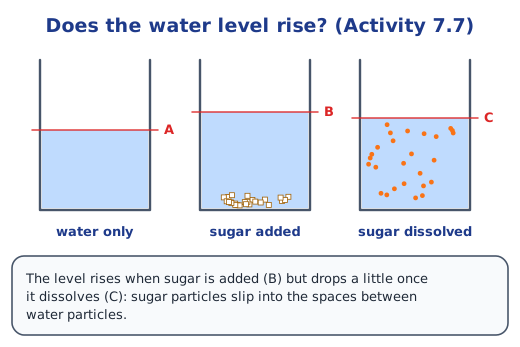
Sugar and the water level. Prediction and result: the level rises from A to B when sugar is added and falls a little below B as the sugar dissolves (C), because sugar particles occupy the spaces between water particles. With salt or glucose, the same happens. With sand or stone pieces, nothing dissolves; the pieces settle and take up room, so the level rises and stays up. Why does sugar dissolve but sand does not? Water particles can pull sugar particles apart, but the particles of sand are held together too strongly. Spacing in solids: solid particles are closely packed, but small spaces, containing nothing at all, still remain between them.
Activities 7.8 and 7.9: moving particles (pages 109–111)
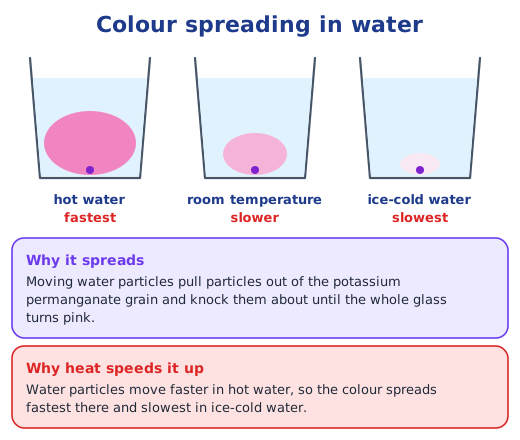
Potassium permanganate in water. Pink streaks spread from the grains, and in time the whole glass is evenly pink, because the moving water particles pull particles out of the grains and spread them. Think like a scientist: the colour spreads fastest in hot water, more slowly at room temperature and slowest in ice-cold water, because particles move faster when heated; the diagram below shows it.
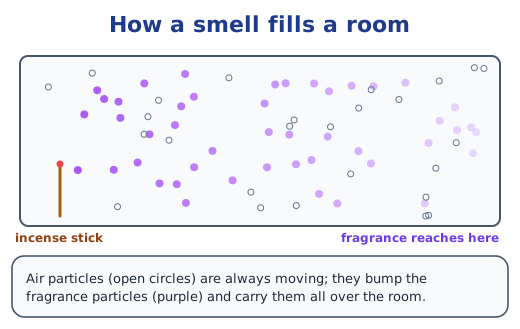
Incense stick. Yes, the fragrance is soon noticed across the room: moving air particles carry its particles everywhere. Other examples: the smell of food cooking reaching another room, perfume or flowers smelt from a distance, the smell of a leaking cooking-gas cylinder, and smoke from a fire spreading.
Keep the curiosity alive (pages 113–114)
1. (iv) Closely packed in solids and move past each other in liquids.
2. (i) True. (ii) True: as a solid melts, its particles move a little apart and the attractions between them decrease. (iii) True. (iv) True. (v) True. (vi) False. Correct: on heating, camphor’s particles gain energy and turn into vapour; these particles spread through the air, and that is what we smell.
3. (iii) Nothing of the chair will remain, because the chair, like all matter, is made entirely of its constituent particles.
4. Gas particles have negligible attraction and large spaces between them, and they move freely and fast, so two gases spread into each other easily. Solid particles are held tightly in fixed positions and can only vibrate, so they cannot move into another solid.
5. Milk is a liquid: its particles can move past one another, so it flows and spreads out over the table. The glass tumbler is a solid: strong attractions hold its particles in fixed positions, so it keeps its shape.
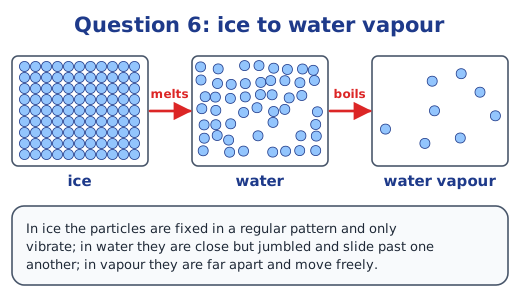
6. In ice the particles are fixed in a regular pattern and only vibrate; when it melts, the water particles are close but jumbled and slide past one another; when the water boils, the vapour particles are far apart and move freely.
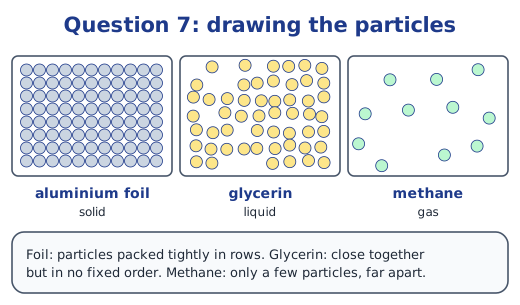
7. Aluminium foil (a solid): particles tightly packed in rows. Glycerin (a liquid): particles close together but in no fixed order. Methane (a gas): a few particles far apart.
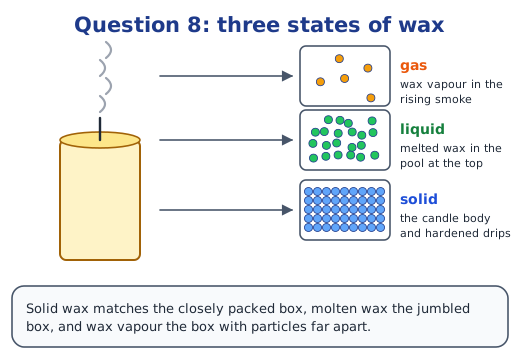
8. The body of the candle and the hardened drips down its sides are solid wax (the closely packed arrangement). The pool of melted wax around the wick is liquid wax (the close but jumbled arrangement). The smoke rising from the wick carries wax vapour, the gaseous state (the arrangement with particles far apart).
9. The salt in seawater is dissolved: it has broken into its constituent particles, which have spread out between the water particles. They are much too small to see, but the tongue can taste them.
10. They are solids. Each grain of rice and each speck of flour has its own fixed shape and volume. The heap takes the shape of the jar only because many small solid pieces can slide over one another; the pieces themselves do not flow like a liquid, and rice can even be piled into a heap, which water cannot.
Discover, design, and debate (page 115)
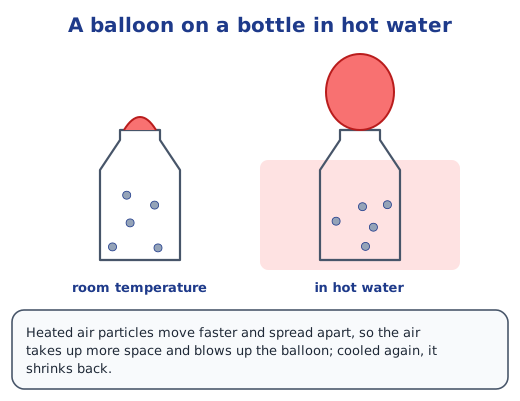
Balloon on a bottle in hot water: the balloon swells, because the heated air particles move faster and spread apart, so the air takes up more space; it shrinks again when cooled. Models: use clay balls or beads packed tightly in a box for a solid, loosely heaped for a liquid and a few spread far apart for a gas. Role-play: stand close and sway in place as a solid, shuffle about while staying close as a liquid, and move quickly all over the room as a gas, faster as the ‘temperature’ rises. Debate, ‘gases can fill all the available space’: useful, because oxygen spreads to every corner of a room, smells warn us of leaking cooking gas or fire, and air fills tyres and balloons evenly; harmful, because poisonous gases, smoke and polluted air also spread quickly.
Short notes and more practice are on the topic pages: states of matter, interparticle spacing and motion and what is matter made of?
Practice
-
Which statement is correct?
Show answer
Answer: (c) Particles of a gas move freely in all directions
-
Camphor heated in one corner of a room is smelt everywhere because:
Show answer
Answer: (b) its vapour particles spread through the air
-
Rice flour takes the shape of its jar, but each tiny piece of it is a:
Show answer
Answer: (c) solid
-
Why does ocean water taste salty though no salt can be seen?
Show answer
Answer: The salt has dissolved: it broke into constituent particles that spread between the water particles. They are far too small to see, but our tongue can still taste them.
-
Why do gases mix easily but solids do not?
Show answer
Answer: Gas particles have negligible attraction, large spaces between them and move freely, so they spread into each other. Solid particles are held tightly in fixed positions and only vibrate, so they cannot move into one another.
Stuck on a question?
Take a photo and Lagnever AI explains it step by step. Try it for 7 days for ₹2.
Get it on Google Play Open in browser
For parents: after the trial, the plan renews monthly by UPI or card autopay. You can cancel anytime in the app.