
States of matter
Answer in short
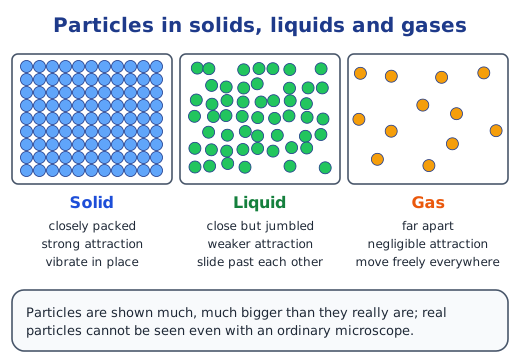
Matter exists as solids, liquids and gases. In solids, closely packed particles with strong attractions only vibrate, so solids keep their shape and volume. In liquids, attractions are slightly weaker and particles move within a limited space, so liquids keep their volume but not their shape. In gases, attractions are negligible and particles move freely, filling any space.
Stuck on a question? Take a photo and Lagnever AI explains it step by step. Try it for 7 days for ₹2. Get it on Google Play
Three states, one idea
Matter is found in three physical states: solid, liquid and gas. What decides the state is how strongly the particles attract one another. These interparticle attractions depend on the kind of substance and on the distance between particles, and even a slight increase in distance weakens them sharply. Strong attractions keep particles locked together; weak ones let them wander.
Solids
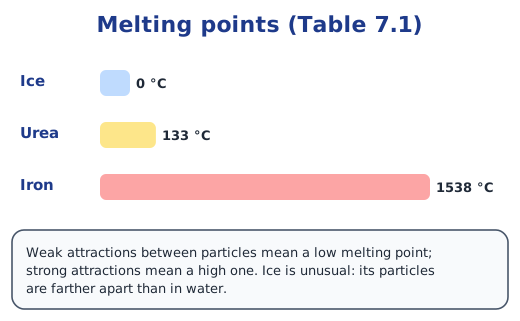
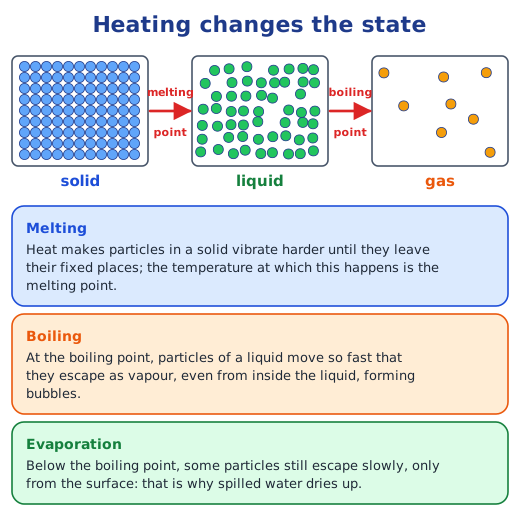
An iron nail, a lump of rock salt, a stone, a wooden block, a key and a piece of aluminium all keep their own shape and size: solids have a definite shape and volume. Their particles are tightly packed, and strong attractions hold them in fixed positions, so they can only vibrate to and fro and cannot move past one another. Heating makes them vibrate harder. At last the particles break away from their positions, the attractions weaken and the solid becomes a liquid. The lowest temperature at which this happens at atmospheric pressure is the melting point. Solids with weak attractions melt easily and those with strong ones need great heat: ice melts at 0 °C, urea at 133 °C and iron at 1538 °C. In most substances the particles of the liquid are a little farther apart than in the solid; ice is an exception, since its particles are farther apart than in water.
Liquids
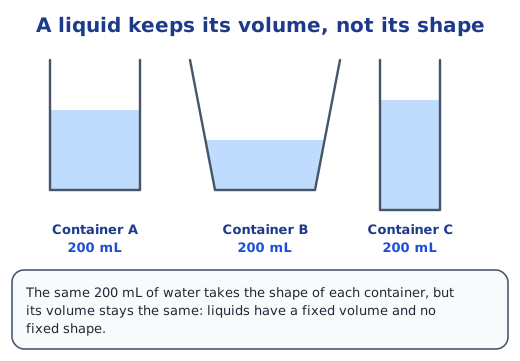
Pour 200 mL of water into three containers of different shapes, one after another: it takes the shape of each, yet it still measures 200 mL (if a container is not clean, a little may cling to its walls). Liquids have a fixed volume but no fixed shape, because their particles can move, though only within a limited space. You can run a finger through water and the water closes behind it, which you cannot do with a solid: the attractions are a little weaker than in a solid, yet still enough to hold the particles near one another. At the boiling point, particles move so fast that they escape as vapour throughout the liquid, forming bubbles. Evaporation is slower and happens only at the surface, at any temperature: that is how spilled water disappears.
Gases
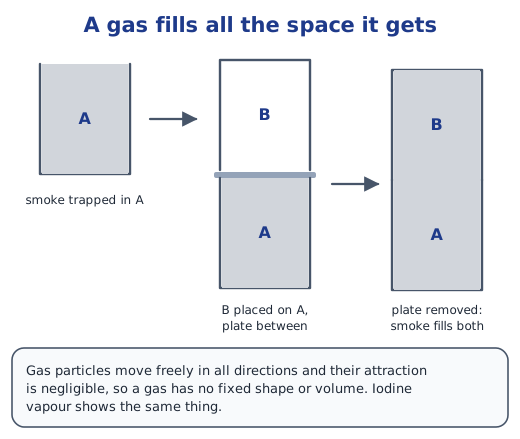
Trap smoke from an incense stick in a gas jar, cover it with a glass plate, place a second jar upside down on top and slide the plate away: the smoke spreads to fill both jars. Gases have no fixed shape or volume; their particles move freely in all directions and the attractions between them are negligible. The smoke specks themselves are visible only because invisible gas particles keep striking them. Iodine vapour, made by keeping solid iodine in a closed jar, shows the same spreading, though it can irritate, so it must be handled with care. Because liquids and gases both flow and take the shape of their containers, they are together called fluids.
Heat decides the state
The state of a substance depends on the thermal (heat) energy of its particles. In a solid, the particles have little energy, stay close and feel strong attractions, so they only vibrate. At the melting point, the added energy overcomes the attractions enough for particles to move about, though still within a limited space. In a gas, the particles carry so much energy that they escape the attractions completely and move freely in every direction.
Why it matters
The states of matter explain everyday things, from ice cubes melting in a glass to wet clothes drying on a line. What matter is made of is in what is matter made of?, and how particles are spaced and move in interparticle spacing and motion. Answers to every question are in the NCERT solutions for Chapter 7; see also the full Chapter 7 notes.
Practice
-
What happens to the particles of a solid when it is heated to its melting point?
Show answer
Answer: (b) They vibrate so hard that they leave their fixed positions
-
The melting point of urea is:
Show answer
Answer: (c) 133 °C
-
Which property do liquids and gases share?
Show answer
Answer: (c) They flow
-
Why does water take the shape of cupped hands but lose it when released?
Show answer
Answer: Water is a liquid: its particles can move past one another, so it takes the shape of whatever holds it; once released, nothing holds it in that shape, so it flows away.
-
Why can we pile up stones or sand but not water?
Show answer
Answer: Stones and grains of sand are solids, whose particles are held in fixed positions, so each piece keeps its shape and can rest on others. Water particles slide past one another, so water flows and spreads instead of forming a pile.
Questions students ask
What are the three states of matter?
Solid, liquid and gas. Solids have a fixed shape and volume; liquids have a fixed volume but take the shape of their container; gases have neither and fill all the space available. The differences come from how strongly the particles attract each other and how freely they can move.
What is a melting point?
It is the lowest temperature at which a solid melts into a liquid at atmospheric pressure. Substances with weak interparticle attractions melt at low temperatures, like ice at 0 °C, and those with strong attractions at high temperatures, like iron at 1538 °C.
Why are liquids and gases called fluids?
Because both can flow and neither keeps a fixed shape; they take whatever shape their container has. Solids cannot flow, because their particles are held in fixed positions.
Stuck on a question?
Take a photo and Lagnever AI explains it step by step. Try it for 7 days for ₹2.
Get it on Google Play Open in browser
For parents: after the trial, the plan renews monthly by UPI or card autopay. You can cancel anytime in the app.