
Interparticle spacing and motion
Answer in short
Particles of matter have spaces between them and are always moving. Gas particles have the largest spaces, so air in a syringe can be squeezed while water practically cannot. Sugar dissolves because its particles fit into the spaces between water particles. Moving particles spread colours and smells, and they move faster when heated, so colour spreads fastest in hot water.
Stuck on a question? Take a photo and Lagnever AI explains it step by step. Try it for 7 days for ₹2. Get it on Google Play
Squeezing a gas
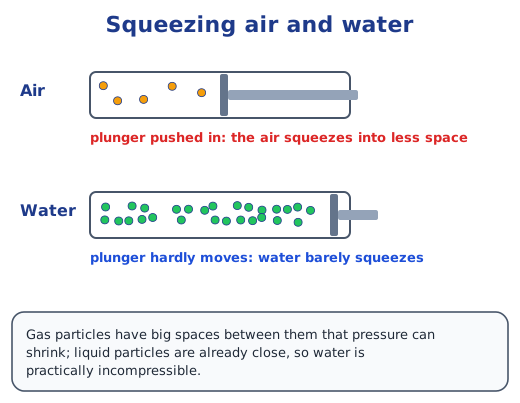
Pull out the plunger of a syringe without a needle, cover the open end with your thumb and push the plunger in slowly: the air inside takes up less space. The particles of a gas have plenty of space between them, and pressure can push them closer. Let go and the particles spread out again, pushing the plunger back. Try the same with water and the plunger hardly moves: water is practically incompressible, because its particles are already close together.
Spaces in liquids
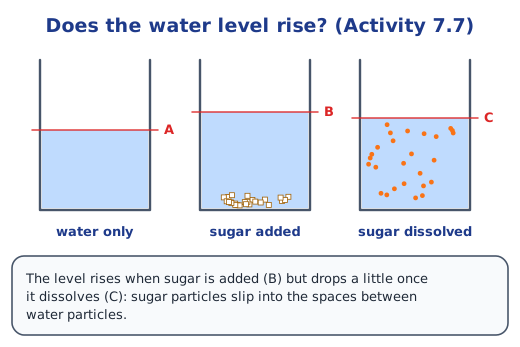
Half-fill a glass with water and mark the level (A). Add two teaspoons of sugar and mark the new level (B), then stir until the sugar dissolves and mark it again (C). The level rose when sugar went in, but after dissolving it falls a little below B, because the sugar particles slip into the spaces between water particles. Common salt and glucose behave the same way. Sand does not dissolve: its particles settle at the bottom and take up their own room, so the level rises and stays up.
Spaces in solids
The particles of a solid are held in place by strong attractions and packed closely, but even so there are small spaces between them. These spaces are not filled with air; they contain nothing at all. Spacing is least in solids, a little more in liquids and greatest in gases. The word ‘particle’ is also used for the specks of dust in polluted air, known as suspended particulate matter, but each speck is itself made of an enormous number of the far smaller particles that make up all matter.
Particles keep moving
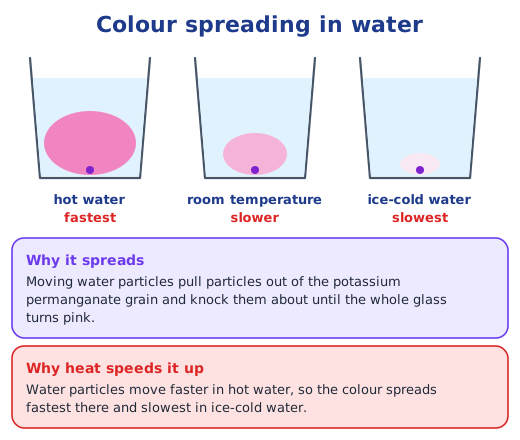
Drop a few grains of potassium permanganate into a glass of water. Pink streaks spread out from the grains, and in time the whole glass turns evenly pink: the moving water particles pull particles out of each grain and knock them all through the liquid. (Scientists call such spreading of particles diffusion.) Use the chemical only with a spoon or spatula, never your fingers. In three glasses of hot, room-temperature and ice-cold water, the colour spreads fastest in the hot water and slowest in the ice-cold water, because heat makes particles move faster. Some substances, like sand, have particles held together so strongly that water cannot pull them out, so they do not dissolve.
Smells travel
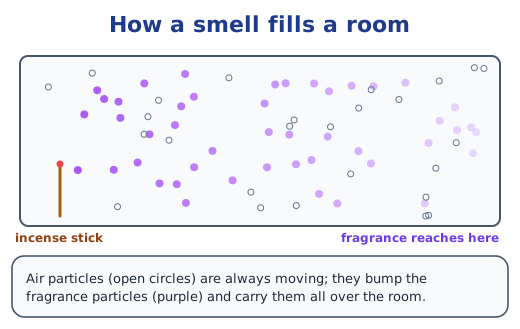
Burn an incense stick in a corner of a room. At first the fragrance is noticed only nearby, but soon it can be smelt everywhere. Air particles are always moving; they strike the particles of fragrance and carry them throughout the room. The same thing brings us the smell of perfume, flowers or food cooking in the kitchen.
Soap and oil
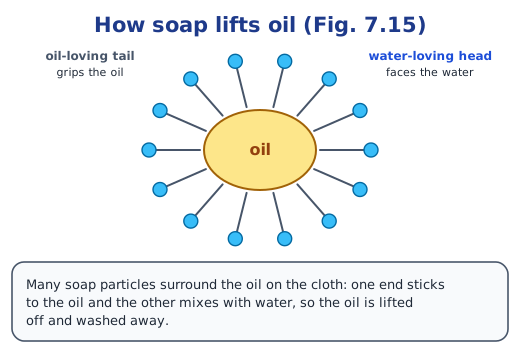
The particle nature of matter is at work in the wash too. When clothes with oily stains are washed with soap, many soap particles surround each bit of oil on the fabric. Each soap particle grips the oil at one end and the water at the other, so the oil is lifted off the cloth and rinsed away.
Why it matters
Spaces between particles explain why gas cylinders can hold so much gas and why a spoonful of sugar seems to vanish, and moving particles explain why smells reach us and why clothes get clean. The three states are in states of matter, and what matter is made of in what is matter made of?. Answers to every question are in the NCERT solutions for Chapter 7; see also the full Chapter 7 notes.
Practice
-
When you push the plunger of a syringe full of air with its end closed, the air:
Show answer
Answer: (b) is squeezed into less space
-
Sand added to water raises the water level because sand:
Show answer
Answer: (b) does not dissolve and takes up space
-
A fragrance spreads through a room because:
Show answer
Answer: (b) moving air particles carry its particles
-
Why does potassium permanganate colour hot water faster than cold water?
Show answer
Answer: Water particles move faster in hot water, so they pull particles out of the grain and spread them through the water more quickly.
-
How does soap remove an oily stain?
Show answer
Answer: Many soap particles crowd around the oil: each grips the oil at one end and the water at the other, so the oil is lifted off the cloth and washed away.
Questions students ask
Why can gases be compressed but liquids cannot?
Gas particles have large spaces between them, which pressure can shrink, as when you push the plunger of a syringe full of air. Liquid particles are already close together, so water is practically incompressible.
Why does the water level drop a little after sugar dissolves?
Because sugar particles slip into the spaces between water particles. The solution takes up less room than the water and the sugar did separately, which shows that there are spaces between water particles.
What happens to the movement of particles when they are heated?
They move faster. That is why colour from potassium permanganate spreads fastest in hot water and slowest in ice-cold water, and why a balloon on a bottle swells when the bottle is put in hot water.
Stuck on a question?
Take a photo and Lagnever AI explains it step by step. Try it for 7 days for ₹2.
Get it on Google Play Open in browser
For parents: after the trial, the plan renews monthly by UPI or card autopay. You can cancel anytime in the app.