
How do cities become centres of work and culture?
Answer in short
Cities grow into centres of economic activity because of where they are and what gathers there. Rivers, coasts and trade routes bring trade; raw materials bring factories; banks, colleges and firms bring skilled jobs. Mumbai, Bengaluru and Delhi grew this way. People from many regions also mix their food, languages and festivals, so cities become cultural hubs.
Stuck on a question? Take a photo and Lagnever AI explains it step by step. Try it for 7 days for ₹2. Get it on Google Play
Why do some places grow into cities?
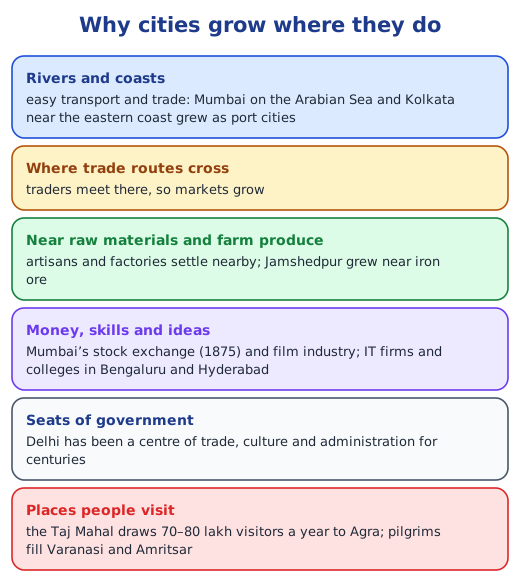
Through history, some places grew into big towns because they had an advantage. A river made it easy to move goods by boat. A spot where trade routes crossed became a meeting point for traders, and markets grew. Farms nearby supplied food, and raw materials attracted artisans and, later, factories. Such places became centres of trade and work, and often also of political power and government.
Location still matters. Jamshedpur grew beside iron ore. Mumbai, on the Arabian Sea, and Kolkata, near the eastern coast, became port cities that traded across India and with the world. Many of today’s cities began as large villages or small towns that were in the right place.
Mumbai: from port to financial capital
The Bombay Stock Exchange, set up in 1875, made the port city of Mumbai the nation’s financial capital. As business grew, skilled and ambitious people of every background were drawn to the city, and the steady flow of news and ideas from abroad sparked new ventures. Films began to be made in Mumbai in the 1910s, and by the 1930s the film industry was thriving. Today the city’s roads and bridges, such as the Bandra Worli Sea Link and the Coastal Road, and business districts such as the Bandra Kurla Complex, support a huge range of work.
Bengaluru and Hyderabad: cities of technology
Bengaluru, often called the Silicon Valley of India, grew into an IT hub because so many software companies, start-ups and colleges sit close together. When firms of one kind cluster in one place, skilled workers find many openings, and colleges and companies can work hand in hand; this has led to new products and services, some of them using Artificial Intelligence. Hyderabad has also become a major centre of technology businesses.
Smaller cities with a speciality
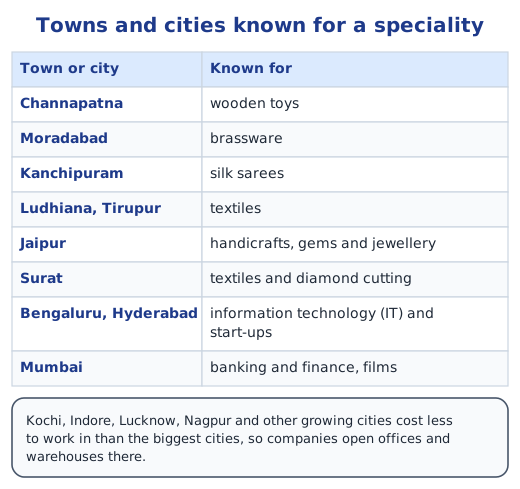
Not every busy city is a giant metropolis. Smaller urban centres often become known for one kind of work. Channapatna makes wooden toys, Moradabad brassware and Kanchipuram silk sarees; Ludhiana and Tirupur are textile towns; and Jaipur is known for its handicrafts, gems and jewellery. Kochi, Indore, Lucknow, Nagpur and other fast-growing cities cost less to work in than the largest cities, so companies open warehouses and offices there and still serve customers across India and abroad.
Cities that people visit
Some cities thrive on history, culture and faith. The Taj Mahal draws 70–80 lakh visitors to Agra every year, and pilgrims fill Amritsar and Varanasi. Visitors need transport, hotels and food, and they buy souvenirs and handicrafts, such as Banarasi sarees in Varanasi, so tourism gives a living to many people.
Delhi and the National Capital Region
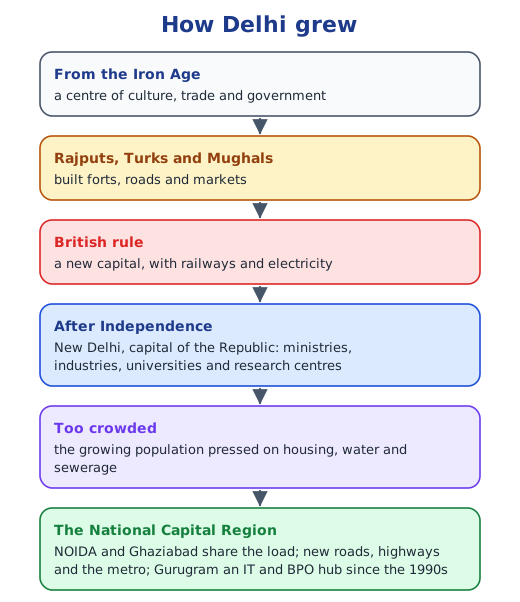
Delhi has been a centre of culture, trade and government since the Iron Age. Rajput, Turkish and Mughal rulers built forts, roads and markets; the British built a new capital and brought railways and electricity. Once India was independent, New Delhi was the Republic’s capital, home to ministries, industries, universities and research centres that drew people from all over India. As the population swelled, housing, water and sewerage came under strain, so the National Capital Region (NCR) was formed to include NOIDA and Ghaziabad. New roads, highways and the metro helped the region spread, and from the 1990s Gurugram grew into a major hub of IT and Business Process Outsourcing (BPO), where firms do work for other companies.
Cities as cultural hubs
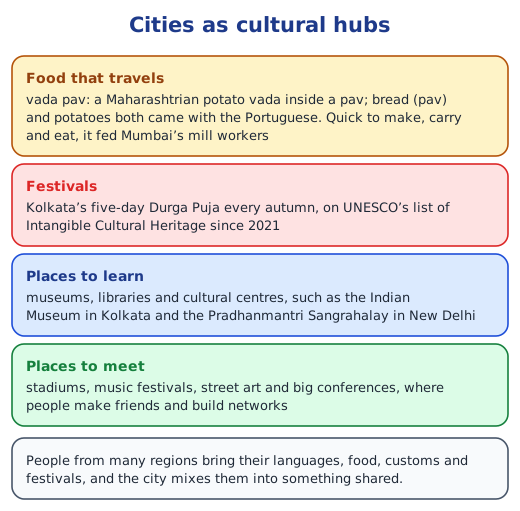
A city attracts people from many regions, and each group brings its own languages, food, customs and festivals, which slowly blend and are shared. Mumbai’s vada pav is a good example: a spiced Maharashtrian potato vada placed inside a pav, and both bread and potatoes reached India through the Portuguese. Quick and cheap, it fed the workers of Mumbai’s textile mills. Kolkata’s five-day Durga Puja every autumn was added to UNESCO’s list of Intangible Cultural Heritage in 2021. Cities also build museums, libraries, cultural centres and stadiums, and hold big events, from conferences to concerts, where people swap ideas, meet and make contacts.
Read on: what is urbanisation?, challenges and planning of cities, the chapter notes and the NCERT solutions.
Practice
-
Mumbai became India’s financial capital after the setting up of:
Show answer
Answer: (b) the Bombay Stock Exchange
-
Channapatna is famous for:
Show answer
Answer: (c) wooden toys
-
Which city in the NCR became a major IT and BPO hub from the 1990s?
Show answer
Answer: (b) Gurugram
-
Why do some companies open offices in cities such as Indore or Nagpur?
Show answer
Answer: Running a business there costs less than in the biggest cities, and they can still serve customers across India and abroad.
-
How did vada pav become popular in Mumbai?
Show answer
Answer: It is quick to make, easy to carry and easy to eat, so it became a favourite snack of the workers in Mumbai’s textile mills.
Questions students ask
Why do cities grow near rivers and coasts?
Rivers and seas make it easy to move goods and people, so trade grows there. Mumbai on the Arabian Sea and Kolkata near the eastern coast became important port cities for trade inside India and with other countries.
Why is Bengaluru called the Silicon Valley of India?
Because many software firms, start-ups and colleges are clustered there. Close links between industry and colleges lead to new products and services that use technologies such as Artificial Intelligence.
What is the National Capital Region?
It is the region around Delhi, including NOIDA, Ghaziabad and Gurugram, created to ease the pressure of Delhi’s growing population on housing, water and sewerage. Roads, highways and the metro link it together.
How are cities cultural hubs?
People from many regions bring their own food, languages, customs and festivals, which mix and are shared. Cities also build museums, libraries, stadiums and cultural centres where people learn, meet and form networks.
Stuck on a question?
Take a photo and Lagnever AI explains it step by step. Try it for 7 days for ₹2.
Get it on Google Play Open in browser
For parents: after the trial, the plan renews monthly by UPI or card autopay. You can cancel anytime in the app.