
What is urbanisation?
Answer in short
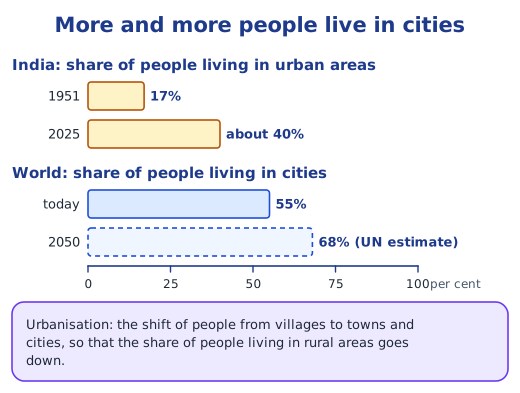
Urbanisation is the shift of people from villages to towns and cities, so that a smaller share of people lives in rural areas. It happens as work moves from farming to industry and services, and jobs draw people in. In India, the urban share grew from 17 per cent in 1951 to about 40 per cent in 2025.
Stuck on a question? Take a photo and Lagnever AI explains it step by step. Try it for 7 days for ₹2. Get it on Google Play
Urban or rural?
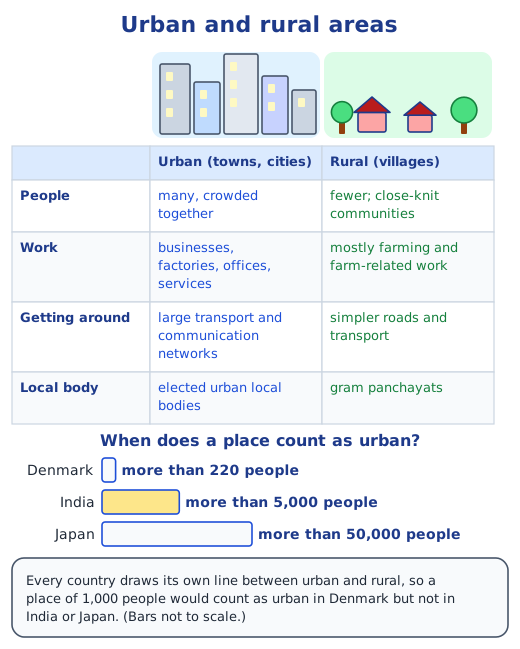
Think of the place where you live. Is it a village, a town or a city? An urban area, a town or city, has many people living close together, all kinds of businesses and jobs, government offices, and big networks of roads, buses, trains and phones. It is looked after by an elected urban local body, such as a municipality. A rural area is made up of villages, with fewer people who often know each other well, more work linked to farming, fewer shops and businesses, and simpler transport. Villages are run by gram panchayats.
There is no single world rule for where a village ends and a town begins. In Denmark, a place becomes urban once it has more than 220 people; in Japan, only above 50,000; in India, above 5,000.
How crowded is it? Population density
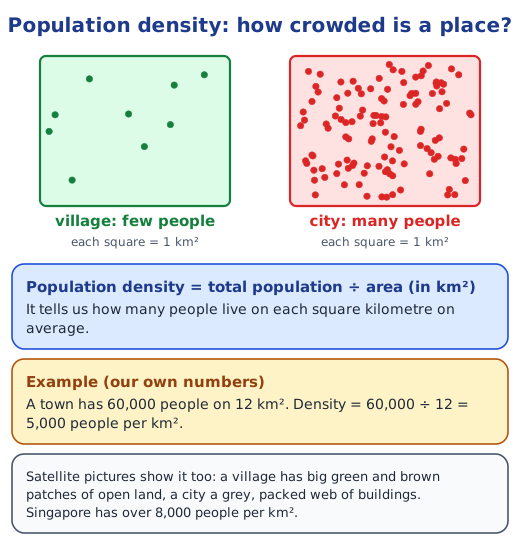
If five friends visit your home, there is space for everyone; if thirty squeeze in, it feels packed. The room is the same size, but the number of people has changed. Demographers, who study populations, measure crowding with population density, the number of people living on each square kilometre:
Population density = total population ÷ area (in km²)
A satellite photo of a village in Haryana shows big green and brown patches of farmland, while one of Gurugram, a city in the same State, shows a grey web of buildings and roads. The village is sparsely crowded; the city is densely crowded, because jobs, shops and services pull people close together.
What is urbanisation?
Urbanisation is the shift of people from rural to urban areas, so that the share of people living in villages goes down. More and more of the world is urban. About 55 per cent of the world’s people live in cities now, and the United Nations expects 68 per cent by 2050. India is following the same path: 17 per cent of Indians lived in urban areas in 1951, and about 40 per cent in 2025.
How does a village grow into a city?
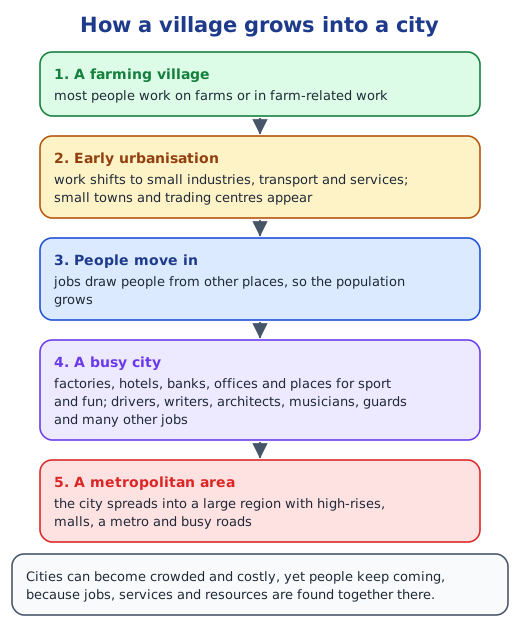
The change is slow and happens in steps. A village begins with farming. Then work shifts to small industries, transport and services, and the place becomes a small town or trading centre. Jobs attract people from other areas, so the population grows. Factories, hotels, banks, government offices and places for sport and entertainment come up, along with many kinds of jobs, from auto drivers to architects. Finally the city spreads into a large metropolitan area with high-rise buildings, malls, a metro and busy roads. A big city can be crowded and costly to live in, yet people keep coming because so many jobs and services are found in one place.
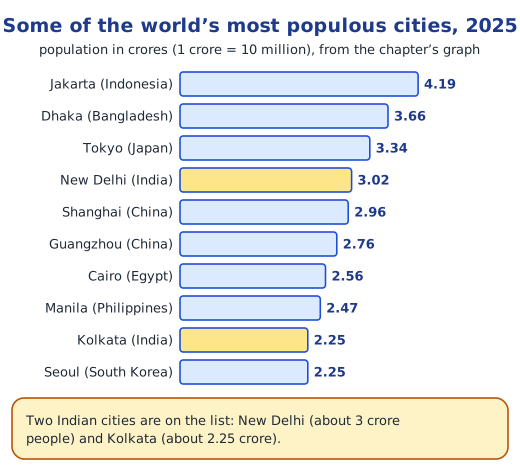
Some cities are now home to crores of people. The chapter’s graph for 2025 puts Jakarta at the top with 4.19 crore, and two Indian cities on the list: New Delhi with 3.02 crore and Kolkata with 2.25 crore.
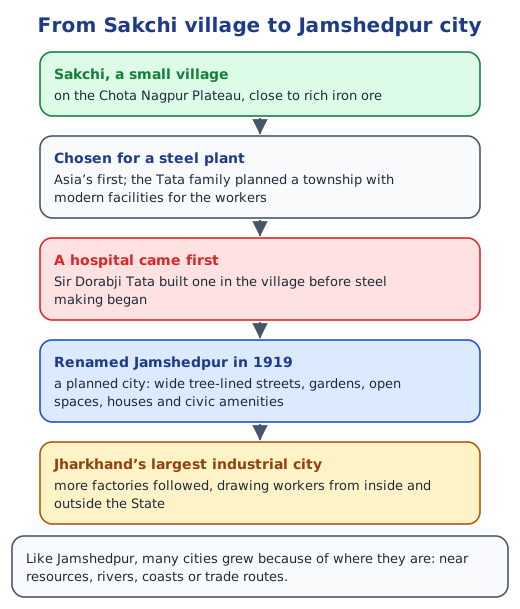
A story of urbanisation: Jamshedpur
Sakchi was a small village on the Chota Nagpur Plateau. Rich iron ore lay nearby, so it was picked as the site of Asia’s first steel plant. The Tata family planned a whole town around the plant, with good homes and services for its workers; Sir Dorabji Tata even opened a hospital there before any steel was made. Broad streets shaded by trees, parks and open ground, houses and public services were laid out to a plan. In 1919 the town was renamed Jamshedpur. More factories followed, workers came from inside and outside the State, and today it is Jharkhand’s biggest industrial city.
Change you can see from space
The chapter shows two satellite views of Electronic City in Bengaluru, from 2012 and 2025. In the later picture there are far more buildings, a metro station on the main road and much less open green land. Offices of technology companies brought jobs, the jobs brought people, and the people needed homes, shops and transport.
Read on: cities as economic and cultural hubs, challenges and planning of cities, the chapter notes and the NCERT solutions.
Practice
-
Population density is usually given as the number of people per:
Show answer
Answer: (c) square kilometre
-
By 2050, about what share of the world’s people is expected to live in cities?
Show answer
Answer: (c) 68%
-
Jamshedpur grew around:
Show answer
Answer: (b) a steel plant
-
A town has 90,000 people living on 30 km². What is its population density?
Show answer
Answer: 90,000 ÷ 30 = 3,000 people per km².
-
Give two differences between an urban and a rural area.
Show answer
Answer: Urban areas have more people and more kinds of work, such as factories, offices and services, while rural areas have fewer people and mostly farm work. Urban areas are run by urban local bodies, villages by gram panchayats.
Questions students ask
What is urbanisation?
It is the movement of people from rural areas to towns and cities, so that the share of people living in villages falls. As a place gains industries, services and jobs, people arrive and the village slowly turns into a town and then a city.
How do you calculate population density?
Divide the total population of a region by its area in square kilometres. For example, 60,000 people on 12 km² gives 60,000 ÷ 12 = 5,000 people per km².
What share of India’s people live in urban areas?
About 40 per cent in 2025, up from 17 per cent in 1951. Across the world, about 55 per cent of people live in cities now, and the United Nations expects 68 per cent by 2050.
Why did Jamshedpur grow into a city?
Sakchi, a village near rich iron ore, was chosen for Asia’s first steel plant. The Tata family planned a township for the workers, more factories followed, and people came for jobs. It was renamed Jamshedpur in 1919.
Stuck on a question?
Take a photo and Lagnever AI explains it step by step. Try it for 7 days for ₹2.
Get it on Google Play Open in browser
For parents: after the trial, the plan renews monthly by UPI or card autopay. You can cancel anytime in the app.