
Class 6 Social Science Chapter 3: Landforms and Life Notes
This chapter in five lines
Landforms are the physical features of the Earth's surface, shaped over millions of years. The three main types are mountains, which rise high with steep slopes and narrow summits; plateaus, which rise from the land around them and have more or less flat tops; and plains, which are wide, flat and low, generally under 300 metres. Each landform has its own climate, plants, animals and ways of life, with challenges as well as opportunities. Deserts are another landform, and people have adapted to all of them.
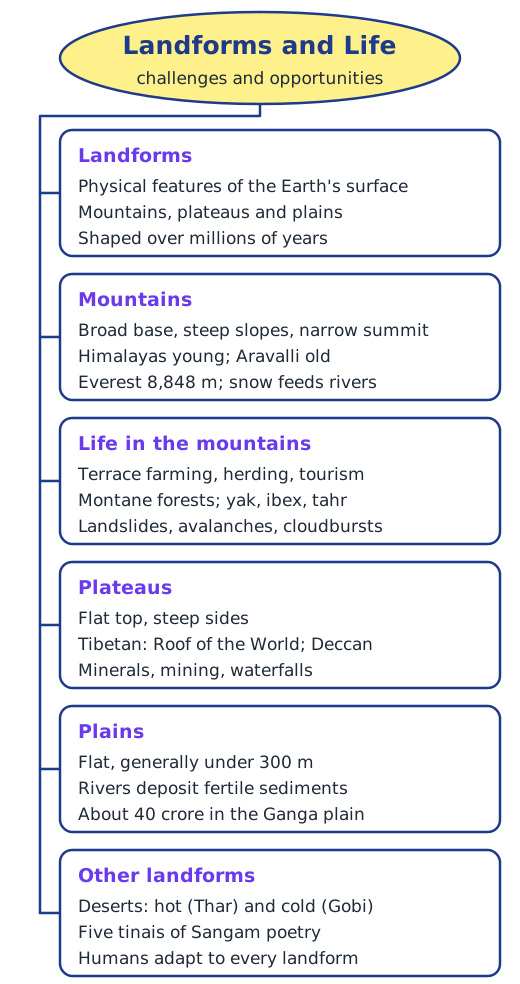
Many landscapes, three main landforms
The chapter opens with lines from the Bhūmi Sūkta of the Atharva Veda, a hymn that praises the Earth’s heights, slopes and great plains and calls the Earth our mother. Land looks very different from place to place. Travel by road from the Chhota Nagpur region of Jharkhand to Prayagraj in Uttar Pradesh and on to Almora in Uttarakhand, and you cross three very different landscapes.
A landform is a physical feature on the surface of the Earth. Landforms take shape over millions of years and are closely linked with the environment and life. The three main categories are mountains, plateaus and plains. Each has its own climate, plants and animals, and different numbers of people live on each.
Mountains
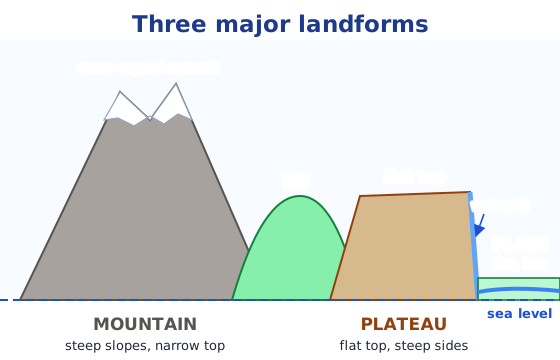
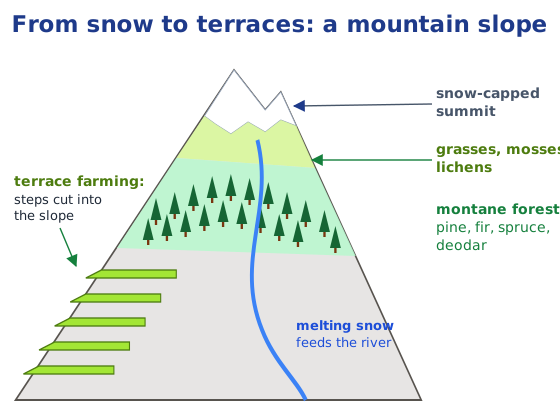
Mountains are much higher than the land around them, with a broad base, steep slopes and a narrow summit. High mountains may be snow-capped all year; lower down, snow melts every summer and the water feeds rivers. Highlands that are lower, with gentler slopes and rounded tops, are hills.
Most mountains are grouped in mountain ranges, such as the Himalayas in Asia, the Alps in Europe and the Andes in South America. Mount Everest (8,848 m, between Tibet in China and Nepal) and Kanchenjunga (between Nepal and Sikkim) are the two highest peaks of the Himalayas. Aconcagua is the highest peak of the Andes, Kilimanjaro in eastern Africa stands alone, Mont Blanc is the highest in the Alps, and Anamudi (Anai Peak) in Kerala is the highest mountain in south India.
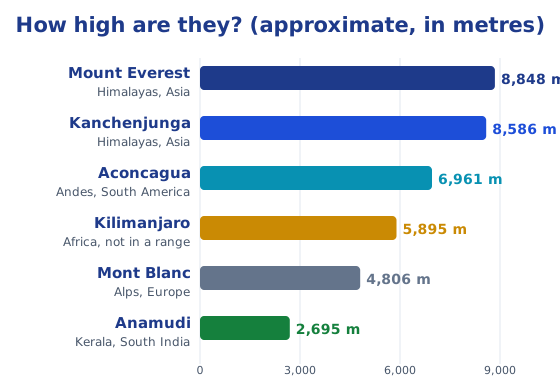
Tall, sharp-peaked mountains like the Himalayas are young: formed recently in the Earth’s history, though still millions of years ago, and still rising. Lower, rounded ranges like the Aravalli are much older, worn down by erosion. Read more in mountains and life in the mountains.
Mountain environment and life
Mountain slopes are often covered with montane forest of tall, cone-shaped conifers such as pine, fir, spruce and deodar; higher up, trees give way to grasses, mosses and lichens. Forests, rivers, lakes, grasslands and caves are home to animals such as the golden eagle, the peregrine falcon, the snow leopard, the ibex, the Himalayan tahr, the yak and the black bear. The Ganga, nearly 2,500 km long, rises in the Himalayas, and so do tributaries like the Yamuna and the Ghaghara.
The terrain is rugged and steep, so regular farming is possible only in some valleys; on the slopes, people practise terrace farming, and in many mountain regions herding is preferred to farming. Tourism, sports such as skiing and paragliding, and pilgrimages bring income, though too many visitors can harm the fragile environment. Mountain life also has challenges: landslides, avalanches, cloudbursts, flash floods, heavy snowfall and cold. Bachendri Pal, the first Indian woman to climb Mount Everest (1984), and Arunima Sinha, who climbed it in 2013 after losing a leg, show the courage the mountains inspire. Many communities hold mountains sacred: Tibetans call Everest Chomolungma, Nepalis call it Sagarmatha, and Mount Kailash is sacred to Hindus, Buddhists, Jains and followers of Bon.
Plateaus
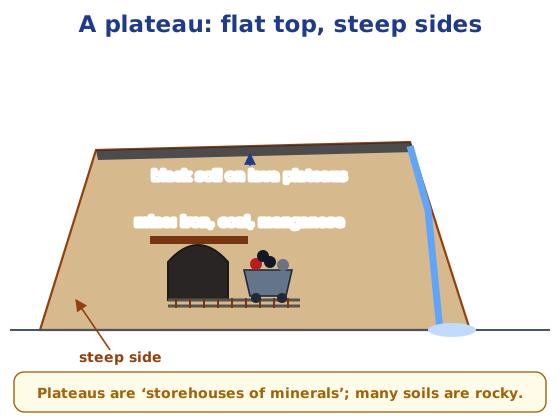
A plateau rises from the land around it and has a more or less flat top, often with steep slopes on some sides. Plateaus can be young or old and from a few hundred to several thousand metres high. The Tibetan Plateau, the largest and highest in the world, averages about 4,500 m and is called the ‘Roof of the World’; the Deccan Plateau, formed by volcanic activity, is one of the oldest.
Plateaus are ‘storehouses of minerals’, so mining is a major activity: the East African Plateau is famous for gold and diamonds, and the Chhota Nagpur Plateau has huge reserves of iron, coal and manganese. Many plateaus have rocky, less fertile soil, but lava plateaus often have rich black soil. Plateaus also have spectacular waterfalls, such as the Nohkalikai Falls, which drop 340 m from the Cherrapunji Plateau. Read more in what is a plateau.
Plains
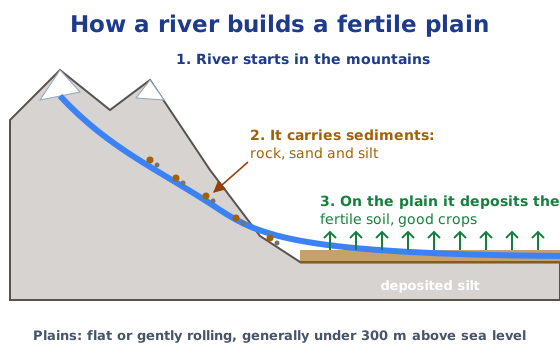
Plains are wide, flat or gently rolling lands without large hills or deep valleys, generally not more than 300 metres above sea level. Floodplains are formed by rivers that start in the mountains, pick up sediments (rock, sand and silt) and deposit them on the plains, making the soil very fertile. So plains are ideal for crops, and farming is the main occupation.
The first civilisations grew around rivers in fertile plains, and a large part of the world’s people still live in plains. About 40 crore people, more than one-fourth of India’s population, live in the Ganga plain, growing rice, wheat, maize, barley and millets, and fibre crops like cotton, jute and hemp. Irrigation from canals and groundwater has raised production but lowered groundwater; high population and pollution are other problems. Gentle slopes make river travel easy, and many river sources and confluences are sacred. Read more in what are plains.
Deserts and other landforms
Experts also describe other landforms, such as deserts: large, dry expanses with very little precipitation and unique plants and animals. Some are hot, like the Sahara in Africa and the Thar in the north-west of the Indian subcontinent; others are cold, like the Gobi in Asia, and some experts call Antarctica a desert. Communities of the Thar have rich traditions of folk songs and legends about the desert. The way humans have made every landform their home shows our adaptability and resilience.
The five tinais
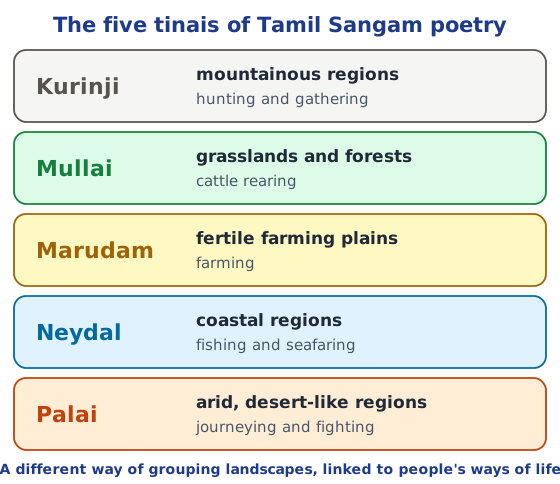
Ancient Tamil Sangam poetry describes five landscapes, the tinais, each with its own way of life: Kurinji (mountains; hunting and gathering), Mullai (grasslands and forests; cattle rearing), Marudam (fertile plains; farming), Neydal (coasts; fishing and seafaring) and Pālai (arid lands; journeying and fighting). They are a different way of grouping landscapes, showing a keen awareness of regions and a deep bond between people and nature.
Answers to every activity and question are in the NCERT solutions for Chapter 3.
Key terms
| Term | Meaning |
|---|---|
| Landform | A physical feature on the surface of the Earth, such as a mountain, a plateau or a plain, formed over millions of years. |
| Altitude | The height of something above sea level, such as a mountain, a flying bird or a satellite. |
| Mountain | A landform much higher than the land around it, with a broad base, steep slopes and a narrow summit. |
| Hill | A highland that is lower than a mountain, with less steep slopes and a rounded top. |
| Mountain range | A group of mountains, such as the Himalayas in Asia, the Alps in Europe and the Andes in South America. |
| Montane forest | Forest that grows on mountain slopes, often of cone-shaped conifer trees such as pine, fir, spruce and deodar. |
| Terrace farming | Growing crops on mountain slopes by cutting steps into the slope. |
| Plateau | A landform that rises from the land around it and has a more or less flat top, with steep slopes on some sides. |
| Plain | A wide stretch of flat or gently rolling land, with no large hills or deep valleys, generally not more than 300 metres above sea level. |
| Sediments | Particles of rock, sand and silt that rivers pick up in the mountains and deposit in the plains, making the soil fertile. |
| Confluence | The meeting point of two or more rivers, often considered sacred in India. |
| Resilience | The capacity to meet challenges and difficulties, adapt to them or overcome them. |
Topics in this chapter
Practice
-
Which is the highest mountain in the world?
Show answer
Answer: (b) Mount Everest
-
Which plateau is called the ‘Roof of the World’?
Show answer
Answer: (c) Tibetan Plateau
-
Plains are generally not more than how high above sea level?
Show answer
Answer: (b) 300 m
-
Cutting steps into a hill slope to grow crops is called:
Show answer
Answer: (a) terrace farming
-
Which of these is a cold desert?
Show answer
Answer: (c) Gobi
Questions students ask
What are the main topics of Class 6 SST Chapter 3?
Landforms and their types; mountains, hills and mountain ranges; the mountain environment and life in the mountains; plateaus and their minerals and waterfalls; plains and life in the Ganga plain; deserts; and the five tinais of Tamil Sangam poetry.
Is Landforms and Life in the new Exploring Society book?
Yes. Landforms and Life is Chapter 3 of Exploring Society: India and Beyond, the Class 6 Social Science textbook (2026-27 session). It comes after Chapter 2, Oceans and Continents.
How many questions does Chapter 3 have at the end?
The “Questions, activities and projects” section has 5 questions. Our NCERT solutions page answers all of them, along with the Big Questions, every Let's Explore and the Think About It box.
Stuck on a question?
Take a photo and Lagnever AI explains it step by step. Try it for 7 days for ₹2.
Get it on Google Play Open in browser
For parents: after the trial, the plan renews monthly by UPI or card autopay. You can cancel anytime in the app.