
What is a plateau?
Answer in short
A plateau is a landform that rises from the land around it and has a more or less flat top, often with steep slopes on some sides. The Tibetan Plateau, the largest and highest, is the ‘Roof of the World’. Plateaus are storehouses of minerals, so mining is important, and many have spectacular waterfalls.
Stuck on a question? Take a photo and Lagnever AI explains it step by step. Try it for 7 days for ₹2. Get it on Google Play
The meaning of a plateau
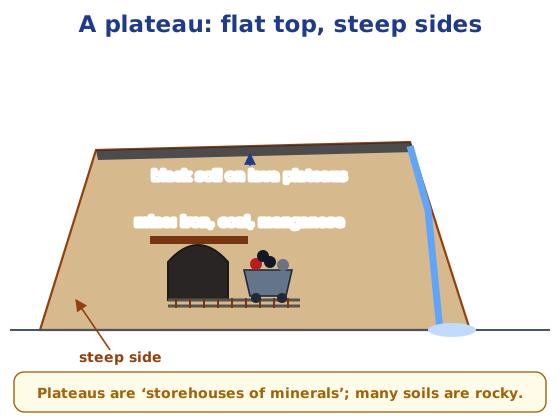
A plateau is a landform that rises up from the land around it and has a more or less flat surface. Some of its sides are often steep slopes. Think of it as a raised table of land. Like mountains, plateaus can be young or old in the Earth’s history, and their height can vary from a few hundred metres to several thousand metres.
Plateau, mountain or plain?
| Mountain | Plateau | Plain | |
|---|---|---|---|
| Top | Narrow summit | More or less flat | Flat or gently rolling |
| Sides | Steep slopes | Steep on some sides | No large hills or deep valleys |
| Height | Much higher than surroundings | A few hundred to several thousand metres | Generally under 300 m |
Two famous plateaus
- The Tibetan Plateau is the largest and highest plateau in the world. Its average altitude is about 4,500 m, which is why it is nicknamed the ‘Roof of the World’. From east to west it is nearly 2,500 km long, about the distance from Chandigarh to Kanyakumari.
- The Deccan Plateau of central and south India is one of the oldest plateaus in the world. It was formed through volcanic activity millions of years ago.
Storehouses of minerals
Like mountains, plateaus are rich in mineral deposits, so they have been called ‘storehouses of minerals’. Mining is a major activity on plateaus, and many of the world’s largest mines are found there.
- The East African Plateau is famous for gold and diamond mining.
- In India, the Chhota Nagpur Plateau has huge reserves of iron, coal and manganese.
These minerals are used to make steel, run power stations and build machines, so plateau regions are important for industry. Mining also brings challenges, such as cleared forests and damaged land, which need careful handling.
Soils and farming
The plateau environment varies a lot across the world. Many plateaus have rocky soil, which is less fertile than the soil of plains, so they are less favourable for farming. The exception is lava plateaus, formed by volcanic activity, which often have rich black soil. Parts of the Deccan Plateau have such black soil, which holds moisture well.
Waterfalls
Rivers flowing over the edges of plateaus create many spectacular waterfalls.
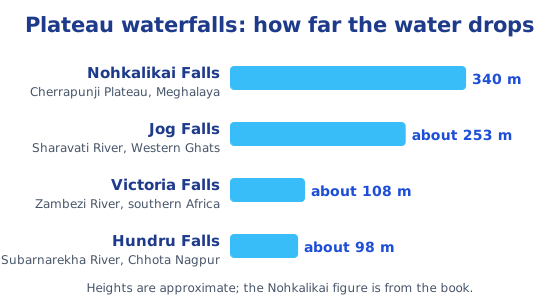
- Victoria Falls on the Zambezi River in southern Africa.
- Hundru Falls on the Subarnarekha River in the Chhota Nagpur Plateau.
- Jog Falls on the Sharavati River in the Western Ghats.
- Nohkalikai Falls, which drop 340 m from the Cherrapunji Plateau in Meghalaya.
Extra: the other heights in the chart are approximate figures from common sources, given only to compare.
Plateaus on the journey
At the start of the chapter, a road trip begins in the Chhota Nagpur region of Jharkhand. There you would see a plateau landscape: rolling uplands with rocky soil, forests, mines of coal and iron, and waterfalls such as Hundru. As the road descends to Prayagraj, the land becomes a flat, fertile plain.
For the other landforms, read mountains and life in the mountains and what are plains. For the textbook’s questions, see the Chapter 3 NCERT solutions; for the whole chapter, see the Chapter 3 notes.
Practice
-
Plateaus are often called:
Show answer
Answer: (a) storehouses of minerals
-
The Chhota Nagpur Plateau is rich in:
Show answer
Answer: (b) iron, coal and manganese
-
The Nohkalikai Falls drop from which plateau?
Show answer
Answer: (c) Cherrapunji Plateau
-
Why is the Tibetan Plateau called the ‘Roof of the World’?
Show answer
Answer: It is the largest and highest plateau in the world, with an average altitude of about 4,500 metres, so it sits high above most of the world like a roof.
-
Why are most plateaus less favourable for farming than plains?
Show answer
Answer: Many plateaus have rocky soil, which is less fertile than the soil of plains. Lava plateaus are an exception, as they often have rich black soil.
Questions students ask
What is a plateau?
A landform that rises up from the surrounding land and has a more or less flat surface on top; some of its sides are often steep slopes. Plateaus can be a few hundred metres or several thousand metres high.
Which are the major plateaus mentioned in the chapter?
The Tibetan Plateau (the largest and highest), the Deccan Plateau of central and south India (one of the oldest), the Chhota Nagpur Plateau in Jharkhand, the East African Plateau, and the Cherrapunji Plateau in Meghalaya.
Why is mining important on plateaus?
Like mountains, plateaus are rich in mineral deposits and are called storehouses of minerals. Many of the world's largest mines are on plateaus, such as the gold and diamond mines of the East African Plateau and the iron, coal and manganese of the Chhota Nagpur Plateau.
Stuck on a question?
Take a photo and Lagnever AI explains it step by step. Try it for 7 days for ₹2.
Get it on Google Play Open in browser
For parents: after the trial, the plan renews monthly by UPI or card autopay. You can cancel anytime in the app.