
Mountains and life in the mountains
Answer in short
Mountains are landforms much higher than the land around them, with a broad base, steep slopes and a narrow summit; some are snow-capped all year. Most lie in ranges such as the Himalayas. Mountain people grow crops on terraces cut into slopes, herd animals and earn from tourism, but face landslides, avalanches, cloudbursts and cold.
Stuck on a question? Take a photo and Lagnever AI explains it step by step. Try it for 7 days for ₹2. Get it on Google Play
What is a mountain?
Mountains are landforms that are much higher than the land around them. You can recognise one by its broad base, steep slopes and narrow summit. High mountains may stay snow-capped all year. Lower down, the snow melts every summer and the water feeds rivers. Highlands that are lower, with gentler slopes and rounded tops, are called hills.
Snow is simply precipitation in solid form. In most of India, precipitation falls as rain or hail, but at high altitudes, where it is cold enough, snow covers the land in a soft white blanket.
Mountain ranges and famous peaks
Most mountains are grouped in mountain ranges, some thousands of kilometres long: the Himalayas in Asia, the Alps in Europe and the Andes in South America.
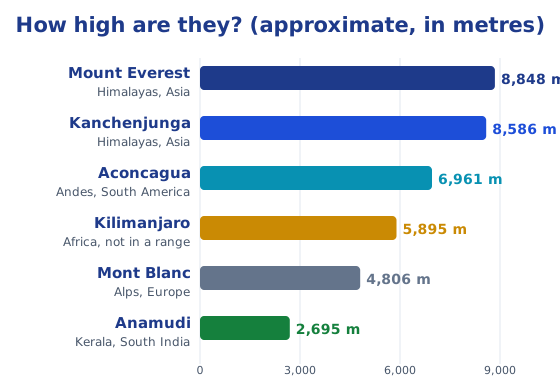
- Mount Everest (8,848 m), between Tibet (China) and Nepal, and Kanchenjunga, between Nepal and Sikkim, are the two highest peaks of the Himalayas.
- Aconcagua is the highest peak of the Andes.
- Kilimanjaro in eastern Africa stands alone; it is not part of any range.
- Mont Blanc is the highest mountain of the Alps.
- Anamudi (Anai Peak) in Kerala is the highest mountain in south India.
Young and old mountains
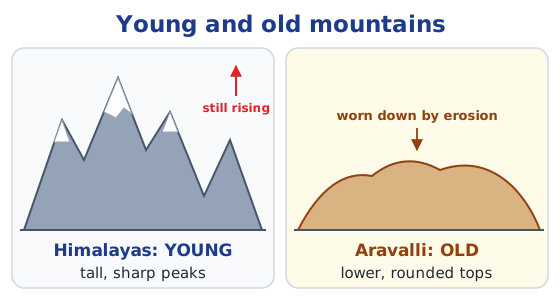
Mountains with tall, sharp peaks, like the Himalayas, are young: they formed recently in the Earth’s history, though that is still millions of years ago. The Himalayas are still being pushed up, even as erosion wears them down, so they are still growing in height. Shorter, rounded mountains and hills, like the Aravalli Range, are much older and have been rounded by erosion.
The mountain environment
Mountain slopes are often covered with montane forest. Conifer trees such as pine, fir, spruce and deodar grow tall and cone-shaped, with thin, pointed leaves. Higher up, trees give way to grasses, mosses and lichens. Forests, rivers, lakes, grasslands and caves are home to the golden eagle, the peregrine falcon, the Canadian lynx, the snow leopard, the ibex, the Himalayan tahr, the mountain hare, the yak, the grey fox and the black bear.
Mountains feed great rivers. The Ganga, nearly 2,500 km long, rises in the Himalayas, and so do tributaries such as the Yamuna and the Ghaghara. The poet Kalidasa, at least 1,500 years ago, opened his poem Kumarasambhava by praising the Himalayas as the ‘Lord of mountains’, stretching from the western to the eastern ocean, with winds carrying spray from the descending Ganga and shaking the deodar trees.
Life in the mountains
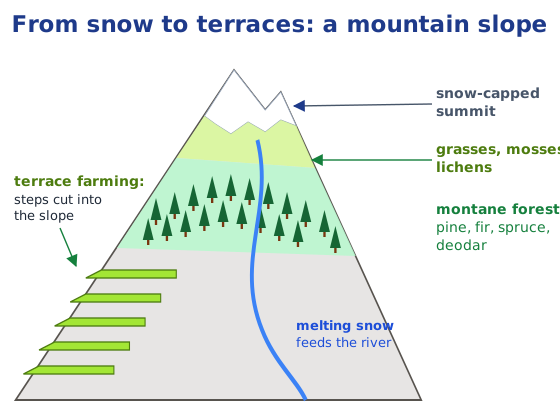
- Farming: the terrain is rugged and steep, so regular farming is possible only in some valleys. On the slopes, people cut steps into the hillside: this is terrace farming.
- Herding: in many mountain regions, herding animals is preferred to farming.
- Tourism: crisp air and scenic beauty attract tourists, and some come for skiing, hiking, mountaineering and paragliding.
- Pilgrimage: for centuries, people have travelled to holy sites in the mountains.
Too many visitors, however, put pressure on the fragile mountain environment, and it is often hard to find the right balance.
Challenges of mountain life
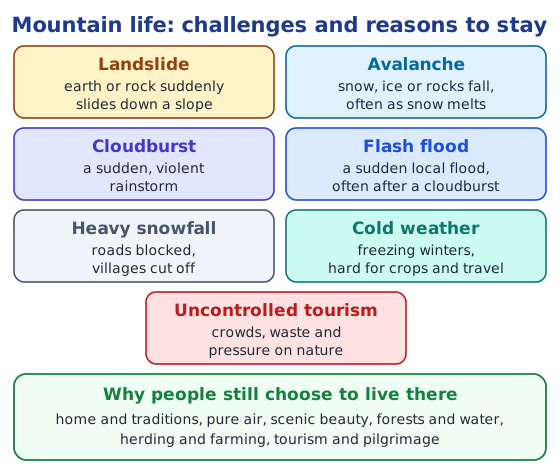
A landslide is the sudden collapse of earth or rock from a mountainside. An avalanche is a sudden fall of snow, ice or rocks, often when snow starts melting. A cloudburst is a sudden, violent rainstorm, and it can cause a flash flood, a sudden local flood. Heavy snowfall and cold weather add to the hardship. Yet people still choose to live in the mountains for their homes and traditions, the pure air and beauty, the forests and water, and the work that herding, tourism and pilgrimage bring.
Courage and reverence
Bachendri Pal led many women’s climbing expeditions and in 1984 became the first Indian woman to climb Mount Everest. Arunima Sinha, who lost a leg in an accident at 22, climbed Everest in 2013 with Bachendri Pal’s training and went on to climb the highest peak of every continent. Many communities hold mountains sacred: Tibetans call Everest Chomolungma (‘Mother Goddess of the World’), Nepalis call it Sagarmatha (‘Goddess of the Sky’), and Mount Kailash is sacred to followers of Hinduism, Buddhism, Jainism and Bon.
For the other landforms, read what is a plateau and what are plains. For the textbook’s questions, see the Chapter 3 NCERT solutions; for the whole chapter, see the Chapter 3 notes.
Practice
-
Which mountain is NOT part of any range?
Show answer
Answer: (c) Mount Kilimanjaro
-
The Aravalli Range is an example of:
Show answer
Answer: (b) old mountains rounded by erosion
-
The first Indian woman to climb Mount Everest was:
Show answer
Answer: (b) Bachendri Pal
-
Why is terrace farming practised in the mountains?
Show answer
Answer: The terrain is rugged and steep, so regular farming is possible only in some valleys. Cutting steps into the slopes creates flat strips of land where crops can grow.
-
Name two natural challenges and one human-made challenge of life in the mountains.
Show answer
Answer: Natural: landslides, avalanches, cloudbursts, flash floods, heavy snowfall or cold weather. Human-made: uncontrolled tourism, which puts pressure on the fragile environment.
Questions students ask
What is a mountain?
A landform that is much higher than the land around it, with a broad base, steep slopes and a narrow summit. Depending on their height, some mountains are covered with snow all year.
What is the difference between young and old mountains?
Young mountains, like the Himalayas, are tall with sharp peaks; they formed recently in the Earth's history and are still rising. Old mountains, like the Aravalli Range, are lower and rounded because erosion has worn them down for a very long time.
How do people earn a living in the mountains?
By terrace farming on the slopes and farming in valleys, by herding animals, and through tourism, sports such as skiing and paragliding, and pilgrimages to holy sites.
Stuck on a question?
Take a photo and Lagnever AI explains it step by step. Try it for 7 days for ₹2.
Get it on Google Play Open in browser
For parents: after the trial, the plan renews monthly by UPI or card autopay. You can cancel anytime in the app.