
What are plains?
Answer in short
Plains are wide stretches of flat or gently rolling land without large hills or deep valleys, generally not more than 300 metres above sea level. Floodplains form when rivers from the mountains deposit rock, sand and silt, making the soil very fertile. Plains are ideal for farming, and about 40 crore people live in the Ganga plain alone.
Stuck on a question? Take a photo and Lagnever AI explains it step by step. Try it for 7 days for ₹2. Get it on Google Play
The meaning of plains
Plains are landforms with an extensive flat or gently undulating (rolling) surface. They do not have any large hills or deep valleys, and they are generally not more than 300 metres above sea level. Sea level is the average level of the surface of the oceans, also called mean sea level; heights of land are measured from it.
How rivers make floodplains
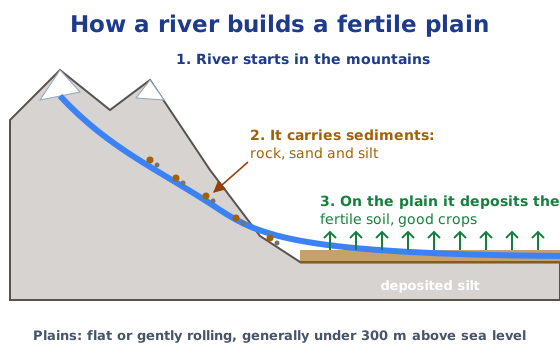
Floodplains are one type of plains, formed by rivers that start in mountain ranges. On their way, the rivers collect particles of rock, sand and silt, called sediments. They carry these sediments all the way to the plains and deposit them there, especially when they flood. The sediments make the soil very fertile, so these plains are ideal for growing crops of all kinds, and farming is the main occupation. Plains also support a variety of plants and animals.
Great river plains of the world include those of the Ganga and Brahmaputra and the Indus in South Asia, the Yangtze in China, the Nile in Africa, and the Mississippi and the Amazon in the Americas.
Life in the plains
Thousands of years ago, the first civilisations developed around rivers in fertile plains. Today too, a large part of the world’s population lives in plains.
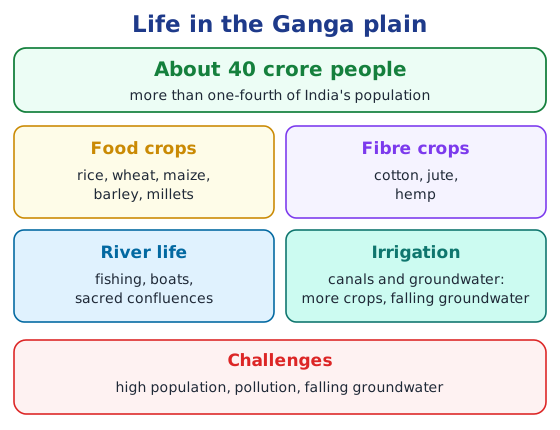
About 40 crore people, more than one-fourth of India’s population, live in the Ganga plain, often called the Gangetic plain. As in many other plains:
- People work in farming and river fishing.
- Food crops such as rice, wheat, maize, barley and millets are grown.
- Fibre crops such as cotton, jute and hemp are grown too.
Irrigation and its cost
Traditional farming here was mostly rainfed, watered by rain. In recent decades, farming has turned to irrigation, with water brought by networks of canals or pumped from groundwater. Irrigation has increased production, but it has also caused the depletion of groundwater, a challenge for the future of farming in the region. High population and pollution are other problems of the Ganga plain.
Rivers, travel and culture
Because plains have a gentle slope, river navigation is easy and supports many economic activities. In earlier days, people used rivers a lot to travel from place to place; even today, on some stretches of the Ganga, people prefer boats to move around.
Rivers also carry great cultural value. Many communities consider a river’s source and its confluence, the meeting point of two or more rivers, to be sacred. In India, many festivals, ceremonies and rituals are held at such places: Prayagraj, where the Ganga and the Yamuna meet, is one well-known example.
Plains seen from space
A satellite photograph of north India shows the Ganga plain as a wide green expanse, the farmland of the plain. Above it, a white band marks the snow-covered Himalayas, and the brown land at the lower left is drier country with little green cover, towards the deserts and rocky uplands of the west.
Plains on the journey
On the chapter’s road trip, the land around Prayagraj is a plain: flat, fertile and green with fields, crossed by the Ganga and the Yamuna. It lies between the Chhota Nagpur Plateau to the south-east and the mountains around Almora to the north-west.
For the other landforms, read mountains and life in the mountains and what is a plateau. For the textbook’s questions, see the Chapter 3 NCERT solutions; for the whole chapter, see the Chapter 3 notes.
Practice
-
Particles of rock, sand and silt carried by rivers are called:
Show answer
Answer: (b) sediments
-
About how many people live in India's Ganga plain?
Show answer
Answer: (b) 40 crore
-
Which of these is a fibre crop grown in the Ganga plain?
Show answer
Answer: (b) Jute
-
Why is the soil of floodplains fertile?
Show answer
Answer: Rivers coming from the mountains collect sediments (particles of rock, sand and silt) and deposit them on the plains, especially during floods. These sediments make the soil very fertile.
-
What is a confluence? Give an example.
Show answer
Answer: The meeting point of two or more rivers. Prayagraj, where the Ganga and the Yamuna meet, is a famous confluence considered sacred.
Questions students ask
What are plains?
Landforms with an extensive flat or gently undulating surface, without large hills or deep valleys, and generally not more than 300 metres above sea level.
What are floodplains?
Plains formed by rivers that start in mountain ranges, collect particles of rock, sand and silt, and deposit them on the plains, making the soil very fertile. They are ideal for growing crops of all kinds.
What are the problems of the Ganga plain?
Irrigation from canals and groundwater has increased crops but has also made groundwater fall. High population and pollution are other problems facing the region.
Stuck on a question?
Take a photo and Lagnever AI explains it step by step. Try it for 7 days for ₹2.
Get it on Google Play Open in browser
For parents: after the trial, the plan renews monthly by UPI or card autopay. You can cancel anytime in the app.