
Changes During Adolescence
Answer in short
Adolescence, from about 10 to 19 years, is a time of rapid growth. Height shoots up, weight and strength increase, the voice box grows, hair appears in the armpits and pubic region, and oily skin may cause pimples. Emotions grow stronger too, with mood swings and greater sensitivity. The timing and extent of the changes differ from person to person.
Stuck on a question? Take a photo and Lagnever AI explains it step by step. Try it for 7 days for ₹2. Get it on Google Play
When does adolescence begin?
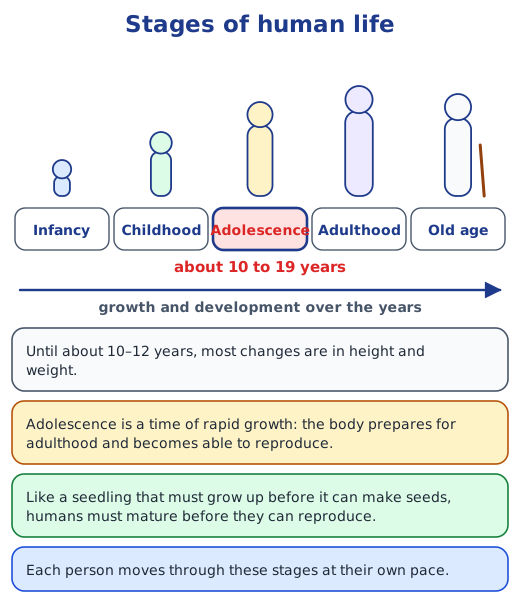
A plant cannot make seeds as soon as it sprouts; it must first grow and mature. The same is true of animals and of us. Human life moves through infancy, childhood, adolescence, adulthood and old age. Until about 10–12 years of age, the main changes are in height and weight. Then a new set of changes begins, and this marks the start of adolescence, the stage between childhood and adulthood. It usually lasts from about 10 to 19 years, a time when the body grows and develops quickly and gets ready for adulthood.
Growing taller, heavier and stronger
We grow taller from the day we are born, but the increase becomes most noticeable in adolescence, which is why a cousin you have not seen for a year can suddenly look much taller. Weight and strength increase as well. Boys may find their shoulders becoming broader and their chests wider, while girls also gain height and weight, and their breasts develop. Activity 6.1 asks a class to collect such changes anonymously on paper slips in a jar and discuss them; height, weight and strength, and appearance usually top the list.
A changing voice
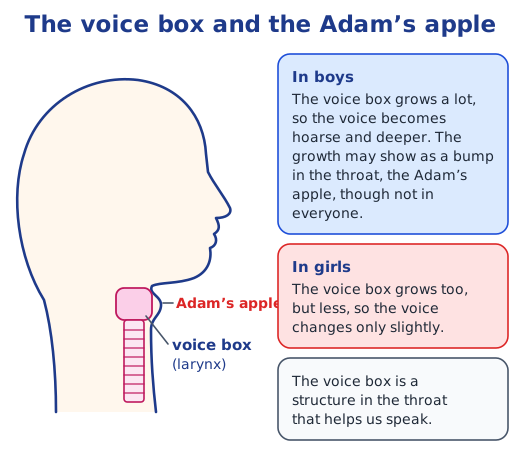
The voice box, or larynx, is a structure in the throat that helps us speak. During adolescence it grows. In boys it grows a lot, so the voice cracks, sounds hoarse and then settles deeper. The enlarged voice box may be seen as a bump at the front of the throat, called the Adam’s apple, although it is not noticeable in every boy. The voice box grows in girls too, but not as much, so their voices change only slightly.
Hair and skin
Both boys and girls begin to grow hair in the armpits and the pubic region. Boys usually develop facial hair, which turns into a moustache and, later, a beard; some also grow hair on the chest and back, and a few have very little body hair at all. Both the amount of hair and the age at which it appears vary, and that is normal.
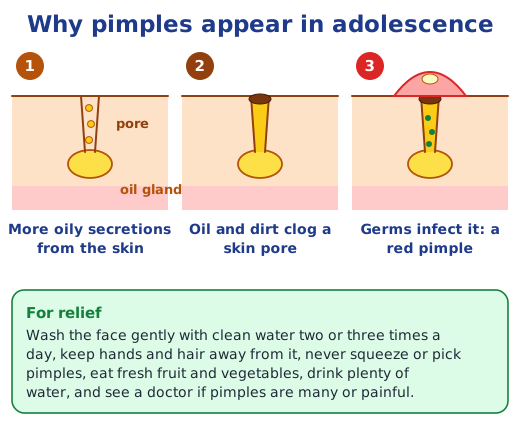
The skin changes too. In adolescence it produces more oily secretions, which can block the tiny pores in the skin. A blocked pore can get infected, and a small reddish pimple appears, most often on the face. The skin condition itself is called acne; pimples are how it shows. Washing the face gently with clean water a few times a day and not squeezing pimples help keep it in check.
Every body has its own timetable
A key point runs through the whole chapter: when the changes start, what form they take and how far they go differ from one person to another. One student may grow tall at 11, another at 14; one boy may have a moustache early, another may not have one for years. Each person goes through adolescence at their own pace, and how long it lasts also varies. None of these differences means anything is wrong.
Feelings and behaviour
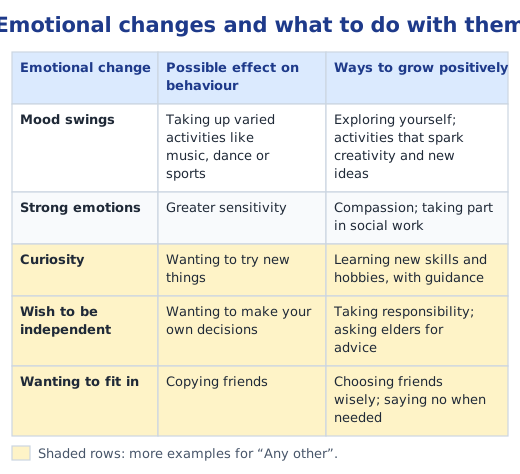
Adolescence is not only about the body. Emotions often become stronger than in childhood, and moods can swing quickly between excitement and feeling low. Many adolescents become more sensitive to the feelings of others, more curious, and keen to try new things or to fit in with friends. These feelings can be put to good use. Mood swings can be channelled into music, dance or sport, which also help us discover our own interests and spark creativity. Strong emotions and sensitivity can grow into compassion, such as joining a social initiative to help people in need. Understanding how emotions affect what we do helps us respond to situations thoughtfully rather than on impulse.
Why it matters
Knowing what to expect makes adolescence less confusing and easier to enjoy. The changes that make the body able to reproduce, and the hormones behind them, are in puberty and hormones, and ways to stay healthy and happy through these years are in healthy habits in adolescence. Answers to every question are in the NCERT solutions for Chapter 6; see also the full Chapter 6 notes.
Practice
-
What is the bump at the front of the throat in many adolescent boys called?
Show answer
Answer: (a) Adam’s apple
-
Which change happens in both boys and girls during adolescence?
Show answer
Answer: (b) Hair in the armpits
-
Why do pimples often appear in adolescence?
Show answer
Answer: (b) Extra oil clogs the skin’s pores
-
Why does the voice change more in boys than in girls?
Show answer
Answer: The voice box grows in both, but in boys it grows much bigger, so their voices turn hoarse and deeper and an Adam’s apple may show. In girls it grows less, so the voice changes only slightly.
-
Give one good way to deal with mood swings.
Show answer
Answer: Take up varied activities such as music, dance or sport. They help us explore our own interests and can lead to creativity and new ideas.
Questions students ask
What changes happen during adolescence?
Height increases fastest, weight and strength go up and the body’s shape changes; the voice box grows, so the voice changes; hair grows in the armpits and pubic region, and boys grow facial hair; and oily skin can cause pimples. Inside the body, the parts involved in reproduction mature, and emotions grow stronger, with mood swings and greater sensitivity.
What is the Adam’s apple?
It is a bump at the front of the throat formed by the voice box as it grows in adolescence. It is usually seen in boys, whose voice box grows much larger, though not every boy has a noticeable one. The same growth makes boys’ voices hoarse and deeper.
Is it normal if my friends change earlier than me?
Yes. Adolescence usually runs from about 10 to 19 years, but each person goes through it at their own pace. When the changes begin, what they are like and how far they go all vary, and these differences are completely normal.
Stuck on a question?
Take a photo and Lagnever AI explains it step by step. Try it for 7 days for ₹2.
Get it on Google Play Open in browser
For parents: after the trial, the plan renews monthly by UPI or card autopay. You can cancel anytime in the app.