
NCERT Solutions Class 7 Science Chapter 6: Adolescence: A Stage of Growth and Change
Answers to every question in Chapter 6, Adolescence: A Stage of Growth and Change, of Curiosity, the Class 7 Science textbook (Reprint 2026-27): the questions in the text, Activities 6.1 to 6.4 with Tables 6.1 to 6.4, the Science and Society and Know a Scientist boxes, all ten questions of Let Us Enhance Our Learning and the Exploratory Projects. Page numbers follow the book (pages 73–88). Answers to activities give typical results; record what you and your class actually find. Short notes: Chapter 6 notes.
Venkatesh and Devyani (page 74)
What is interesting about their conversation? Each notices how the other has changed since they last met: Venkatesh now has a thin moustache and a different voice, and Devyani has grown much taller. These are signs that both have entered adolescence, the stage between childhood and adulthood when the body grows fast and starts to prepare for adult life.
Activity 6.1 and Table 6.1 (pages 74–75)
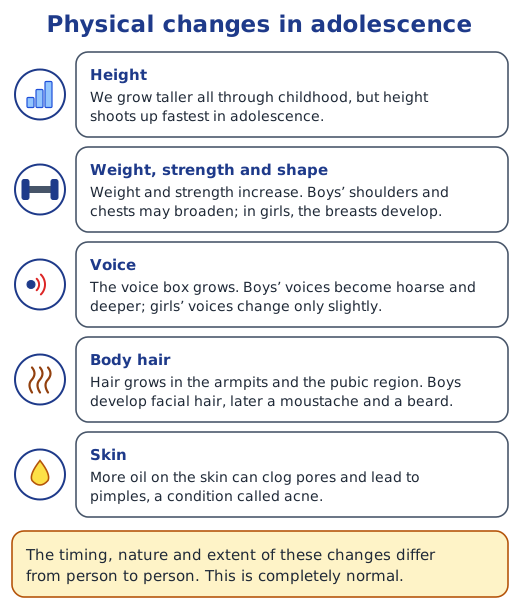
Table 6.1: the commonest changes while growing up (typical observations, written as a list):
- Height: many students have grown taller quickly over a year or two. In Grades 6 and 7, some girls shoot up before many boys, and the boys often catch up later.
- Weight and strength: students gain weight and become stronger; they can run faster, play longer and lift more. Some boys’ shoulders and chests become broader.
- Appearance: pimples on the face, hair in the armpits, a thin moustache in some boys, and body-shape changes such as the development of breasts in girls.
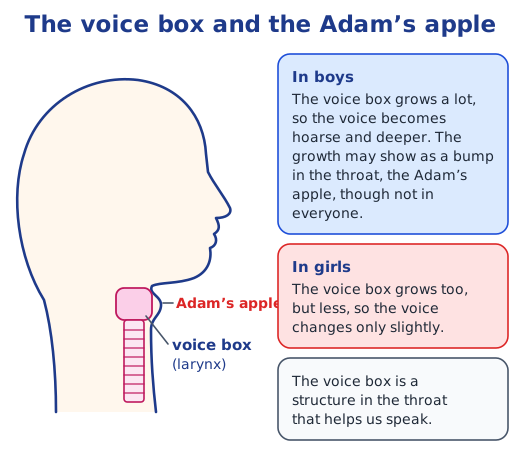
- Voice: many boys’ voices sound hoarse or crack and then become deeper; girls’ voices change only a little.
- Behaviour: more mood swings, a wish for privacy and independence, spending more time with friends, and new interests.
Have you noticed any of these changes in yourself? Most students of this age have noticed a few. If you have not yet, that is normal too: the changes begin at a different time for each person.
What Table 6.1 shows (pages 75–77)
Height increases fastest in adolescence; weight, strength and body shape change; the voice box grows, so boys’ voices turn deep and an Adam’s apple may show; hair grows in the armpits and pubic region, and boys grow facial hair; and oily skin can cause pimples (acne). Some of these, such as a deeper voice, facial and chest hair in boys and breasts in girls, are secondary sexual characteristics: they help tell males from females but are not directly involved in reproduction. They mark the start of puberty, when the body becomes able to reproduce, and in girls the menstrual cycle begins.
Activity 6.2 and Table 6.2 (page 78)
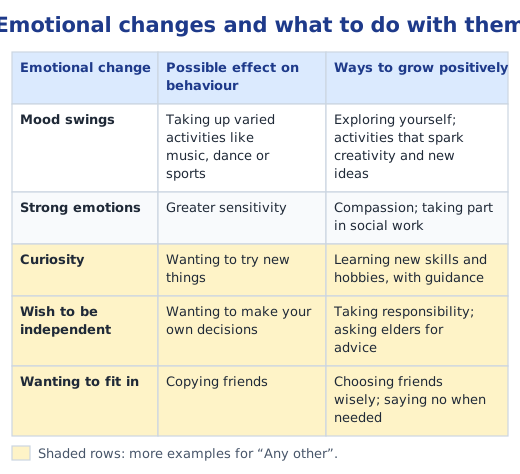
Table 6.2: emotional changes, how they may show in behaviour, and how to grow from them (written as a list: change → possible effect → way to grow). The book fills in the first two rows; the rest are examples for “Any other”.
- Mood swings → taking up varied activities such as music, dance or sports → exploring yourself; activities that lead to creativity and new ideas.
- Strong emotions → greater sensitivity → compassion; taking part in social work.
- Curiosity → wanting to try new things → learning new skills and hobbies, with guidance.
- Wish to be independent → wanting to make your own decisions → taking responsibility; asking elders for advice.
- Wanting to fit in → copying friends’ behaviour → choosing friends wisely; saying no when needed.
- Feeling self-conscious about looks → worrying about pimples, height or weight → remembering that everyone changes at their own pace; talking to a trusted adult.
Activity 6.3 and Table 6.3 (page 79)
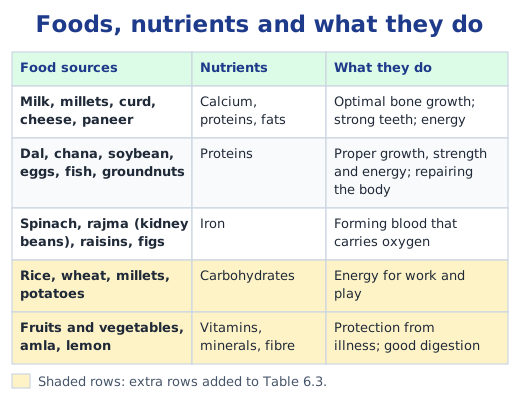
Table 6.3: foods, the nutrients they contain, and what those nutrients do (blanks filled, with two extra rows, written as a list: foods → nutrients → functions):
- Milk, curd, paneer, cheese and millets → calcium, proteins and fats → optimal bone growth, strong teeth, and energy from the fats.
- Dal, chana, soybean, eggs, fish and groundnuts → proteins → proper growth, strength and energy, and repair of the body.
- Spinach, kidney beans (rajma), raisins and figs → iron → forming blood, which carries oxygen, and preventing anaemia.
- Rice, wheat, millets and potatoes (extra row) → carbohydrates → energy for work and play.
- Fruits and vegetables, amla and lemon (extra row) → vitamins, minerals and fibre → protection from illness and good digestion.
Science and Society: iron and vitamin B12 (page 80)
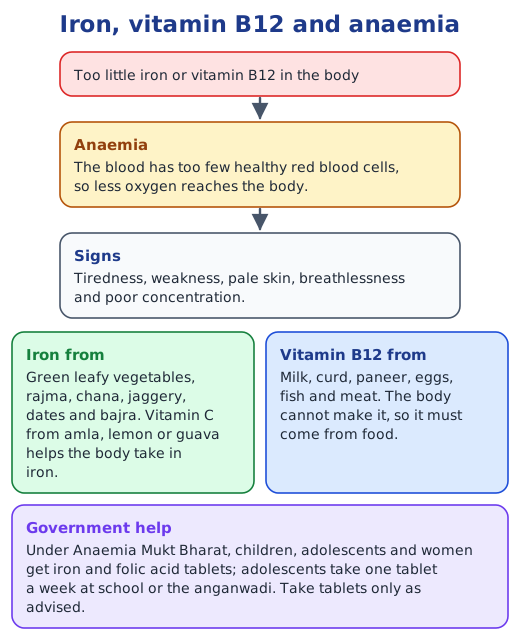
Find out about such health problems. The main one is anaemia, in which the blood has too little haemoglobin or too few healthy red blood cells, so less oxygen reaches the body. Lack of iron causes iron-deficiency anaemia, and lack of vitamin B12 causes another kind. Signs include tiredness, weakness, pale skin and nails, breathlessness, dizziness and poor concentration. Adolescent girls are more at risk because they lose some blood every month during menstruation and their growing bodies need more iron.
How can we manage iron deficiency?
- Eat iron-rich foods every day: green leafy vegetables such as spinach and methi, rajma, chana and other pulses, jaggery, dates, raisins and figs, and millets such as bajra; eggs, fish and meat for those who eat them.
- Have a source of vitamin C, such as amla, lemon, guava or oranges, with meals, since it helps the body take in iron; avoid tea right with meals, which reduces it.
- Take iron and folic acid tablets only as advised by a doctor or the school health programme, and take deworming tablets when given, since worms cause blood loss.
Government schemes: Anaemia Mukt Bharat gives iron and folic acid supplements to children, adolescents and women (adolescents take one tablet a week at school or the anganwadi), with deworming and testing for anaemia; National Deworming Day is held twice a year; and rice fortified with iron, folic acid and vitamin B12 is supplied through ration shops and school meals under PM POSHAN.
Know a Scientist: Dorothy Hodgkin (page 80)
Sources of vitamin B12: milk, curd, paneer and cheese, eggs, fish, chicken and meat. Plant foods contain almost none, so vegetarians depend on milk products and on fortified foods. Dorothy Hodgkin used X-rays to work out the structures of penicillin, vitamin B12 and insulin. The two women who won the chemistry prize before her were Marie Curie (1911) and her daughter Irène Joliot-Curie (1935).
Science and Society: menstrual hygiene schemes (page 81)
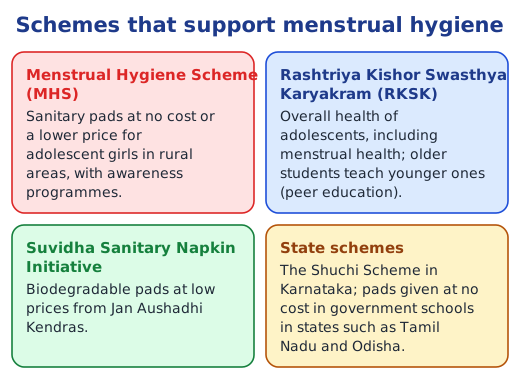
This box has no questions, but the four kinds of support are worth remembering: the Menstrual Hygiene Scheme, which gives adolescent girls in rural areas sanitary pads at no cost or a lower price, along with awareness programmes; the Rashtriya Kishor Swasthya Karyakram, which looks after adolescents’ overall health, including menstrual health, through peer education; the Suvidha initiative, which sells biodegradable pads cheaply at Jan Aushadhi Kendras; and state schemes such as Shuchi in Karnataka, and pads handed out in government schools in Tamil Nadu and Odisha.
Physical activities (page 81)
Do you exercise regularly? What kinds of exercises do you do? A sample answer: “I play football or kabaddi in the evening, skip rope for ten minutes and do yoga on most mornings: Tadasana, Bhujangasana (the cobra pose in Fig. 6.2) and Paschimottanasana (the seated forward bend in Fig. 6.2).” Adolescents should aim for about an hour of active play or exercise a day.
Balanced social life and Activity 6.4 (pages 82–83)
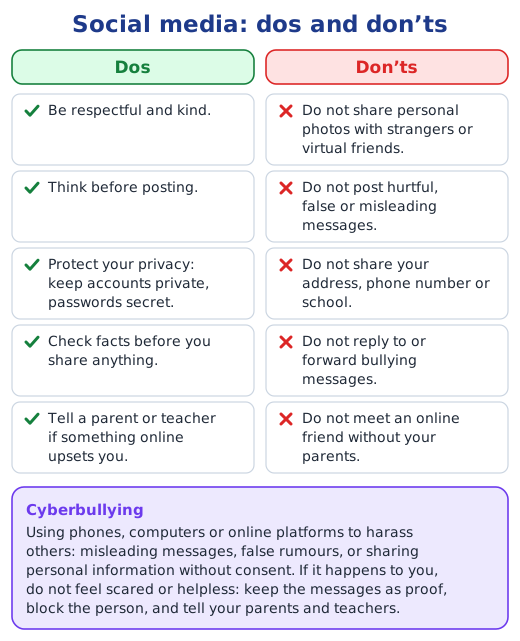
Table 6.4: dos and don’ts on social media (blanks filled, with more rows, written as two lists):
- Dos: be respectful and kind; think before posting; protect privacy by keeping accounts private and passwords secret; check facts before sharing anything; tell a parent or teacher if something online upsets you; limit screen time and take breaks.
- Don’ts: never send your personal photos to strangers or to friends you know only online; do not post or forward hurtful, false or misleading messages; do not share your address, phone number, school or location; do not reply to or forward bullying messages; do not meet an online friend in person without your parents; do not click on unknown links or download unknown apps.
Poster ideas: “Think before you post”, “Your password is yours alone”, “Kind words online too”, “Stranger online = stranger offline”, and “Bullied? Block, save proof, tell an adult.”
Let Us Enhance Our Learning (pages 85–87)
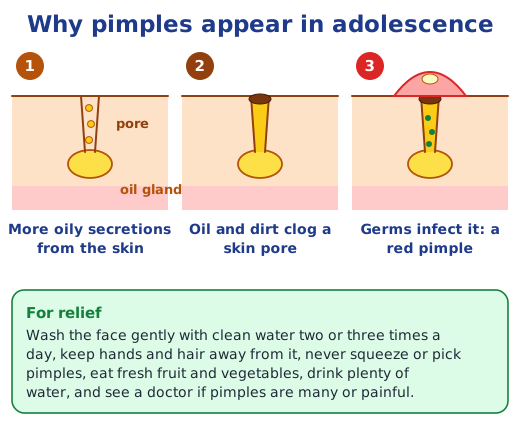
1. Ramesh’s pimples.
- (i) Reasons: in adolescence, hormones make the skin produce more oily secretions. The extra oil, along with dirt and dead skin, can clog the skin’s pores, and germs can infect a clogged pore, so small reddish pimples appear. This condition is acne, a normal part of growing up.
- (ii) Relief: wash the face gently with clean water or a mild soap two or three times a day; do not squeeze or pick the pimples, which spreads infection and leaves marks; keep hands and oily hair away from the face; eat fresh fruits and vegetables and drink plenty of water; and see a doctor if the pimples are many or painful.
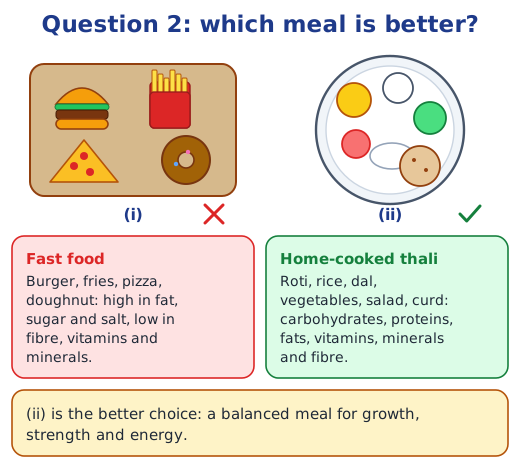
2. Which food group is better? (ii), the home-cooked thali with roti, rice, dal, vegetables, salad and curd. It gives carbohydrates, proteins, fats, vitamins, minerals and fibre, the balanced diet a fast-growing adolescent body needs. Group (i), a burger, fries, pizza and a doughnut, is high in fat, sugar and salt and low in fibre, vitamins and minerals; eaten often, such food can lead to weight gain and poor health.
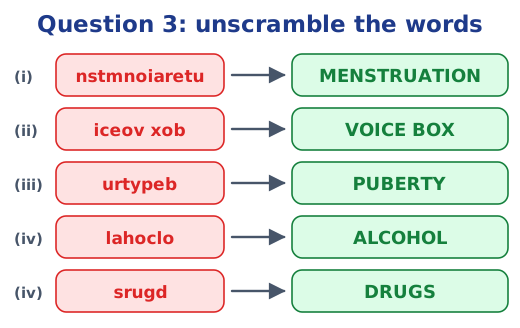
3. Unscrambled words. (i) menstruation; (ii) voice box; (iii) puberty; (iv) alcohol and drugs.
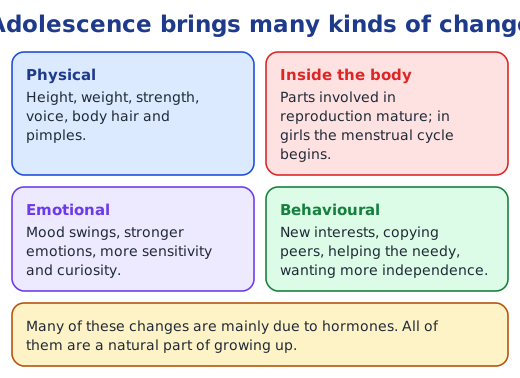
4. Is Shalu correct? No. Growing taller and developing body hair are only some of the changes. Adolescence also brings internal changes (the parts involved in reproduction mature, and in girls the menstrual cycle begins), emotional changes (mood swings, stronger emotions, greater sensitivity) and behavioural changes (new interests, being influenced by peers, joining efforts to help others). A better description: “Adolescence brings physical changes such as growing taller and developing body hair, along with internal, emotional and behavioural changes that prepare us for adulthood.”
5. Questions to check the points.
- (i) “Adolescents do not need to worry about behavioural changes.” Ask: Do our emotions affect how we behave? Can mood swings or pressure from friends lead to choices we regret? How can understanding these changes help us make better decisions? Whom can we turn to when we feel confused? The answers show that behavioural changes need attention, understanding and guidance, so the point is not correct, even though there is no need to panic about them.
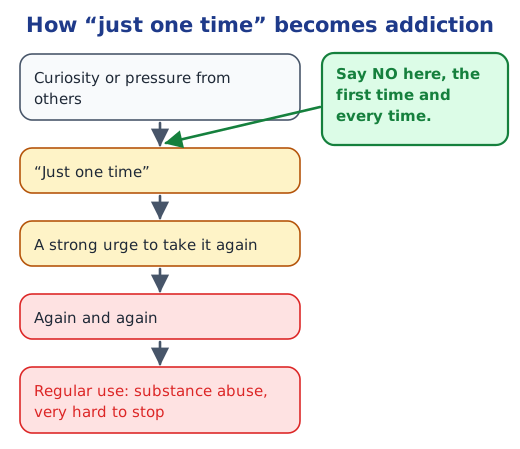
- (ii) “If someone tries a harmful substance once, they can stop anytime they want.” Ask: What does “addictive” mean? Why do people who start with “just one time” end up using it regularly? Do people who are addicted find it easy to stop? If stopping were easy, why would the government run a de-addiction helpline? The answers show the point is wrong: these substances create a strong urge to take them again, so the only safe choice is to say NO the first time.
6. Other behavioural changes in adolescence: wanting more independence and privacy; spending more time with friends and copying their behaviour; feeling attracted to peers; becoming more curious and wanting to try new, sometimes risky, things; developing deep interests in music, sport, art or science; a stronger sense of fairness and a wish to help people in need; worrying more about looks; arguing more with parents at times; and spending more time online. All of these are normal, and talking to trusted adults helps handle them well.
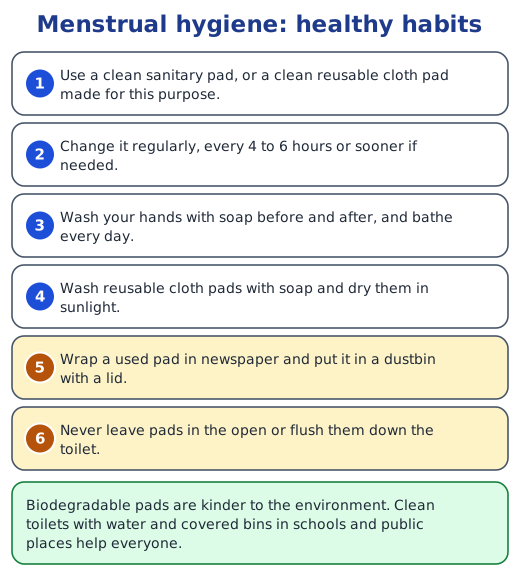
7. Menstrual hygiene and sanitary habits to suggest:
- Use clean sanitary pads, or clean reusable cloth pads made for the purpose, and change them regularly, every 4 to 6 hours or sooner if needed.
- Wash hands with soap before and after changing a pad, and bathe daily.
- Wash reusable cloth pads with soap and dry them in sunlight.
- Wrap a used pad in newspaper or its wrapper and put it in a dustbin with a lid; never leave it in the open, as Mohini saw, or flush it down the toilet.
- Tell the school staff if the toilet has no dustbin, water or soap; carry a spare pad; prefer biodegradable pads where possible.
- Talk about menstruation openly and kindly, so that no girl feels ashamed to ask for help.
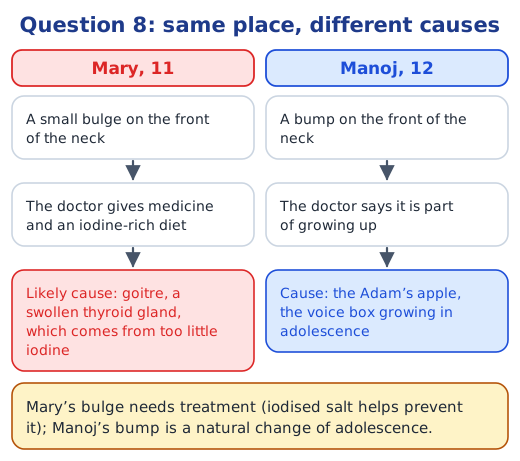
8. Why were Mary and Manoj advised differently? The two bumps look alike but have different causes. Mary’s bulge was most likely a goitre, a swelling of the thyroid gland in the neck that occurs when the body gets too little iodine. So the doctor gave her medicine and an iodine-rich diet; using iodised salt helps prevent it. Manoj’s bump was his Adam’s apple, formed as the voice box grows during adolescence, especially in boys. It is a natural part of growing up and needs no treatment.
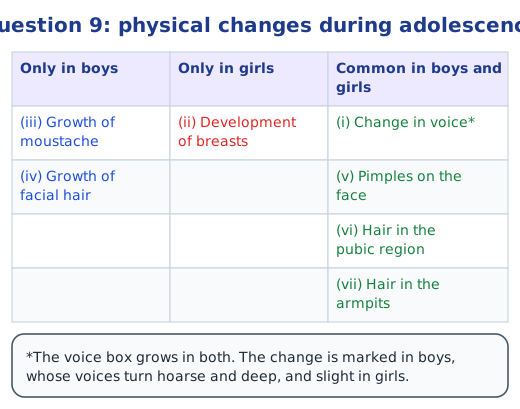
9. Physical changes during adolescence (the table written as a list):
- Observed only in boys: (iii) a moustache; (iv) facial hair.
- Observed only in girls: (ii) breasts developing.
- Common in boys and girls: (i) the voice changing*; (v) pimples; (vi) hair in the pubic region; (vii) hair in the armpits.
*The voice box grows in both boys and girls, so the voice changes in both; the change is marked in boys, whose voices turn hoarse and deep, and slight in girls.
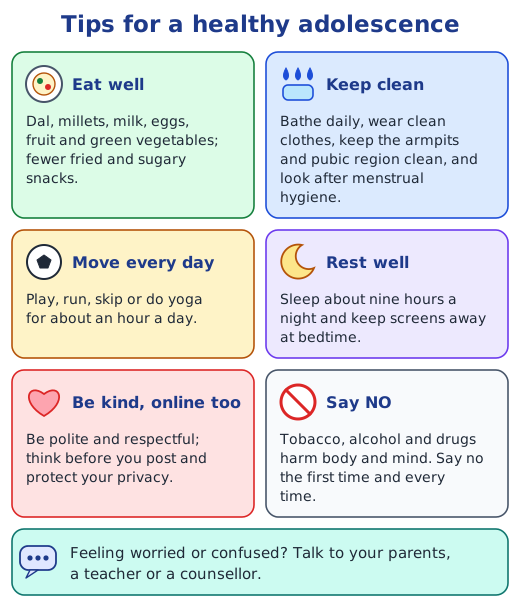
10. Poster: tips for a healthy lifestyle. Title it, for example, Healthy Teens, Happy Teens, and include: eat a balanced diet with dal, millets, milk, fruits and green vegetables, and fewer fried and sugary snacks; drink plenty of water; bathe daily and keep good menstrual hygiene; play, run, skip or do yoga for about an hour a day; sleep about nine hours a night; be kind and careful online; say NO to tobacco, alcohol and drugs; and talk to parents, teachers or a counsellor when worried.
Exploratory Projects (page 88)
Interviews on the mental health of youth. People to approach include school counsellors, psychologists or doctors at the district hospital, and local organisations that run youth helplines or awareness camps. Five questions you could ask:
- What mental health problems do you see most often among young people?
- What early signs show that a young person needs help?
- How can students handle stress about exams, friends or family?
- How does too much time on phones and social media affect young people’s minds?
- How can friends support someone who seems sad or withdrawn, and where can young people get help? (India’s national mental health helpline, Tele MANAS, is 14416.)
Role play: “Child marriage: a social evil”. Plan short scenes: a family arranging the marriage of a 14-year-old girl; a teacher and friends explaining the harm; and the girl going back to school. Key points: under the Prohibition of Child Marriage Act, 2006, a girl must be at least 18 and a boy at least 21 to marry; early marriage often ends a girl’s schooling; pregnancy before the body is fully grown endangers the health of both mother and baby and adds to anaemia; and children lose their childhood and the chance to build their own future. Child marriage can be reported on the Childline number, 1098.
International Yoga Day, 21 June. With your teachers, choose an open space, mats and a time on an empty stomach. Begin with warm-up stretches, then practise simple asanas such as Tadasana (palm tree pose), Vrikshasana (tree pose), Bhujangasana (cobra pose), Paschimottanasana (seated forward bend) and end with Shavasana, followed by slow breathing such as Anulom Vilom. Stop any pose that hurts, and let a trained teacher guide the camp.
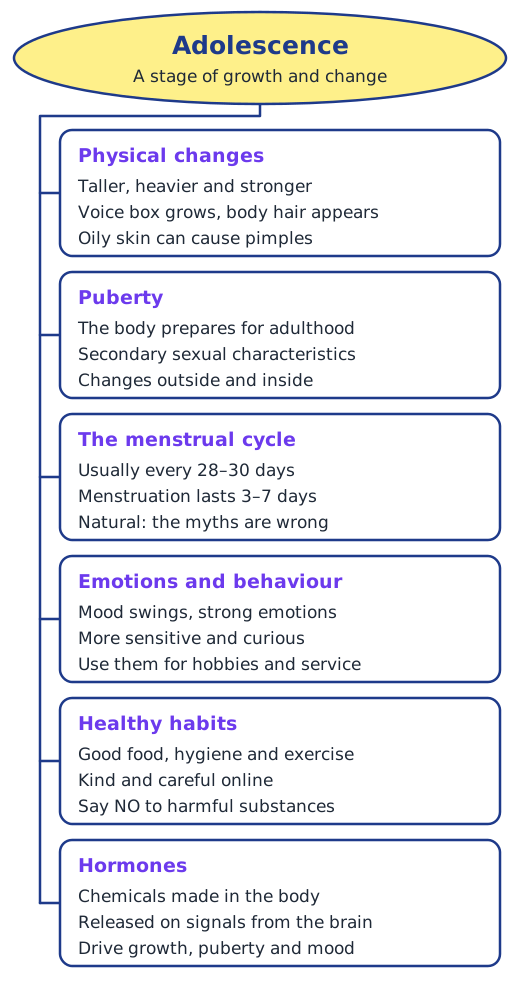
Short notes and more practice are on the topic pages: changes during adolescence, healthy habits in adolescence and puberty and hormones.
Practice
-
Which of these changes is seen only in girls during adolescence?
Show answer
Answer: (b) Development of breasts
-
What is substance abuse?
Show answer
Answer: (b) Regular use of addictive harmful substances
-
Which vitamin did Dorothy Hodgkin study?
Show answer
Answer: (c) Vitamin B12
-
Why should a used sanitary pad be wrapped before it is thrown away?
Show answer
Answer: Wrapping it in newspaper and putting it in a dustbin keeps it out of sight and touch, stops germs from spreading, and keeps toilets and the surroundings clean for everyone.
-
Name two government initiatives that support adolescent health.
Show answer
Answer: The Menstrual Hygiene Scheme, which provides sanitary pads at no cost or at a lower price to adolescent girls in rural areas, and the Rashtriya Kishor Swasthya Karyakram, which works for the overall health of adolescents through peer education.
Stuck on a question?
Take a photo and Lagnever AI explains it step by step. Try it for 7 days for ₹2.
Get it on Google Play Open in browser
For parents: after the trial, the plan renews monthly by UPI or card autopay. You can cancel anytime in the app.