
Class 7 Social Science Chapter 10: The Constitution of India — An Introduction Notes
This chapter in five lines
The Constitution of India — An Introduction explains that a constitution is a country’s rulebook. India’s was written by the Constituent Assembly, adopted on 26 November 1949 and brought into effect on 26 January 1950. Shaped by the freedom movement, India’s heritage and other constitutions, it sets out the organs of government, rights, duties and directive principles, and the Preamble sums up its values.
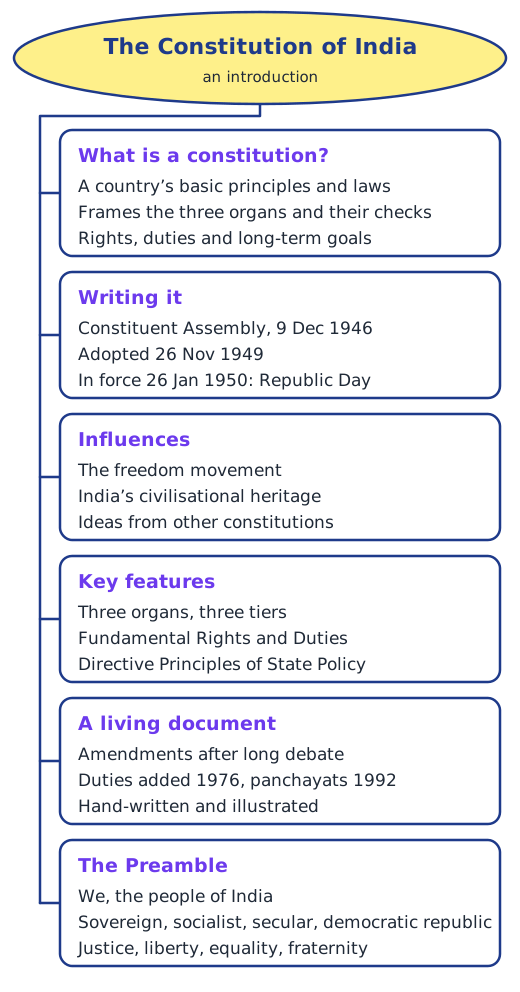
What is this chapter about?
The chapter opens with words of Dr Rajendra Prasad, the first President of India: living by the Constitution can make the country great, but that needs hard work, moral renewal, respect for other people’s views and a readiness to compromise. A family in Delhi then watches the Republic Day Parade on television, and the children learn that the day marks the Constitution coming into effect on 26 January 1950. Its four Big Questions ask what a constitution is, how India’s was prepared, what shaped it, and what its key features are.
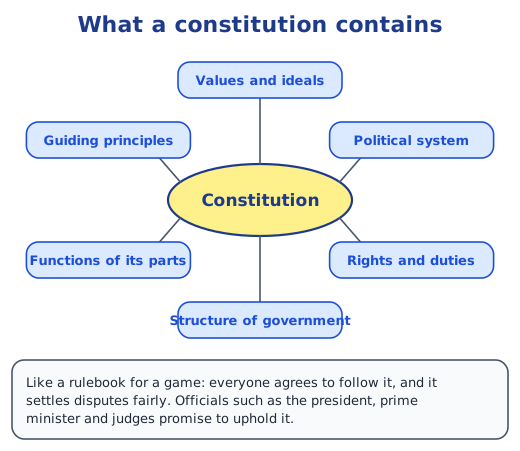
What is a constitution?
A constitution is the document that records a nation’s founding principles and laws. It describes the legislature, executive and judiciary and how each keeps a check on the others, what rights and duties citizens have, and what the nation hopes to achieve in the long run. A kabaddi story shows why one is needed: when a dispute breaks out in a final, the referee and both captains check the official rulebook and accept the decision. The Constitution is a rulebook of this kind for the whole country, and the president, prime minister, ministers and judges all promise to uphold it. Read making of the Constitution.
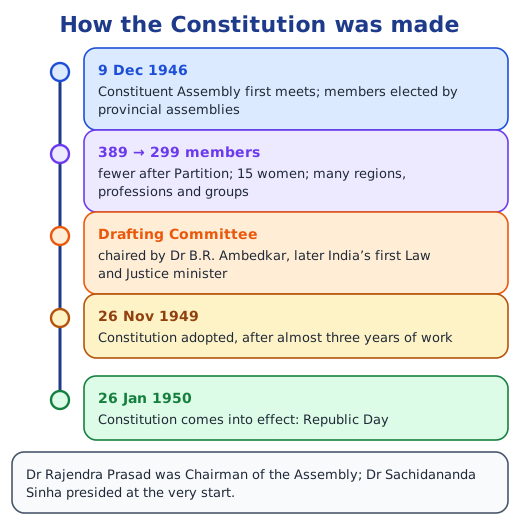
Writing the Constitution
While India was still fighting for freedom, its leaders had to plan how the country would govern itself: what kind of government, which principles, who could vote and how disputes would be settled. A Constituent Assembly was formed on 9 December 1946, its members elected by the provincial legislative assemblies. It began with 389 members, reduced to 299 after Partition, 15 of them women, from many regions, professions and social groups. Dr Rajendra Prasad was its Chairman, and the Drafting Committee, headed by Dr B.R. Ambedkar, prepared the text. The Constitution was adopted on 26 November 1949 and came into effect on 26 January 1950.
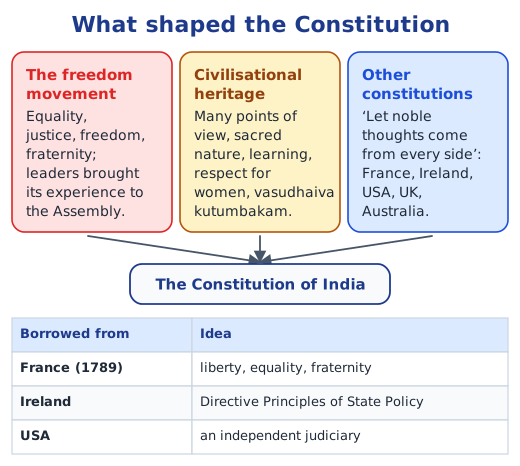
What shaped it
Three influences came together. Many leaders of the freedom movement sat in the Assembly and brought its ideals of equality, justice, freedom and fraternity. India’s civilisational heritage added respect for different points of view, Nature as sacred, learning, respect for women, vasudhaiva kutumbakam and a long tradition of stressing people’s duties. And the makers studied other constitutions: liberty, equality and fraternity came from France, the Directive Principles from Ireland and the independent judiciary from the USA.
Key features
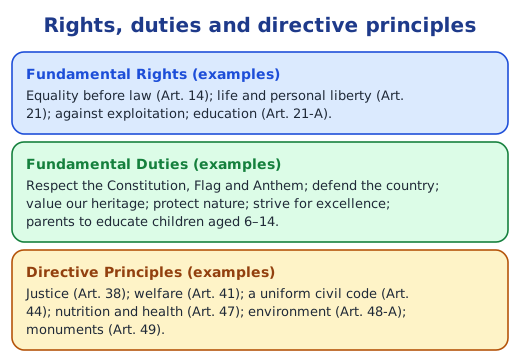
The Constitution sets out the roles and accountability of the legislature, executive and judiciary, the three tiers of central, state and local government, and an electoral system that lets every eligible citizen vote. Its other core parts are the Fundamental Rights, which can be enforced in court, the Fundamental Duties of citizens, and the Directive Principles of State Policy, goals the government should work towards. Read Fundamental Rights, Duties and Directive Principles.
A living document
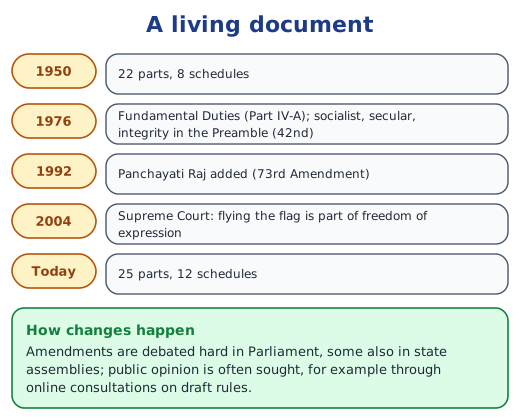
The makers knew new needs would arise, so the Constitution can be amended after careful debate in Parliament, and for some changes in state assemblies too. Fundamental Duties arrived as Part IV-A in 1976 and Panchayati Raj in 1992; in 2004 the Supreme Court held that flying the national flag is part of the freedom of expression. It also is a work of art: the calligrapher Prem Behari Narain Raizada wrote it by hand, and Nandalal Bose and his team illustrated it.
The Preamble
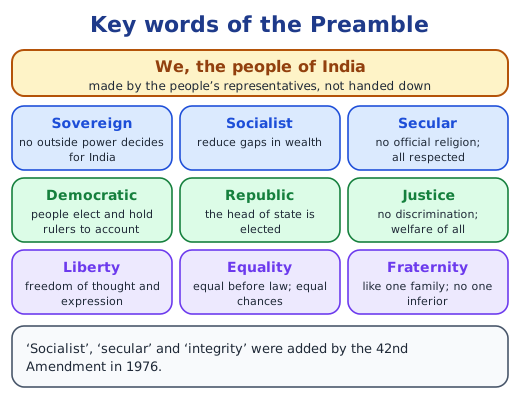
The essence of the Constitution’s guiding values is in the Preamble. It begins ‘We, the people of India’ and describes India as a sovereign, socialist, secular, democratic republic, committed to justice, liberty, equality and fraternity. The words ‘socialist’, ‘secular’ and ‘integrity’ were added by the 42nd Amendment in 1976. Read the Preamble and its values.
Before we move on
The Constitution is the country’s rulebook: it protects every citizen’s rights and expects citizens to follow their duties. India’s heritage, the freedom struggle and good ideas from other constitutions were its building blocks. Its key features shape the country’s social, economic and political structure and its parliamentary form of government, and it can be improved as the country’s needs change. Answers to every question are in the NCERT solutions for Chapter 10.
Key terms
| Term | Meaning |
|---|---|
| Constitution | A document that lays down a country’s basic principles and laws: the organs of government and their checks, citizens’ rights and duties, and the nation’s long-term goals. |
| Constituent Assembly | The body that wrote India’s Constitution, formed on 9 December 1946 with 389 members (299 after Partition), 15 of them women. |
| Drafting Committee | The committee, headed by Dr B.R. Ambedkar, that prepared the first text of the Constitution. |
| Republic Day | 26 January, celebrated every year because the Constitution came into effect on 26 January 1950. |
| Fundamental Rights | Rights such as equality before law and protection of life and personal liberty; a citizen can go to court if they are violated. |
| Fundamental Duties | Duties of citizens, such as respecting the Constitution, the Flag and the Anthem and protecting the environment, added as Part IV-A in 1976. |
| Directive Principles of State Policy | Goals the government should work towards, such as justice and a good standard of living for all; they cannot be enforced in court. |
| Amendment | A change to the Constitution, debated in Parliament (and for some changes in state assemblies) before it is accepted. |
| Preamble | The opening statement of the Constitution, which holds the essence of its guiding values. |
| Separation of powers | Keeping the legislature, executive and judiciary separate, so that each does its own work and checks the others. |
Topics in this chapter
Practice
-
When did the Constitution of India come into effect?
Show answer
Answer: (c) 26 January 1950
-
Who chaired the Drafting Committee of the Constitution?
Show answer
Answer: (b) Dr B.R. Ambedkar
-
The Directive Principles were modelled on ideas from the constitution of:
Show answer
Answer: (c) Ireland
-
Which word was NOT added to the Preamble in 1976?
Show answer
Answer: (d) Sovereign
-
Why is the original Constitution kept in helium?
Show answer
Answer: (b) Helium does not react with paper or ink
-
How many women were members of the Constituent Assembly?
Show answer
Answer: (b) 15
Questions students ask
What are the main topics of Class 7 SST Chapter 10?
What a constitution is and why a country needs one; how the Constituent Assembly wrote India’s Constitution; how the freedom movement, India’s civilisational heritage and other constitutions shaped it; its key features, including Fundamental Rights, Duties and Directive Principles; the Constitution as a living document; and the values in the Preamble.
Is The Constitution of India — An Introduction in the new NCERT Class 7 Social Science book?
Yes. It is Chapter 10 of Exploring Society: India and Beyond, the Class 7 Social Science textbook Part 1 (Reprint 2026-27), on pages 209 to 228, in the theme Governance and Democracy.
Why do we celebrate Republic Day on 26 January?
Because the Constitution of India came into effect on 26 January 1950. The Constituent Assembly had adopted it on 26 November 1949, after almost three years of work, and from 26 January 1950 India was governed by its own Constitution as a republic with an elected head of state.
Why is the Constitution called a living document?
Because it can be changed through amendments as the country’s needs change. Each change is debated in Parliament, some also in state assemblies, and the public is often consulted. Fundamental Duties were added in 1976 and Panchayati Raj in 1992 in this way.
Stuck on a question?
Take a photo and Lagnever AI explains it step by step. Try it for 7 days for ₹2.
Get it on Google Play Open in browser
For parents: after the trial, the plan renews monthly by UPI or card autopay. You can cancel anytime in the app.