
NCERT Solutions Class 7 Social Science Chapter 10: The Constitution of India — An Introduction
Answers to every question in Chapter 10, The Constitution of India — An Introduction, of Exploring Society: India and Beyond, the Class 7 Social Science textbook Part 1 (Reprint 2026-27): the Big Questions, the Let’s Remember task, the Don’t Miss Out question, all five Let’s Explore activities and all seven Questions and activities, including the crossword. Page numbers follow the book (pages 209–228). Short notes: Chapter 10 notes.
The Big Questions (page 209)
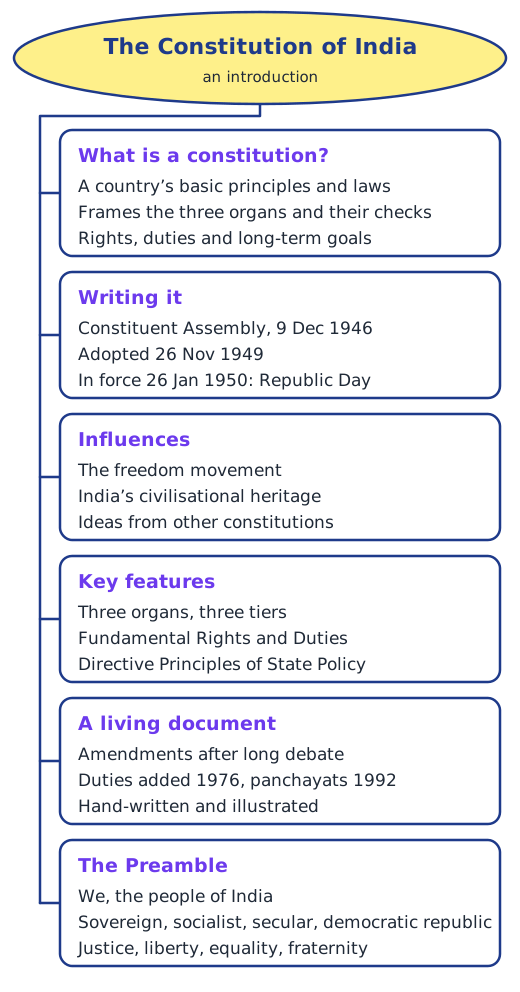
1. What is a constitution, and why do we need one? A constitution is a document that sets out a nation’s basic principles and laws: the three organs of government and the checks among them, citizens’ rights and duties, and the nation’s goals. We need one for the same reason a game needs a rulebook: rules agreed by everyone let disputes be settled fairly and stop anyone, including the government, from acting as they please.
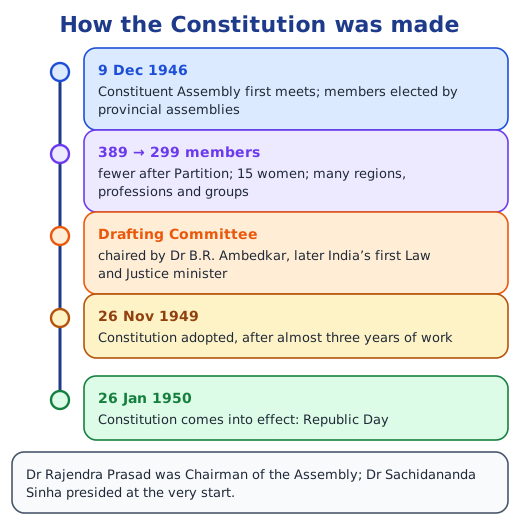
2. How was the Indian Constitution prepared? By the Constituent Assembly, formed on 9 December 1946 with members elected by the provincial assemblies: 389 at first, 299 after Partition, 15 of them women. The Drafting Committee, headed by Dr B.R. Ambedkar, prepared the text, which was debated for almost three years, adopted on 26 November 1949 and brought into effect on 26 January 1950.
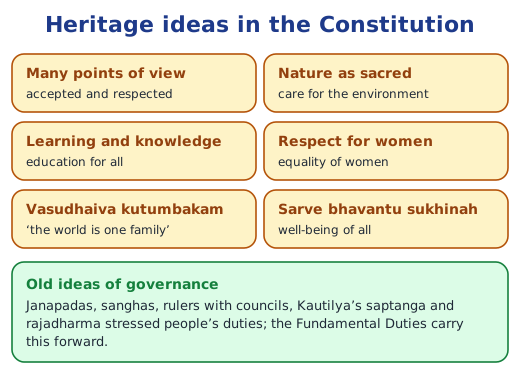
3. How did our freedom struggle and civilisational heritage influence the Constitution? Freedom fighters in the Assembly brought the ideals of equality, justice, freedom and fraternity, and answers to practical questions such as giving every adult the vote. India’s heritage gave respect for different views, Nature as sacred, learning, respect for women, vasudhaiva kutumbakam and a stress on duties, which became the Fundamental Duties.
4. What are its key features, and why is it still relevant? Three organs with separation of powers, three tiers of government, an electoral system for every eligible citizen, Fundamental Rights, Fundamental Duties and Directive Principles, with the Preamble’s values. It stays relevant more than seventy years on because it is a living document: it can be amended, as in 1976 and 1992, and courts apply it to new questions, as in the 2004 flag ruling.
Let’s Remember (page 210)
Questions about a country’s constitution (sample list). Who wrote it, and when? What does it contain? Can it be changed, and how? What rights does it give me, and what duties do I have? Who makes sure the government follows it? What happens if someone breaks it? Why is the original kept in a glass case? How is it different from other countries’ constitutions?
Let’s Explore (pages 211–212)
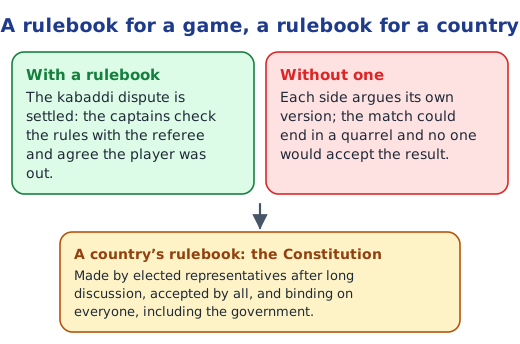
Without a rulebook: each team would push its own version of the rule, the referee’s decision would look like a personal opinion, and the dispute could turn into a quarrel, with the result never accepted. For everyone to abide by it, the rules must be known in advance, fair to both sides, applied the same way to all and read by a referee both teams trust. If the captains refused to use it, the match could not be settled fairly: the louder or stronger side would win, or the match would be abandoned.
Our game (sample). Our group chose gully cricket: everyone bats in turn, a ball hit over the wall is out, not six, and a catch after one bounce off the wall counts. Reaching a common set of rules was hard because groups played different local versions, each wanted rules that suited its strongest players, and we needed discussion, compromise and finally a vote. A country’s rulebook is its constitution; it should be made by people’s representatives after long discussion among all groups, as India’s Constituent Assembly did.
Don’t Miss Out (page 212)
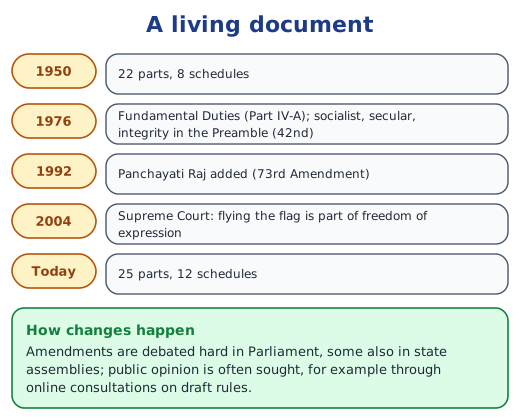
Why have the parts and schedules increased since 1950? Because amendments added new parts and schedules as the country’s needs grew, for example Part IV-A on Fundamental Duties in 1976, and the parts and schedules on panchayats and municipalities in 1992. The Constitution grew from 22 parts and 8 schedules to 25 parts and 12 schedules.
Let’s Explore (page 215)
Members from our region. Answers depend on where you live. Good sources are the Constituent Assembly pages of the Lok Sabha website (sansad.in), which list members by province, school and local libraries, and elders. A few examples: from Bihar, Dr Rajendra Prasad, Dr Sachidananda Sinha and Jaipal Singh Munda (from today’s Jharkhand); from Gujarat, Sardar Vallabhbhai Patel and Hansa Mehta; from Kerala, Ammu Swaminathan and Dakshayani Velayudhan; from Tamil Nadu, Alladi Krishnaswamy Ayyar and T.T. Krishnamachari; from Assam, Gopinath Bordoloi; from Uttar Pradesh, Jawaharlal Nehru and Begum Aizaz Rasul; from West Bengal, Syama Prasad Mookerjee.
Let’s Explore (page 221)
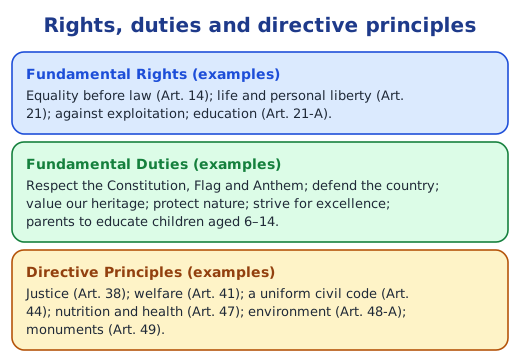
Begum Aizaz Rasul’s speech. She was most likely referring to the right to equality: Article 14, equality before law, with Article 15, which forbids discrimination on grounds of religion, race, caste, sex or place of birth. She said women’s equality was not a new idea because respect for women is part of India’s civilisational heritage; in ancient times women scholars such as Gargi and Maitreyi took part in learned debates. Social conditions later lowered women’s status, and the Constitution restored the old ideal in law.
Let’s Explore (page 223)
Amendments in the past ten years (2016 to 2023): the 101st (2016) brought in the Goods and Services Tax; the 102nd (2018) gave the National Commission for Backward Classes constitutional status; the 103rd (2019) allowed up to 10% reservation for economically weaker sections; the 104th (2020) extended reserved seats for Scheduled Castes and Scheduled Tribes in the Lok Sabha and state assemblies by ten years; the 105th (2021) restored states’ power to list socially and educationally backward classes; and the 106th (2023) reserved one-third of seats in the Lok Sabha and state assemblies for women. Check the Lok Sabha or Legislative Department website for any amendment passed after 2023.
Let’s Explore (page 226)
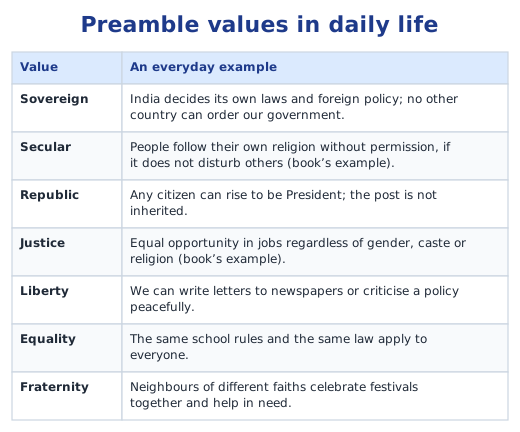
The Preamble in daily life. Sovereign: India makes its own laws and foreign policy, and no other country can order our government. Secular (book’s example): no permission is needed to practise one’s religion, if it does not disturb others. Republic: any citizen can rise to be President; the post is not inherited. Justice (book’s example): equal opportunity in jobs regardless of gender, caste or religion. Liberty: we can write to newspapers or criticise a policy peacefully. Equality: the same school rules and the same laws apply to everyone. Fraternity: neighbours of different faiths celebrate festivals together and help each other in need.
Questions and activities (pages 227–228)
1. A diverse assembly meant people of every region, religion, caste, gender, profession and social group had a voice, so the Constitution reflects the needs of all Indians, not a few. This made it acceptable to everyone, which is what makes a rulebook work, and helped protect minorities and weaker groups; with 15 women members, for instance, women’s equality was argued from inside the Assembly.
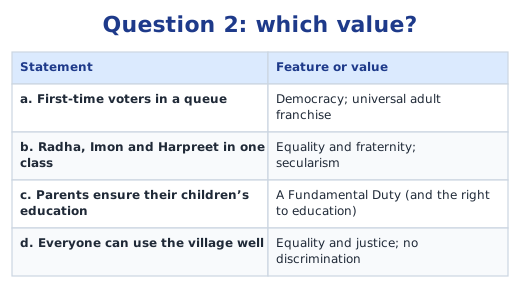
2. a. First-time voters in a queue: democracy and universal adult franchise. b. Radha, Imon and Harpreet in one class: equality, fraternity and secularism, since children of all backgrounds learn together. c. Parents arranging their children’s education: a Fundamental Duty (with the right to education, Article 21-A). d. Everyone using the village well: equality and justice, with no discrimination.
3. In law, yes: Article 14 promises equality before law, so the same laws apply to a minister and a farmer, and courts have ruled against powerful people. In practice, not fully: richer people can afford better lawyers, cases can take years, many people do not know their rights, and discrimination still happens. So it is a fact in principle and a goal in practice; legal aid, awareness and faster courts can close the gap.
4. The freedom struggle was a movement of all Indians, men and women, rich and poor, of every caste and religion, and its leaders believed every adult deserved an equal say in the new nation. Limiting the vote by property, education or gender would have kept old inequalities alive. Giving every adult the vote also helped unite a very diverse country and showed trust in ordinary citizens’ judgement.
5. The freedom struggle gave the ideals of equality, justice, freedom and fraternity, and many of its leaders sat in the Assembly, bringing their experience to questions such as voting rights, separation of powers and fundamental rights. Civilisational heritage inspired several features: respect for many points of view (secularism and freedom of expression), Nature as sacred (the duty to protect the environment and Article 48-A), learning (the right to education), respect for women (equality), vasudhaiva kutumbakam (fraternity), and a long stress on duties (the Fundamental Duties).
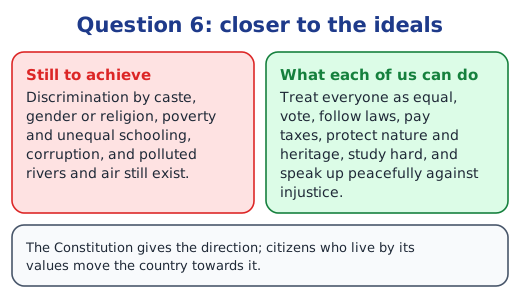
6. Not yet. Discrimination by caste, gender or religion, poverty and unequal schooling, corruption and polluted rivers and air still exist. Each of us can help: treat everyone as equal, vote when old enough, follow laws and pay taxes, protect nature and heritage, study hard and speak up peacefully against injustice. The Constitution gives the direction; citizens who live by its values move the country towards it.
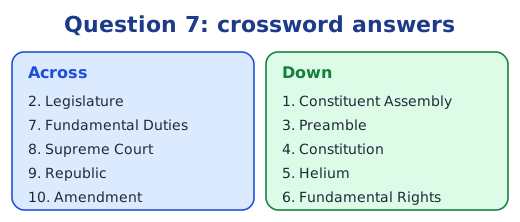
7. Across: 2. Legislature, 7. Fundamental Duties, 8. Supreme Court, 9. Republic, 10. Amendment. Down: 1. Constituent Assembly, 3. Preamble, 4. Constitution, 5. Helium, 6. Fundamental Rights.
Short notes and more practice are on the topic pages: making of the Constitution, the Preamble and its values and Fundamental Rights, Duties and Directive Principles.
Practice
-
Which gas is used to preserve the original Constitution?
Show answer
Answer: (c) Helium
-
Which branch of government makes laws?
Show answer
Answer: (b) Legislature
-
In Fig. 10.14, which Article is the right to education?
Show answer
Answer: (c) Article 21-A
-
Why was it important for the Constituent Assembly to be diverse?
Show answer
Answer: So that people of every region, religion, caste, gender and profession had a voice, the Constitution would reflect the needs of all Indians, and everyone would accept it as their own rulebook.
-
Which values does ‘people of all castes, genders and religions can use the village well’ show?
Show answer
Answer: Equality and justice: no one may be kept away from a public well because of caste, gender or religion, which Article 15 of the Constitution specifically forbids.
Stuck on a question?
Take a photo and Lagnever AI explains it step by step. Try it for 7 days for ₹2.
Get it on Google Play Open in browser
For parents: after the trial, the plan renews monthly by UPI or card autopay. You can cancel anytime in the app.