
The Preamble and its values
Answer in short
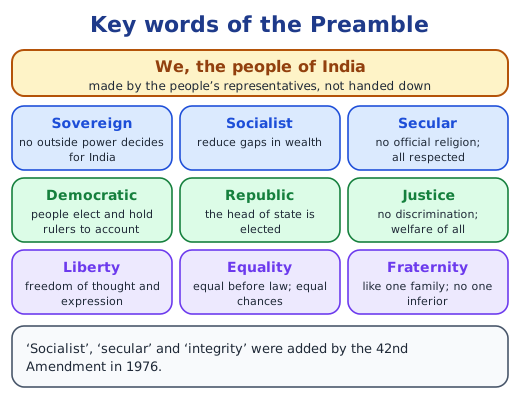
The Preamble is the opening statement of the Constitution and holds the essence of its guiding values. Beginning ‘We, the people of India’, it calls India a sovereign, socialist, secular, democratic republic and promises justice, liberty, equality and fraternity. The words ‘socialist’, ‘secular’ and ‘integrity’ were added by the 42nd Amendment in 1976.
Stuck on a question? Take a photo and Lagnever AI explains it step by step. Try it for 7 days for ₹2. Get it on Google Play
The essence of the Constitution
The values at the heart of the Constitution guide the government’s policies and decisions, and citizens are expected to practise them as well as they can. These values run through the whole Constitution, but their essence is written in its opening statement, the Preamble. That is why the chapter ends with it. The Preamble also records the day the Constituent Assembly adopted the Constitution, 26 November 1949.
We, the people of India
The Preamble opens with ‘We, the people of India’. These words say that Indians themselves framed and adopted the Constitution, acting through their elected representatives in the Constituent Assembly. It was not handed down by a king or imposed by any outside power, so its authority comes from the citizens.
Sovereign, socialist, secular, democratic republic
Sovereign means the people have the supreme right to decide internal and external matters, and no outside power can dictate how India is governed. Socialist means wealth is generated by society as a whole and should be shared, so the government regulates ownership of land and industry to reduce economic and social gaps. Secular means every citizen may practise any religion, the State has no religion of its own, and the government treats all beliefs and practices with equal respect. Democratic means all citizens have the same political rights, choose their leaders and can make them answer for their actions, and the government works by basic rules. Republic means the head of state is elected, not a hereditary ruler.
Justice, liberty, equality, fraternity
Justice means no citizen may be discriminated against because of caste, religion or gender, social inequalities must be reduced, and the government must work for everyone’s welfare, especially groups with fewer advantages. Liberty means there are no unreasonable limits on what citizens think, how they express their thoughts and how they act on them. Equality means everyone is equal before the law, social inequalities must end, and the government must give everyone equal opportunity. Fraternity means we should live like members of one family, and nobody may look down on another citizen.
The 1976 amendment
The Preamble too has been amended once. The 42nd Constitutional Amendment of 1976 added ‘socialist’ and ‘secular’ to the description of India, which had read ‘sovereign democratic republic’, and changed ‘the unity of the nation’ to ‘the unity and integrity of the nation’. This shows the Constitution, even its opening statement, is a living document.
Values in daily life
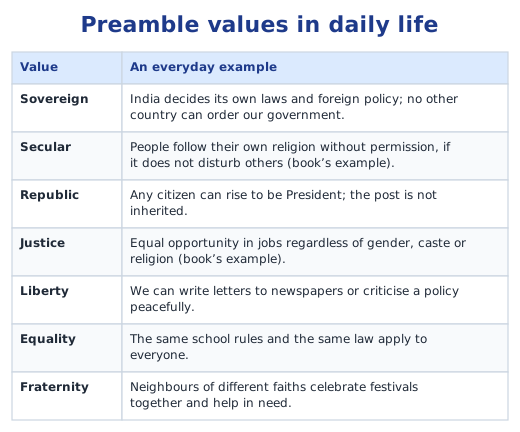
The chapter asks students to find examples of each value around them. Two are worked out in the book: for secularism, a person need not take the State’s permission to practise their religion, provided it does not disturb others; for justice, the State gives everyone an equal chance at jobs whatever their gender, caste or religion. Other examples are easy to find. India makes its own laws and foreign policy, which is sovereignty. Any citizen can rise to become President, which is the republic. A letter to a newspaper criticising a policy is liberty. The same rules for every student show equality, and neighbours of different faiths sharing festivals and helping in hard times show fraternity.
Why it matters
The Preamble is a short test we can apply to any law, policy or action: does it respect justice, liberty, equality and fraternity? How the Constitution was written is in making of the Constitution, and its rights, duties and goals in Fundamental Rights, Duties and Directive Principles. Answers to every question are in the NCERT solutions for Chapter 10; see also the full Chapter 10 notes.
Practice
-
Which word in the Preamble means that no outside power can dictate India’s government?
Show answer
Answer: (b) Sovereign
-
Which amendment added ‘socialist’, ‘secular’ and ‘integrity’ to the Preamble?
Show answer
Answer: (b) 42nd
-
‘No one should treat a fellow citizen as inferior’ describes:
Show answer
Answer: (c) Fraternity
-
What do the words ‘We, the people of India’ tell us?
Show answer
Answer: That Indians framed and adopted the Constitution themselves through their elected representatives; no king or foreign power handed it to them.
-
Give an everyday example of liberty.
Show answer
Answer: Writing a letter to a newspaper, or peacefully criticising a government policy, without being punished for one’s views.
Questions students ask
What is the Preamble of the Constitution?
The Preamble is the opening statement of the Constitution of India. The Constitution’s guiding values appear throughout it, but their essence is in the Preamble. The government is expected to follow these values in its policies and decisions, and citizens are expected to practise them.
What do sovereign, socialist, secular, democratic and republic mean?
Sovereign: the people decide internal and external matters and no outside power can dictate India’s government. Socialist: wealth is produced by society and inequalities should be reduced. Secular: no official religion and equal respect for all. Democratic: people elect and hold their rulers to account. Republic: the head of state is elected.
Which words were added to the Preamble later?
‘Socialist’, ‘secular’ and ‘integrity’ were added by the 42nd Constitutional Amendment in 1976. The original Preamble described India as a sovereign democratic republic and spoke of the unity of the nation; since 1976 it speaks of the unity and integrity of the nation.
Stuck on a question?
Take a photo and Lagnever AI explains it step by step. Try it for 7 days for ₹2.
Get it on Google Play Open in browser
For parents: after the trial, the plan renews monthly by UPI or card autopay. You can cancel anytime in the app.