
Making of the Constitution
Answer in short
India’s Constitution was written by the Constituent Assembly, formed on 9 December 1946 with members elected by the provincial assemblies. The Drafting Committee, headed by Dr B.R. Ambedkar, prepared its text. It was adopted on 26 November 1949 and came into effect on 26 January 1950, drawing on the freedom movement, India’s heritage and other constitutions.
Stuck on a question? Take a photo and Lagnever AI explains it step by step. Try it for 7 days for ₹2. Get it on Google Play
A rulebook for the country
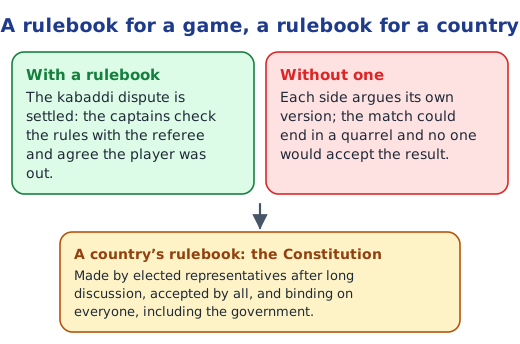
Picture a state-level kabaddi final. A raider from the other team is caught, but she insists she had already crossed back into her own half. The referee saw that she was out, and to settle the matter calmly she takes out the official rulebook; the two captains read the rules with her and agree on the decision. Without a rulebook, each side would argue its own version and the match could end in a quarrel. A country needs such a rulebook too, made fairly and accepted by everyone, and for India that rulebook is the Constitution.
What a constitution contains
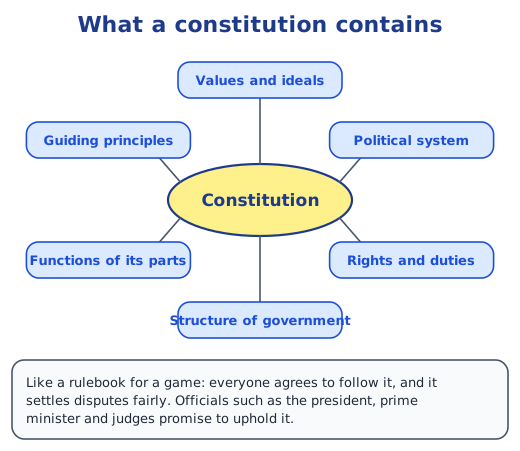
A constitution records a nation’s founding principles and laws. It describes the three organs of government, the legislature, executive and judiciary, and their roles; the checks and balances among them that keep each fair, responsible and accountable; the rights and duties of citizens; and the nation’s long-term goals. It decides how laws are made and carried out, who elects the executive and how the judiciary is formed. Many constitutions, India’s included, also state the values the country stands for, such as equality, justice, fraternity, pluralism and freedom, and these values form the basis of its laws. The President swears to protect and defend the Constitution, and the prime minister, ministers and judges promise to follow it.
The Constituent Assembly
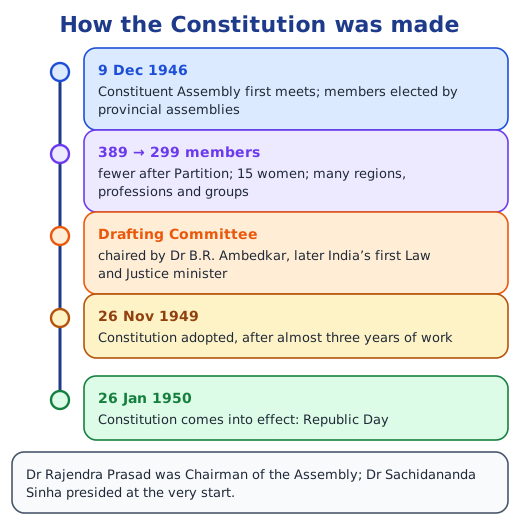
Even before independence, leaders had to decide how a huge and diverse India would govern itself. The Constituent Assembly was formed on 9 December 1946. Its members were chosen by the provincial legislatures, whose own members the people had voted in. It began with 389 members, cut to 299 after Partition, of whom 15 were women, drawn from many regions, professions and social groups. Dr Sachidananda Sinha presided at the very start, and Dr Rajendra Prasad was its Chairman. The first text came from the Drafting Committee, headed by Dr B.R. Ambedkar, a social reformer who became independent India’s first Law and Justice minister. After almost three years of work the Constitution was adopted on 26 November 1949, now observed as Constitution Day, and it came into effect on 26 January 1950, Republic Day.
The freedom movement and India’s heritage
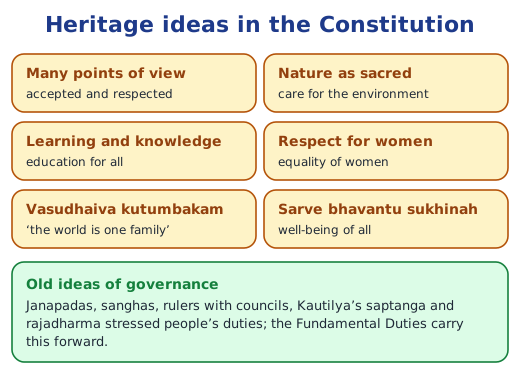
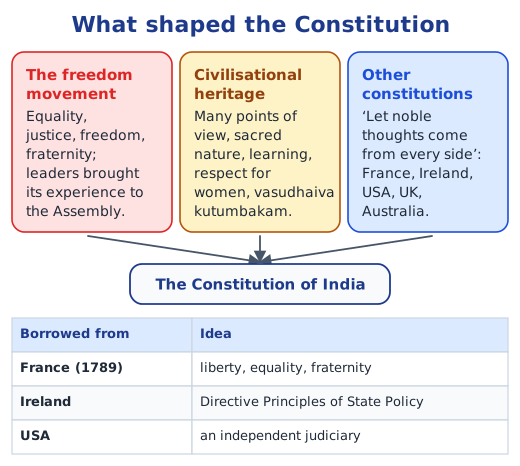
Many members of the Assembly had led the freedom struggle, and they brought its values with them: equality and justice for all, freedom, fraternity, care for India’s cultural heritage and the idea that the Constitution itself is a tool for reaching these goals. The struggle also helped answer practical questions: how every adult could vote, how to keep the three organs separate, how to protect fundamental rights, how to amend the Constitution, and how the Centre and states should relate. India’s civilisational heritage contributed ideas such as accepting different points of view, treating Nature as sacred, valuing learning, respecting women, vasudhaiva kutumbakam (‘the world is one family’) and sarve bhavantu sukhinah (well-being of all). Older systems, from janapadas and sanghas to rajadharma, had stressed people’s duties, which is why Fundamental Duties are part of the Constitution.
Ideas from the world
In the spirit of a Vedic prayer asking for good thoughts to reach us from all directions, the makers studied the constitutions of France, the USA, the UK, Ireland, Australia and other democracies. Liberty, equality and fraternity came from France, whose 1789 Declaration of the Rights of Man and of the Citizen spread these ideals widely. The Directive Principles were inspired by Ireland, and the idea of an independent judiciary by the USA.
A work of art
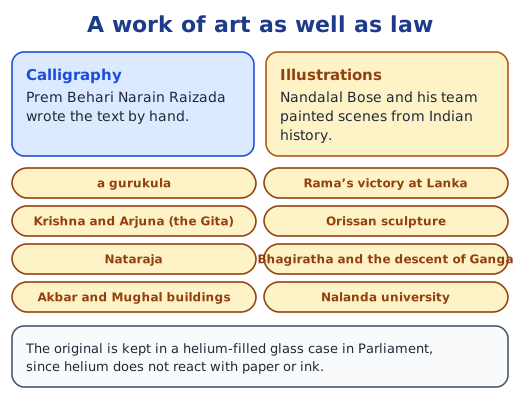
The Constitution is also a work of art. Every word was handwritten by the calligrapher Prem Behari Narain Raizada, and the artist Nandalal Bose led a team that decorated its pages with pictures from India’s past, from Mohenjo-daro right up to the freedom struggle: an ancient gurukula, Rama’s conquest of Lanka, Krishna teaching the Gita to Arjuna, Orissan sculpture, Nataraja, Bhagiratha’s penance and the descent of the Ganga from Mahabalipuram, Akbar with Mughal buildings, and Nalanda. The original is preserved in Parliament inside a glass case filled with helium, a gas that leaves paper and ink untouched.
Why it matters
Knowing how the Constitution was made shows that it is not a foreign rulebook but one written by elected Indians who drew on their own struggle and heritage. Its key features are in Fundamental Rights, Duties and Directive Principles, and its values in the Preamble and its values. Answers to every question are in the NCERT solutions for Chapter 10; see also the full Chapter 10 notes.
Practice
-
How many members did the Constituent Assembly have after Partition?
Show answer
Answer: (b) 299
-
Who was the Chairman of the Constituent Assembly?
Show answer
Answer: (b) Dr Rajendra Prasad
-
The ideals of liberty, equality and fraternity were taken from the constitution of:
Show answer
Answer: (c) France
-
Why does a country need a constitution?
Show answer
Answer: Like a rulebook in a game, it gives rules that everyone has agreed to, so disputes can be settled fairly. It sets out how the government is formed and works, the checks on each organ, citizens’ rights and duties and the nation’s goals.
-
Who wrote and who illustrated the original Constitution?
Show answer
Answer: Every word was handwritten by the calligrapher Prem Behari Narain Raizada, and the artist Nandalal Bose led the team that painted scenes from India’s history on its pages.
Questions students ask
Who made the Constitution of India?
The Constituent Assembly, whose members were elected by the provincial legislative assemblies. It had 389 members at first and 299 after Partition, 15 of them women, from many regions, professions and social groups. Dr Rajendra Prasad was its Chairman, and the Drafting Committee, headed by Dr B.R. Ambedkar, prepared the text.
How long did it take to write the Constitution?
Almost three years. The Constituent Assembly was formed on 9 December 1946 and adopted the Constitution on 26 November 1949, now marked as Constitution Day. It took effect on 26 January 1950, celebrated every year as Republic Day.
What influenced the Indian Constitution?
Three things: the ideals and experience of the freedom movement, such as equality, justice, freedom and fraternity; India’s civilisational heritage, such as respect for different views, Nature as sacred and an emphasis on duties; and useful ideas from other constitutions, especially those of France, Ireland and the USA.
Stuck on a question?
Take a photo and Lagnever AI explains it step by step. Try it for 7 days for ₹2.
Get it on Google Play Open in browser
For parents: after the trial, the plan renews monthly by UPI or card autopay. You can cancel anytime in the app.